







Iran backs Kyrgyzstan proposal to build refinery, Pezeshkian says
Iranian President Masoud Pezeshkian said on Monday that Tehran supports Kyrgyzstan’s proposal to build a joint refinery in the Central Asian country, as the two sides seek to expand economic and energy cooperation.
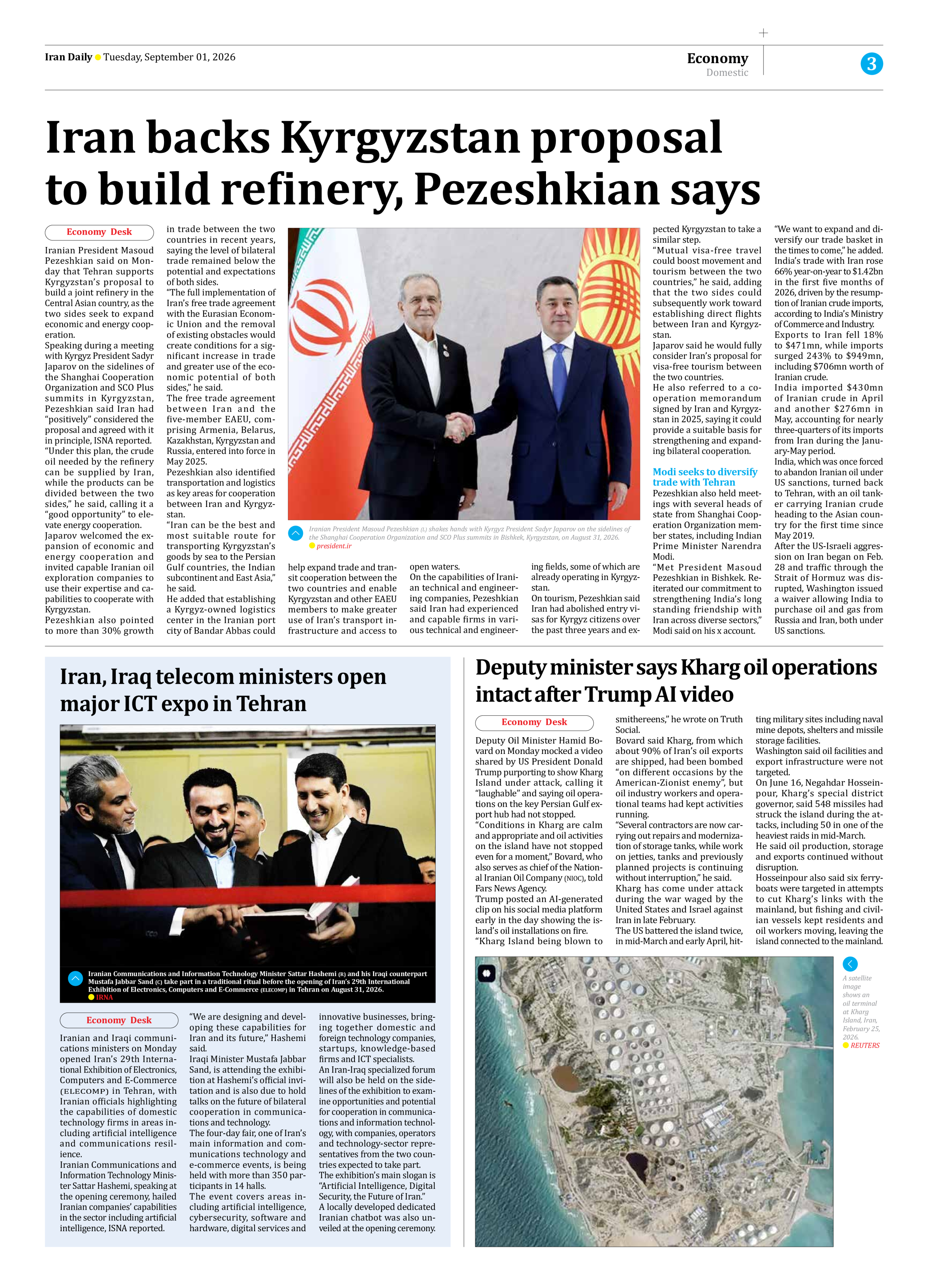
Speaking during a meeting with Kyrgyz President Sadyr Japarov on the sidelines of the Shanghai Cooperation Organization and SCO Plus summits in Kyrgyzstan, Pezeshkian said Iran had “positively” considered the proposal and agreed with it in principle, ISNA reported.
“Under this plan, the crude oil needed by the refinery can be supplied by Iran, while the products can be divided between the two sides,” he said, calling it a “good opportunity” to elevate energy cooperation.
Japarov welcomed the expansion of economic and energy cooperation and invited capable Iranian oil exploration companies to use their expertise and capabilities to cooperate with Kyrgyzstan.
Pezeshkian also pointed to more than 30% growth in trade between the two countries in recent years, saying the level of bilateral trade remained below the potential and expectations of both sides.
“The full implementation of Iran’s free trade agreement with the Eurasian Economic Union and the removal of existing obstacles would create conditions for a significant increase in trade and greater use of the economic potential of both sides,” he said.
The free trade agreement between Iran and the five-member EAEU, comprising Armenia, Belarus, Kazakhstan, Kyrgyzstan and Russia, entered into force in May 2025.
Pezeshkian also identified transportation and logistics as key areas for cooperation between Iran and Kyrgyzstan.
“Iran can be the best and most suitable route for transporting Kyrgyzstan’s goods by sea to the Persian Gulf countries, the Indian subcontinent and East Asia,” he said.
He added that establishing a Kyrgyz-owned logistics center in the Iranian port city of Bandar Abbas could help expand trade and transit cooperation between the two countries and enable Kyrgyzstan and other EAEU members to make greater use of Iran’s transport infrastructure and access to open waters.
On the capabilities of Iranian technical and engineering companies, Pezeshkian said Iran had experienced and capable firms in various technical and engineering fields, some of which are already operating in Kyrgyzstan.
On tourism, Pezeshkian said Iran had abolished entry visas for Kyrgyz citizens over the past three years and expected Kyrgyzstan to take a similar step.
“Mutual visa-free travel could boost movement and tourism between the two countries,” he said, adding that the two sides could subsequently work toward establishing direct flights between Iran and Kyrgyzstan.
Japarov said he would fully consider Iran’s proposal for visa-free tourism between the two countries.
He also referred to a cooperation memorandum signed by Iran and Kyrgyzstan in 2025, saying it could provide a suitable basis for strengthening and expanding bilateral cooperation.
Modi seeks to diversify trade with Tehran
Pezeshkian also held meetings with several heads of state from Shanghai Cooperation Organization member states, including Indian Prime Minister Narendra Modi.
“Met President Masoud Pezeshkian in Bishkek. Reiterated our commitment to strengthening India’s long standing friendship with Iran across diverse sectors,” Modi said on his x account.
“We want to expand and diversify our trade basket in the times to come,” he added.
India’s trade with Iran rose 66% year-on-year to $1.42bn in the first five months of 2026, driven by the resumption of Iranian crude imports, according to India’s Ministry of Commerce and Industry.
Exports to Iran fell 18% to $471mn, while imports surged 243% to $949mn, including $706mn worth of Iranian crude.
India imported $430mn of Iranian crude in April and another $276mn in May, accounting for nearly three-quarters of its imports from Iran during the January-May period.
India, which was once forced to abandon Iranian oil under US sanctions, turned back to Tehran, with an oil tanker carrying Iranian crude heading to the Asian country for the first time since May 2019.
After the US-Israeli aggression on Iran began on Feb. 28 and traffic through the Strait of Hormuz was disrupted, Washington issued a waiver allowing India to purchase oil and gas from Russia and Iran, both under US sanctions.