





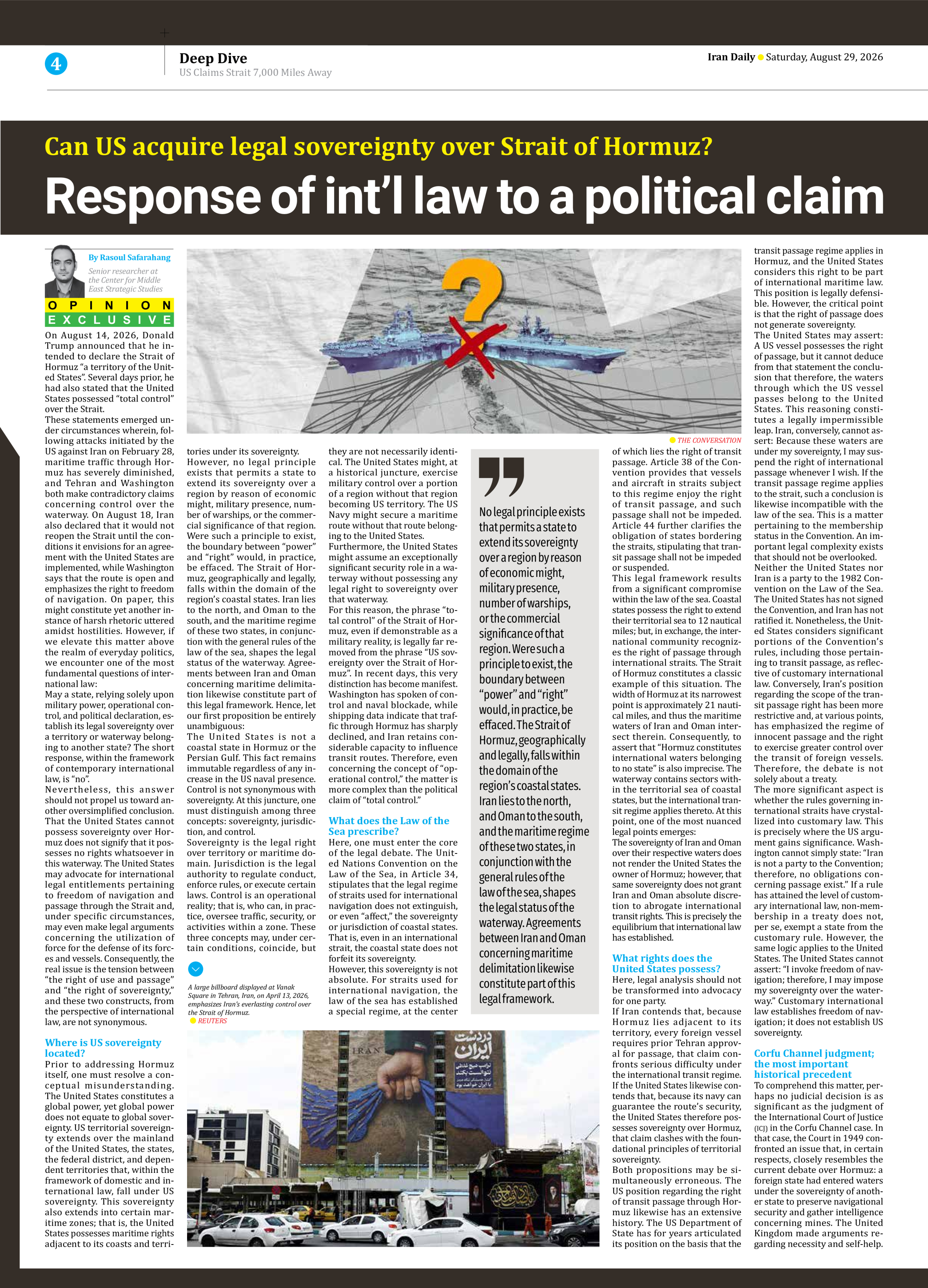


Can US acquire legal sovereignty over Strait of Hormuz?
Response of int’l law to a political claim
Senior researcher at the Center for Middle East Strategic Studies
On August 14, 2026, Donald Trump announced that he intended to declare the Strait of Hormuz “a territory of the United States”. Several days prior, he had also stated that the United States possessed “total control” over the Strait.
These statements emerged under circumstances wherein, following attacks initiated by the US against Iran on February 28, maritime traffic through Hormuz has severely diminished, and Tehran and Washington both make contradictory claims concerning control over the waterway. On August 18, Iran also declared that it would not reopen the Strait until the conditions it envisions for an agreement with the United States are implemented, while Washington says that the route is open and emphasizes the right to freedom of navigation. On paper, this might constitute yet another instance of harsh rhetoric uttered amidst hostilities. However, if we elevate this matter above the realm of everyday politics, we encounter one of the most fundamental questions of international law:
May a state, relying solely upon military power, operational control, and political declaration, establish its legal sovereignty over a territory or waterway belonging to another state? The short response, within the framework of contemporary international law, is “no”.
Nevertheless, this answer should not propel us toward another oversimplified conclusion. That the United States cannot possess sovereignty over Hormuz does not signify that it possesses no rights whatsoever in this waterway. The United States may advocate for international legal entitlements pertaining to freedom of navigation and passage through the Strait and, under specific circumstances, may even make legal arguments concerning the utilization of force for the defense of its forces and vessels. Consequently, the real issue is the tension between “the right of use and passage” and “the right of sovereignty,” and these two constructs, from the perspective of international law, are not synonymous.
Where is US sovereignty located?
Prior to addressing Hormuz itself, one must resolve a conceptual misunderstanding. The United States constitutes a global power, yet global power does not equate to global sovereignty. US territorial sovereignty extends over the mainland of the United States, the states, the federal district, and dependent territories that, within the framework of domestic and international law, fall under US sovereignty. This sovereignty also extends into certain maritime zones; that is, the United States possesses maritime rights adjacent to its coasts and territories under its sovereignty.
However, no legal principle exists that permits a state to extend its sovereignty over a region by reason of economic might, military presence, number of warships, or the commercial significance of that region. Were such a principle to exist, the boundary between “power” and “right” would, in practice, be effaced. The Strait of Hormuz, geographically and legally, falls within the domain of the region’s coastal states. Iran lies to the north, and Oman to the south, and the maritime regime of these two states, in conjunction with the general rules of the law of the sea, shapes the legal status of the waterway. Agreements between Iran and Oman concerning maritime delimitation likewise constitute part of this legal framework. Hence, let our first proposition be entirely unambiguous:
The United States is not a coastal state in Hormuz or the Persian Gulf. This fact remains immutable regardless of any increase in the US naval presence. Control is not synonymous with sovereignty. At this juncture, one must distinguish among three concepts: sovereignty, jurisdiction, and control.
Sovereignty is the legal right over territory or maritime domain. Jurisdiction is the legal authority to regulate conduct, enforce rules, or execute certain laws. Control is an operational reality; that is, who can, in practice, oversee traffic, security, or activities within a zone. These three concepts may, under certain conditions, coincide, but they are not necessarily identical. The United States might, at a historical juncture, exercise military control over a portion of a region without that region becoming US territory. The US Navy might secure a maritime route without that route belonging to the United States.
Furthermore, the United States might assume an exceptionally significant security role in a waterway without possessing any legal right to sovereignty over that waterway.
For this reason, the phrase “total control” of the Strait of Hormuz, even if demonstrable as a military reality, is legally far removed from the phrase “US sovereignty over the Strait of Hormuz”. In recent days, this very distinction has become manifest. Washington has spoken of control and naval blockade, while shipping data indicate that traffic through Hormuz has sharply declined, and Iran retains considerable capacity to influence transit routes. Therefore, even concerning the concept of “operational control,” the matter is more complex than the political claim of “total control.”
What does the Law of the Sea prescribe?
Here, one must enter the core of the legal debate. The United Nations Convention on the Law of the Sea, in Article 34, stipulates that the legal regime of straits used for international navigation does not extinguish, or even “affect,” the sovereignty or jurisdiction of coastal states. That is, even in an international strait, the coastal state does not forfeit its sovereignty.
However, this sovereignty is not absolute. For straits used for international navigation, the law of the sea has established a special regime, at the center of which lies the right of transit passage. Article 38 of the Convention provides that vessels and aircraft in straits subject to this regime enjoy the right of transit passage, and such passage shall not be impeded. Article 44 further clarifies the obligation of states bordering the straits, stipulating that transit passage shall not be impeded or suspended.
This legal framework results from a significant compromise within the law of the sea. Coastal states possess the right to extend their territorial sea to 12 nautical miles; but, in exchange, the international community recognizes the right of passage through international straits. The Strait of Hormuz constitutes a classic example of this situation. The width of Hormuz at its narrowest point is approximately 21 nautical miles, and thus the maritime waters of Iran and Oman intersect therein. Consequently, to assert that “Hormuz constitutes international waters belonging to no state” is also imprecise. The waterway contains sectors within the territorial sea of coastal states, but the international transit regime applies thereto. At this point, one of the most nuanced legal points emerges:
The sovereignty of Iran and Oman over their respective waters does not render the United States the owner of Hormuz; however, that same sovereignty does not grant Iran and Oman absolute discretion to abrogate international transit rights. This is precisely the equilibrium that international law has established.
What rights does the United States possess?
Here, legal analysis should not be transformed into advocacy for one party.
If Iran contends that, because Hormuz lies adjacent to its territory, every foreign vessel requires prior Tehran approval for passage, that claim confronts serious difficulty under the international transit regime. If the United States likewise contends that, because its navy can guarantee the route’s security, the United States therefore possesses sovereignty over Hormuz, that claim clashes with the foundational principles of territorial sovereignty.
Both propositions may be simultaneously erroneous. The US position regarding the right of transit passage through Hormuz likewise has an extensive history. The US Department of State has for years articulated its position on the basis that the transit passage regime applies in Hormuz, and the United States considers this right to be part of international maritime law. This position is legally defensible. However, the critical point is that the right of passage does not generate sovereignty.
The United States may assert: A US vessel possesses the right of passage, but it cannot deduce from that statement the conclusion that therefore, the waters through which the US vessel passes belong to the United States. This reasoning constitutes a legally impermissible leap. Iran, conversely, cannot assert: Because these waters are under my sovereignty, I may suspend the right of international passage whenever I wish. If the transit passage regime applies to the strait, such a conclusion is likewise incompatible with the law of the sea. This is a matter pertaining to the membership status in the Convention. An important legal complexity exists that should not be overlooked.
Neither the United States nor Iran is a party to the 1982 Convention on the Law of the Sea. The United States has not signed the Convention, and Iran has not ratified it. Nonetheless, the United States considers significant portions of the Convention’s rules, including those pertaining to transit passage, as reflective of customary international law. Conversely, Iran’s position regarding the scope of the transit passage right has been more restrictive and, at various points, has emphasized the regime of innocent passage and the right to exercise greater control over the transit of foreign vessels. Therefore, the debate is not solely about a treaty.
The more significant aspect is whether the rules governing international straits have crystallized into customary law. This is precisely where the US argument gains significance. Washington cannot simply state: “Iran is not a party to the Convention; therefore, no obligations concerning passage exist.” If a rule has attained the level of customary international law, non-membership in a treaty does not, per se, exempt a state from the customary rule. However, the same logic applies to the United States. The United States cannot assert: “I invoke freedom of navigation; therefore, I may impose my sovereignty over the waterway.” Customary international law establishes freedom of navigation; it does not establish US sovereignty.
Corfu Channel judgment; the most important historical precedent
To comprehend this matter, perhaps no judicial decision is as significant as the judgment of the International Court of Justice (ICJ) in the Corfu Channel case. In that case, the Court in 1949 confronted an issue that, in certain respects, closely resembles the current debate over Hormuz: a foreign state had entered waters under the sovereignty of another state to preserve navigational security and gather intelligence concerning mines. The United Kingdom made arguments regarding necessity and self-help. The Court did not accept this reasoning. The Court, simultaneously, recognized the right of British warships to pass through an international strait under the circumstances at issue, but it deemed the British minesweeping operations in Albanian territorial waters, conducted contrary to the coastal state’s will, a violation of Albanian sovereignty. The Court also rejected the theory of “self-help” as a basis for such intervention.
This judgment established a very important red line: the right of passage through a strait is not synonymous with the right to intervene in the sovereignty of the coastal state. If the United States today asserts, “We are entering Hormuz to preserve freedom of navigation,” one must inquire into the precise nature of that entry. If what is meant is the escort of vessels, minesweeping under conditions where the requisite legal basis exists, or the protection of US forces, that legal discussion is one matter. However, if what is meant is permanent force deployment, unilateral control over traffic, the imposition of regulations upon coastal states, and, ultimately, the declaration of US ownership, then we have entered a different domain. At that point, the issue is no longer “freedom of navigation”. The issue is “the alteration of the legal status of a territory,” and these two matters cannot be conflated.
Nicaragua judgment; military power does not create legal right
The ICJ’s 1986 judgment in the case concerning military and paramilitary activities of the United States against Nicaragua is likewise highly significant for the current situation. In that case, the Court distinguished between military power and legal entitlement and held the United States responsible for violations of customary rules concerning the prohibition of the use of force, non-intervention, and respect for Nicaragua’s sovereignty. The Court also considered activities related to mining and interference with maritime commerce.
The judgment’s message for Hormuz is clear. Even if the United States can, through its military power, alter the conditions of passage, this fact does not, by itself, create a new legal right to sovereignty. Indeed, if military control is employed to generate a new territorial right, that very use of force may itself become part of the legal problem.
Article 2, paragraph 4, of the United Nations Charter is precisely relevant to this situation. This provision prohibits states from threatening or using force against the territorial integrity or political independence of other states.
Consequently, a state cannot first acquire control over a region by force and then assert: because I now control it, I therefore possess the right. If this reasoning were accepted, the prohibition on the use of force would, in practice, be rendered meaningless.
Can self-defense alter the situation?
Here, perhaps the most significant Washington argument may be advanced. Suppose the United States has indeed been subjected to an armed attack. Suppose US vessels in the Strait of Hormuz have been targeted. Suppose mining or missile attacks against US forces have occurred. Does the United States, under such circumstances, lack the right of self-defense? The response is that it may possess such a right. However, even self-defense does not create a “right of ownership”.
Article 51 of the United Nations Charter recognizes the inherent right of self-defense in the event of an armed attack. This right, under customary law, is also limited by two important conditions: necessity and proportionality.
The International Court of Justice, in the Oil Platforms case between Iran and the United States, directly examined these very criteria. The United States had invoked self-defense to justify its attack on Iranian oil platforms, but the Court concluded that the conditions necessary to justify US actions as self-defense had not been established, and it emphasized necessity and proportionality as legal requirements of self-defense.
This judgment is particularly important for the Hormuz crisis because the United States cannot simply reference “navigational security” as a highly significant strategic interest and deduce from it that any action to control Hormuz is legitimate. Under international law, the objective of self-defense is to repel or halt an attack; it is not to alter the region’s political map. This distinction is extremely important. If the United States undertakes a limited action to repel a specific attack on a vessel, that action must be assessed according to necessity and proportionality. However, if that same state asserts: “From today, this waterway is US territory,” the matter is no longer one of self-defense. Self-defense cannot be transformed into authorization for territorial annexation.
From military control to occupation and annexation
One point that receives less attention in political debates is the distinction among military control, occupation, and annexation. A state at war may, in practice, bring a portion of another state’s territory under military control. However, even in this situation, the law of war and the law of occupation do not convert this control into a transfer of sovereignty. To state it simply, occupation is not synonymous with ownership.
Military power can alter operational realities; but it does not, automatically, alter the legal right to territory. From this perspective, even if the United States, in an extreme scenario, could bring all traffic in the Strait of Hormuz under its navy’s operational control, the legal question would persist: on what basis has sovereignty been transferred? A US presidential declaration is insufficient. A congressional decision is insufficient. The deployment of a fleet is insufficient. The control of vessels is insufficient. Even continuous control of the region, by itself, is insufficient. To effect a lawful change in territorial status, a valid legal right must exist. And if this change is imposed by force against the coastal state, the problem becomes even more grave because Article 2, paragraph 4, of the UN Charter and the principle of non-acquisition of territory by force stand in opposition to such an approach.
Question of Oman; a link not to be forgotten
A common error in analyses concerning Hormuz is to treat the matter solely as a US-Iran dispute. The Strait of Hormuz is not solely an Iranian issue. Oman is likewise a coastal state. In recent months, efforts have also been advanced to establish a regional mechanism for the management and security of Hormuz. Oman’s proposal has focused on a regional mechanism for security, relief, navigation, and transit management. This demonstrates that, even from the perspective of regional states, the Hormuz issue is more a matter of governance and security of an international waterway than one of ownership by an external power. This point carries significant legal weight.
If Iran and Oman reach agreement on modalities of management, security, maritime services, or passage arrangements, this could fall within the scope of their rights and international obligations. However, the United States cannot unilaterally replace Iran or Oman within this framework. If the United States wishes to assume a security role, that role could be shaped through agreement, the consent of the relevant states, or appropriate legal frameworks. But a “security role” differs from “sovereignty”.
Two perspectives on the Hormuz issue
From the first perspective, one can comprehend the US argument. Hormuz is not an ordinary waterway. Its security holds extraordinary importance for global commerce and the energy market. If a coastal state or a war party disrupts vessel transit, the user states of the waterway cannot forfeit all their rights simply because they are not themselves coastal states. The United States can defend freedom of navigation. It can emphasize the right of passage for commercial vessels and, under specific conditions, for its military vessels. It can challenge, by reference to international law, Iranian actions to prevent passage. In the event of an armed attack against the United States, it can even argue self-defense. These are legally debatable claims and, under certain circumstances, defensible.
However, the second perspective, which to my mind is more significant for today’s issue, draws a clear boundary. None of these rights confer US sovereignty over Hormuz. The right of passage is not ownership. Freedom of navigation is not ownership. The escort of vessels is not ownership. The presence of warships is not ownership. Military control, even if actually established, is not necessarily sovereignty, and self-defense is not a license for territorial annexation. The response of international law is quite rigorous.
If what is meant by making the Strait of Hormuz American is that the United States, with the consent of the relevant states and pursuant to a valid agreement, assumes a specified responsibility for the security or management of a portion of maritime traffic, the discussion would be entirely different. However, if what is meant is the transfer of Iranian or Omani sovereignty to the United States through threat, force, or unilateral declaration, such an action is incompatible with the fundamental structure of international law.
A significant contradiction for Washington
It happens that the claim of US sovereignty over Hormuz may also conflict with one of Washington’s own traditional policies concerning the law of the sea. The United States has for decades championed “freedom of navigation”. The philosophy behind this policy has been clear: no coastal state should be able, merely by virtue of its geographic position, to convert a vital waterway into an exclusive domain.
However, this same principle carries a reciprocal implication. If freedom of navigation is a universal right, it cannot be transformed into the property of one power. Indeed, the logic of the law of the sea was designed precisely to prevent this very situation. Iran cannot assert: “Because Hormuz lies beside Iran, it is entirely under Iran’s control.” The United States likewise cannot assert: “Because Hormuz is vital to the global economy and the US Navy can guarantee its security, it should therefore belong to the United States.” International law accepts neither of these extremes.
Future of Hormuz will likely be neither Iranian nor American
The current crisis may eventually lead to a new agreement concerning the security and management of Hormuz. It may even result in a multilateral or regional mechanism for vessel transit, maritime services, minesweeping, relief, and security coordination. However, if such arrangements are to be sustainable, they must achieve equilibrium between the sovereignty of coastal states and the interests of the international community. This may be the sole way out of the current impasse.
Hormuz can neither become a completely closed waterway under exclusive Iranian control nor be transformed by unilateral Washington declaration into “a territory of the United States”. What international law proposes is more complex but more realistic: the sovereignty of coastal states must be preserved, international transit rights must be observed, and navigational security must be provided through mechanisms that do not alter the legal position of the waterway.
In the final analysis, one must maintain a distinction between a political reality and a legal reality. The United States may be capable of projecting substantial military power in the Strait of Hormuz. It may be capable of escorting certain transit routes. It may be capable of influencing a portion of maritime traffic. Under specific conditions, it may justify limited military action based on self-defense or other legal grounds. However, none of these circumstances, individually or collectively, creates US legal sovereignty over the Strait of Hormuz.
The Corfu Channel judgment demonstrates that the right of passage cannot be equated with the right to intervene in sovereignty. The Nicaragua judgment demonstrates that military power and threats of force cannot displace the sovereignty of another state. The Oil Platforms judgment likewise demonstrates that even self-defense, if it is to serve as a basis for the use of force, is subject to the rigorous test of necessity and proportionality.
From this perspective, the Hormuz issue may be summarized in a single sentence: The United States can argue for freedom of navigation in Hormuz; but it cannot extract sovereignty for itself from freedom of navigation, and this boundary is the boundary between the international legal order and the mere logic of power. If today military power can, through a political declaration, alter the sovereignty of a waterway, tomorrow the same logic will be applicable to any other strategic strait. In that event, international law would no longer determine who possesses the right; it would merely describe who, at that moment, possesses more naval vessels. The international legal system after the Second World War was established precisely to prevent such a world.
The Strait of Hormuz today lies at the center of a war. But the true dispute over it is not merely a dispute between Iran and the United States. The larger question is whether, in the 21st century, legal right still takes precedence over military power. Regarding sovereignty over Hormuz, the response of international law remains clear: control may be acquired through power; legal sovereignty cannot be declared solely through power.