







US sanctions hurt ordinary Iranians
Self-proclaimed human rights defender acts against human rights in Iran
After failing in its military aggression on Iran, the United States has now reverted to its old playbook and announced plans for a new round of sanctions against Iran. The US Treasury secretary has claimed that the Islamic Republic will be brought down through a blockade and the toughest economic sanctions the world has ever seen.
Washington’s latest push to exert economic pressure on Iran and impose sanctions is hardly new. What appears to be new, however, is the psychological warfare and extensive media campaign being waged through claims and statements by White House officials. Since the 1979 Islamic Revolution, the Islamic Republic has faced various forms of US pressure and, at times, some of the most severe US-led sanctions imposed by the UN Security Council. The stated aim of the new sanctions is the collapse of the Islamic Republic. Previously, however, the stated purpose of the sanctions imposed over the past decades had been to change Iran’s behavior and policies. The reality was much more straightforward: even US officials have acknowledged that sanctions had failed to bring about the desired results. Had sanctions been effective in forcing Iran to change its behavior, there would presumably have been no need for war and the enormous costs that came with it.
Many experts, including Americans, have likewise predicted no significantly different outcome for the new sanctions. Nate Swanson, the former Iran director at the US National Security Council, wrote in the Atlantic Council: “At what cost? And even if the economic pressure campaign succeeds, what will it accomplish? China is easily Iran’s most important trading partner and if those trade ties were severed, the Islamic Republic would have no replacement. But China has also skirted American sanctions for years and has given little indication that it will stop now. Is President Donald Trump really willing to risk the trade détente with China to take the necessary actions against Chinese banks, refiners, and ports to curtail trade with Iran? Is the US economy prepared for retaliation from China? These would be very difficult steps to take—especially right before Chinese President Xi Jinping is scheduled to visit.”
Emadeddin Baghi’s letter to UN human rights commissioner
Trump’s decision to announce renewed pressure on Iran is driven by clear political objectives: changing Iran’s policies and behavior or, ultimately, bringing about the fall of the system. But sanctions are not solely a security or political issue. As the experience of the past several decades has shown, their most visible effects have often been felt in areas far removed from politics and security.
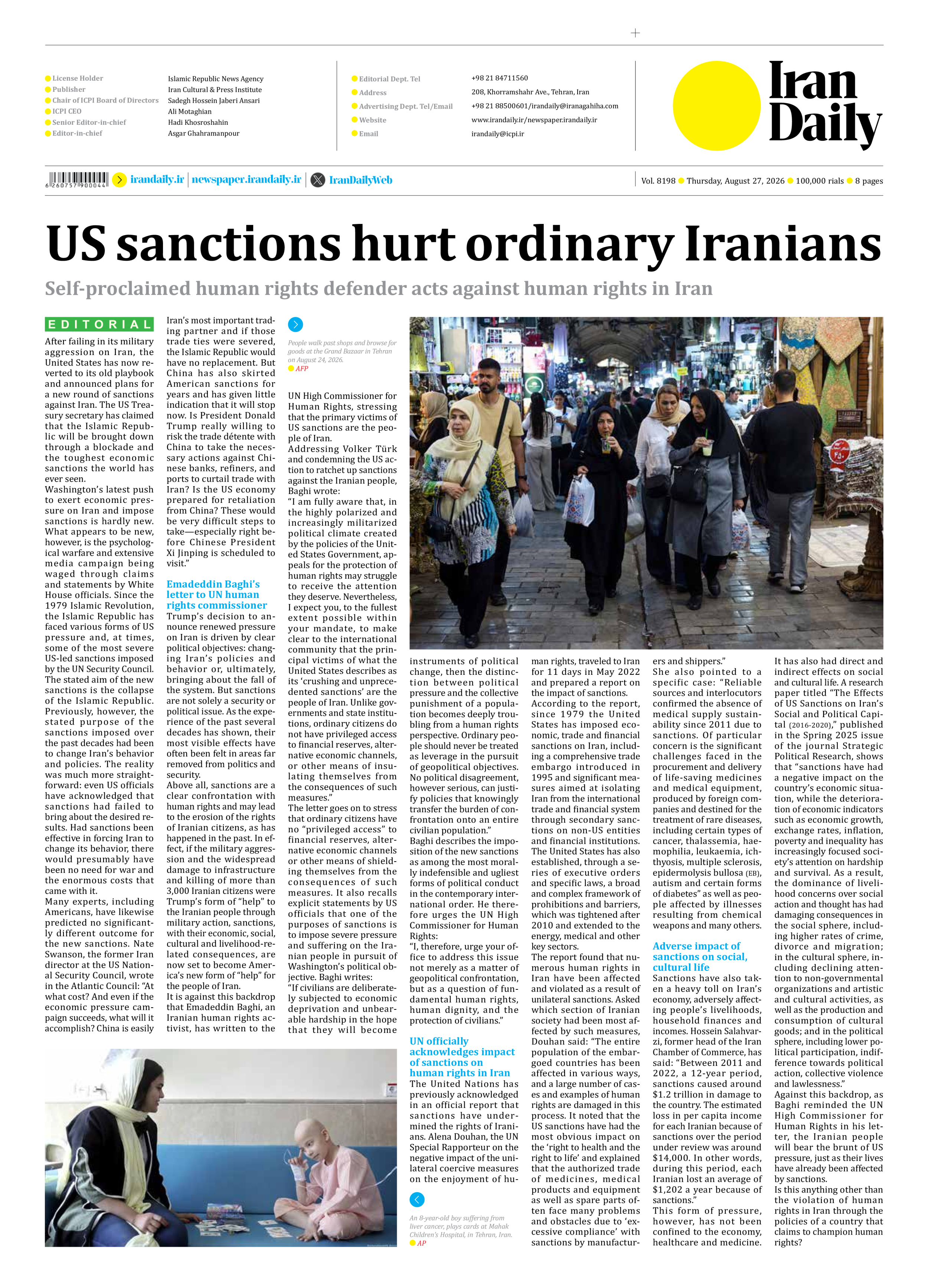
Above all, sanctions are a clear confrontation with human rights and may lead to the erosion of the rights of Iranian citizens, as has happened in the past. In effect, if the military aggression and the widespread damage to infrastructure and killing of more than 3,000 Iranian citizens were Trump’s form of “help” to the Iranian people through military action, sanctions, with their economic, social, cultural and livelihood-related consequences, are now set to become America’s new form of “help” for the people of Iran.
It is against this backdrop that Emadeddin Baghi, an Iranian human rights activist, has written to the UN High Commissioner for Human Rights, stressing that the primary victims of US sanctions are the people of Iran.
Addressing Volker Türk and condemning the US action to ratchet up sanctions against the Iranian people, Baghi wrote:
“I am fully aware that, in the highly polarized and increasingly militarized political climate created by the policies of the United States Government, appeals for the protection of human rights may struggle to receive the attention they deserve. Nevertheless, I expect you, to the fullest extent possible within your mandate, to make clear to the international community that the principal victims of what the United States describes as its ‘crushing and unprecedented sanctions’ are the people of Iran. Unlike governments and state institutions, ordinary citizens do not have privileged access to financial reserves, alternative economic channels, or other means of insulating themselves from the consequences of such measures.”
The letter goes on to stress that ordinary citizens have no “privileged access” to financial reserves, alternative economic channels or other means of shielding themselves from the consequences of such measures. It also recalls explicit statements by US officials that one of the purposes of sanctions is to impose severe pressure and suffering on the Iranian people in pursuit of Washington’s political objective. Baghi writes:
“If civilians are deliberately subjected to economic deprivation and unbearable hardship in the hope that they will become instruments of political change, then the distinction between political pressure and the collective punishment of a population becomes deeply troubling from a human rights perspective. Ordinary people should never be treated as leverage in the pursuit of geopolitical objectives. No political disagreement, however serious, can justify policies that knowingly transfer the burden of confrontation onto an entire civilian population.”
Baghi describes the imposition of the new sanctions as among the most morally indefensible and ugliest forms of political conduct in the contemporary international order. He therefore urges the UN High Commissioner for Human Rights:
“I, therefore, urge your office to address this issue not merely as a matter of geopolitical confrontation, but as a question of fundamental human rights, human dignity, and the protection of civilians.”
UN officially acknowledges impact of sanctions on human rights in Iran
The United Nations has previously acknowledged in an official report that sanctions have undermined the rights of Iranians. Alena Douhan, the UN Special Rapporteur on the negative impact of the unilateral coercive measures on the enjoyment of human rights, traveled to Iran for 11 days in May 2022 and prepared a report on the impact of sanctions.
According to the report, since 1979 the United States has imposed economic, trade and financial sanctions on Iran, including a comprehensive trade embargo introduced in 1995 and significant measures aimed at isolating Iran from the international trade and financial system through secondary sanctions on non-US entities and financial institutions. The United States has also established, through a series of executive orders and specific laws, a broad and complex framework of prohibitions and barriers, which was tightened after 2010 and extended to the energy, medical and other key sectors.
The report found that numerous human rights in Iran have been affected and violated as a result of unilateral sanctions. Asked which section of Iranian society had been most affected by such measures, Douhan said: “The entire population of the embargoed countries has been affected in various ways, and a large number of cases and examples of human rights are damaged in this process. It noted that the US sanctions have had the most obvious impact on the ‘right to health and the right to life’ and explained that the authorized trade of medicines, medical products and equipment as well as spare parts often face many problems and obstacles due to ‘excessive compliance’ with sanctions by manufacturers and shippers.”
She also pointed to a specific case: “Reliable sources and interlocutors confirmed the absence of medical supply sustainability since 2011 due to sanctions. Of particular concern is the significant challenges faced in the procurement and delivery of life-saving medicines and medical equipment, produced by foreign companies and destined for the treatment of rare diseases, including certain types of cancer, thalassemia, haemophilia, leukaemia, ichthyosis, multiple sclerosis, epidermolysis bullosa (EB), autism and certain forms of diabetes” as well as people affected by illnesses resulting from chemical weapons and many others.
Adverse impact of sanctions on social, cultural life
Sanctions have also taken a heavy toll on Iran’s economy, adversely affecting people’s livelihoods, household finances and incomes. Hossein Salahvarzi, former head of the Iran Chamber of Commerce, has said: “Between 2011 and 2022, a 12-year period, sanctions caused around $1.2 trillion in damage to the country. The estimated loss in per capita income for each Iranian because of sanctions over the period under review was around $14,000. In other words, during this period, each Iranian lost an average of $1,202 a year because of sanctions.”
This form of pressure, however, has not been confined to the economy, healthcare and medicine. It has also had direct and indirect effects on social and cultural life. A research paper titled “The Effects of US Sanctions on Iran’s Social and Political Capital (2016-2020),” published in the Spring 2025 issue of the journal Strategic Political Research, shows that “sanctions have had a negative impact on the country’s economic situation, while the deterioration of economic indicators such as economic growth, exchange rates, inflation, poverty and inequality has increasingly focused society’s attention on hardship and survival. As a result, the dominance of livelihood concerns over social action and thought has had damaging consequences in the social sphere, including higher rates of crime, divorce and migration; in the cultural sphere, including declining attention to non-governmental organizations and artistic and cultural activities, as well as the production and consumption of cultural goods; and in the political sphere, including lower political participation, indifference towards political action, collective violence and lawlessness.”
Against this backdrop, as Baghi reminded the UN High Commissioner for Human Rights in his letter, the Iranian people will bear the brunt of US pressure, just as their lives have already been affected by sanctions.
Is this anything other than the violation of human rights in Iran through the policies of a country that claims to champion human rights?