







Ayneh Varzan village preserves rich legacy of history, craftsmanship
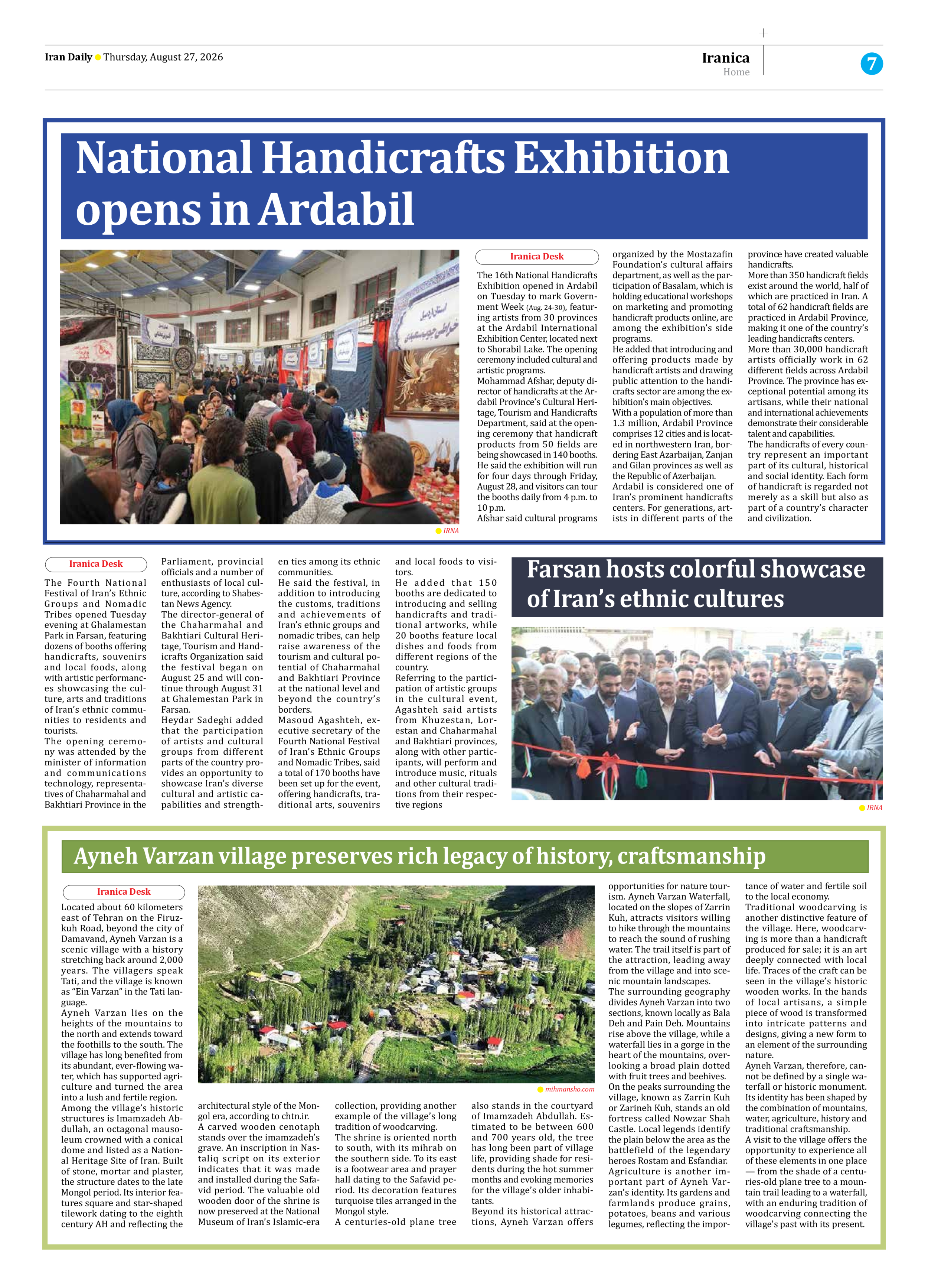
Located about 60 kilometers east of Tehran on the Firuzkuh Road, beyond the city of Damavand, Ayneh Varzan is a scenic village with a history stretching back around 2,000 years. The villagers speak Tati, and the village is known as “Ein Varzan” in the Tati language.
Ayneh Varzan lies on the heights of the mountains to the north and extends toward the foothills to the south. The village has long benefited from its abundant, ever-flowing water, which has supported agriculture and turned the area into a lush and fertile region.
Among the village’s historic structures is Imamzadeh Abdullah, an octagonal mausoleum crowned with a conical dome and listed as a National Heritage Site of Iran. Built of stone, mortar and plaster, the structure dates to the late Mongol period. Its interior features square and star-shaped tilework dating to the eighth century AH and reflecting the architectural style of the Mongol era, according to chtn.ir.
A carved wooden cenotaph stands over the imamzadeh’s grave. An inscription in Nastaliq script on its exterior indicates that it was made and installed during the Safavid period. The valuable old wooden door of the shrine is now preserved at the National Museum of Iran’s Islamic-era collection, providing another example of the village’s long tradition of woodcarving.
The shrine is oriented north to south, with its mihrab on the southern side. To its east is a footwear area and prayer hall dating to the Safavid period. Its decoration features turquoise tiles arranged in the Mongol style.
A centuries-old plane tree also stands in the courtyard of Imamzadeh Abdullah. Estimated to be between 600 and 700 years old, the tree has long been part of village life, providing shade for residents during the hot summer months and evoking memories for the village’s older inhabitants.
Beyond its historical attractions, Ayneh Varzan offers opportunities for nature tourism. Ayneh Varzan Waterfall, located on the slopes of Zarrin Kuh, attracts visitors willing to hike through the mountains to reach the sound of rushing water. The trail itself is part of the attraction, leading away from the village and into scenic mountain landscapes.
The surrounding geography divides Ayneh Varzan into two sections, known locally as Bala Deh and Pain Deh. Mountains rise above the village, while a waterfall lies in a gorge in the heart of the mountains, overlooking a broad plain dotted with fruit trees and beehives.
On the peaks surrounding the village, known as Zarrin Kuh or Zarineh Kuh, stands an old fortress called Nowzar Shah Castle. Local legends identify the plain below the area as the battlefield of the legendary heroes Rostam and Esfandiar.
Agriculture is another important part of Ayneh Varzan’s identity. Its gardens and farmlands produce grains, potatoes, beans and various legumes, reflecting the importance of water and fertile soil to the local economy.
Traditional woodcarving is another distinctive feature of the village. Here, woodcarving is more than a handicraft produced for sale; it is an art deeply connected with local life. Traces of the craft can be seen in the village’s historic wooden works. In the hands of local artisans, a simple piece of wood is transformed into intricate patterns and designs, giving a new form to an element of the surrounding nature.
Ayneh Varzan, therefore, cannot be defined by a single waterfall or historic monument. Its identity has been shaped by the combination of mountains, water, agriculture, history and traditional craftsmanship.
A visit to the village offers the opportunity to experience all of these elements in one place — from the shade of a centuries-old plane tree to a mountain trail leading to a waterfall, with an enduring tradition of woodcarving connecting the village’s past with its present.