







Steel capacity expanded as Gilan plant opens new development phase
Iran inaugurated a major expansion at the Gilan Steel Complex on Wednesday, adding 1 million tons to its annual production capacity, as the government moves to bolster domestic industrial output amid ongoing disruptions to the country’s metals sector.
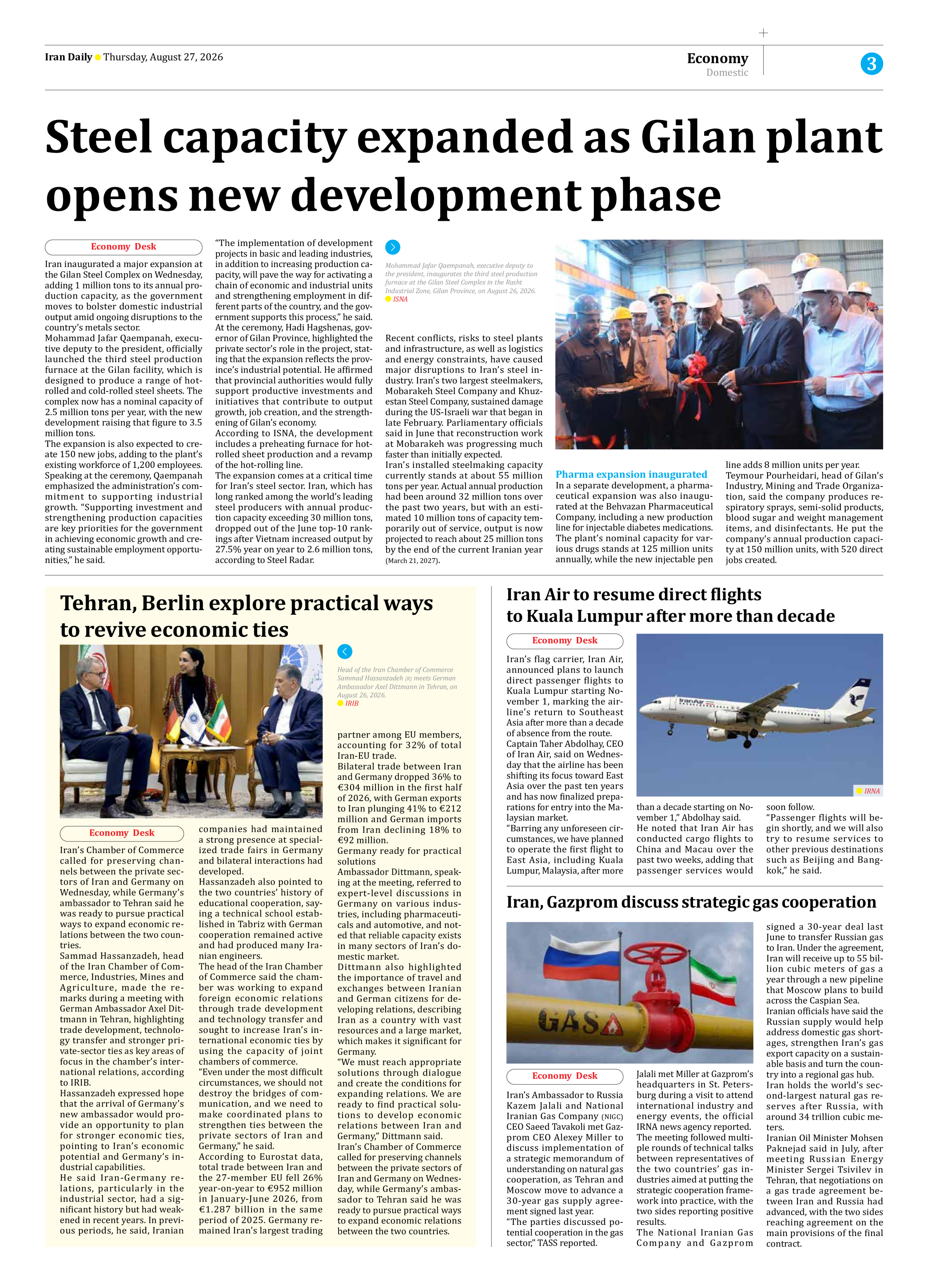
Mohammad Jafar Qaempanah, executive deputy to the president, officially launched the third steel production furnace at the Gilan facility, which is designed to produce a range of hot-rolled and cold-rolled steel sheets. The complex now has a nominal capacity of 2.5 million tons per year, with the new development raising that figure to 3.5 million tons.
The expansion is also expected to create 150 new jobs, adding to the plant’s existing workforce of 1,200 employees.
Speaking at the ceremony, Qaempanah emphasized the administration’s commitment to supporting industrial growth. “Supporting investment and strengthening production capacities are key priorities for the government in achieving economic growth and creating sustainable employment opportunities,” he said.
“The implementation of development projects in basic and leading industries, in addition to increasing production capacity, will pave the way for activating a chain of economic and industrial units and strengthening employment in different parts of the country, and the government supports this process,” he said.
At the ceremony, Hadi Hagshenas, governor of Gilan Province, highlighted the private sector’s role in the project, stating that the expansion reflects the province’s industrial potential. He affirmed that provincial authorities would fully support productive investments and initiatives that contribute to output growth, job creation, and the strengthening of Gilan’s economy.
According to ISNA, the development includes a preheating furnace for hot-rolled sheet production and a revamp of the hot-rolling line.
The expansion comes at a critical time for Iran’s steel sector. Iran, which has long ranked among the world’s leading steel producers with annual production capacity exceeding 30 million tons, dropped out of the June top-10 rankings after Vietnam increased output by 27.5% year on year to 2.6 million tons, according to Steel Radar.
Recent conflicts, risks to steel plants and infrastructure, as well as logistics and energy constraints, have caused major disruptions to Iran’s steel industry. Iran’s two largest steelmakers, Mobarakeh Steel Company and Khuzestan Steel Company, sustained damage during the US-Israeli war that began in late February. Parliamentary officials said in June that reconstruction work at Mobarakeh was progressing much faster than initially expected.
Iran’s installed steelmaking capacity currently stands at about 55 million tons per year. Actual annual production had been around 32 million tons over the past two years, but with an estimated 10 million tons of capacity temporarily out of service, output is now projected to reach about 25 million tons by the end of the current Iranian year (March 21, 2027).
Pharma expansion inaugurated
In a separate development, a pharmaceutical expansion was also inaugurated at the Behvazan Pharmaceutical Company, including a new production line for injectable diabetes medications. The plant’s nominal capacity for various drugs stands at 125 million units annually, while the new injectable pen line adds 8 million units per year.
Teymour Pourheidari, head of Gilan’s Industry, Mining and Trade Organization, said the company produces respiratory sprays, semi-solid products, blood sugar and weight management items, and disinfectants. He put the company’s annual production capacity at 150 million units, with 520 direct jobs created.