







Aichi-Nagoya Asian Games:
Iranian athletics faces race against the clock to deliver on 10-medal goal
When former Olympic silver medalist Ehsan Haddadi embarked on his term at the helm of the Iranian Athletics Federation two years ago, he vowed that Iran would win a 10-medal haul at the upcoming Aichi-Nagoya Asian Games.
However, with less than a month until the athletics competition kicks off at the multi-sport event, recent performances suggest that Iran faces a difficult challenge to turn that ambitious goal into reality.
Iran has still produced encouraging signs, particularly in the women’s events, while several of its leading men remain within striking distance of the Asian Games podium. At the same time, comparisons with the continent’s latest rankings and results show that substantial improvements will be required in a number of disciplines.
The latest indication came from a training camp and preparatory competition in Belarus, where 14 Iranian athletes competed in different events. The meeting was not on the World Athletics calendar, meaning its performances do not count as official marks, but it provided a useful assessment of the athletes’ form.
Among the most notable performances was that of Zahra Zarei, who twice broke Iranian records. She clocked 51.05 seconds in the 400 meters, improving on the national record she had set earlier this year, before running 23.00 in the 200m to erase Maryam Tousi’s seven-year-old mark.
Zarei’s progress has made her one of the more credible medal hopes in the women’s team. Her official 400m best before the Belarus race was 52.71, placing her 19th on the Asian list, although her latest 51.05 indicates considerable improvement.
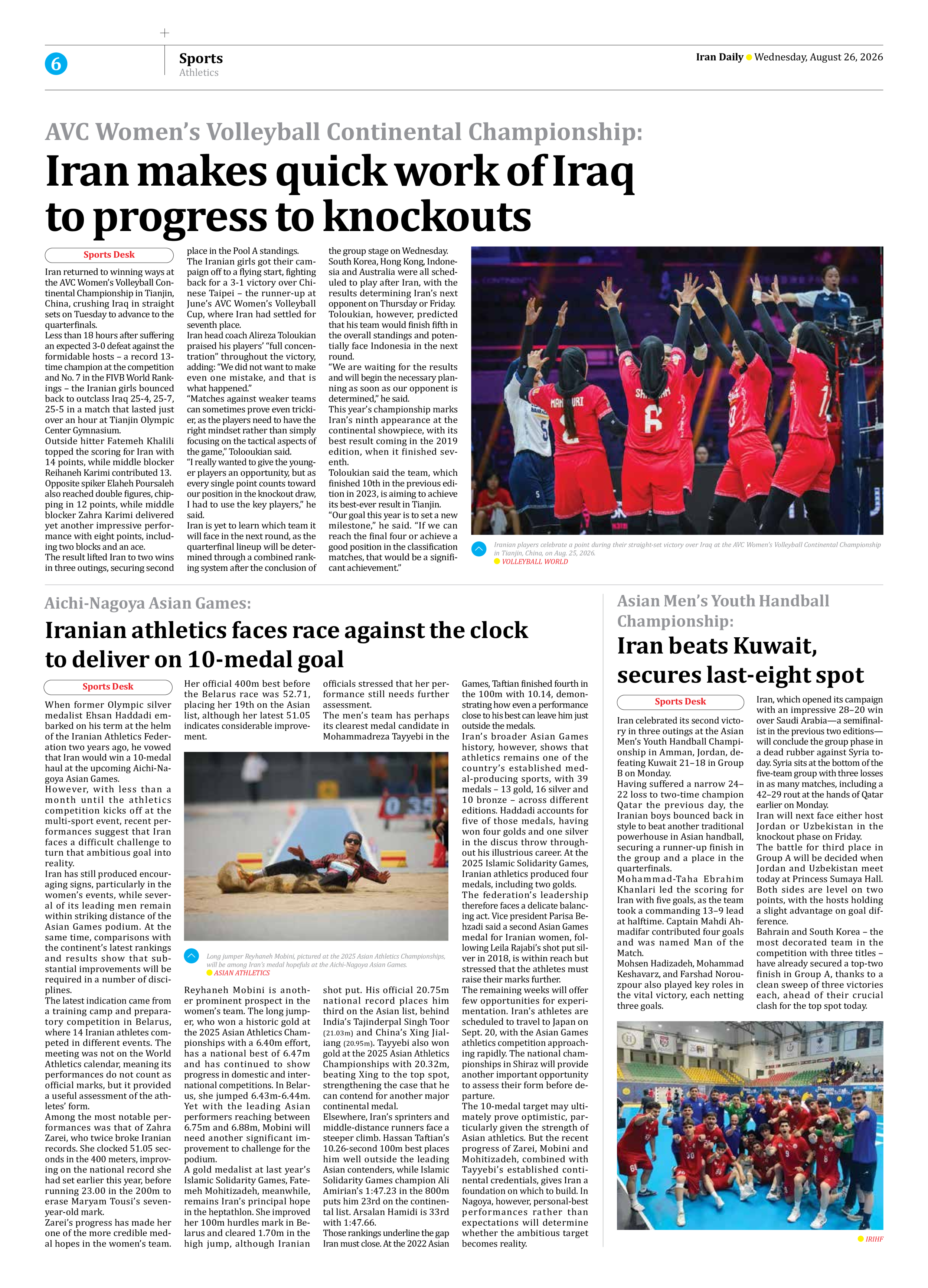
Reyhaneh Mobini is another prominent prospect in the women’s team. The long jumper, who won a historic gold at the 2025 Asian Athletics Championships with a 6.40m effort, has a national best of 6.47m and has continued to show progress in domestic and international competitions. In Belarus, she jumped 6.43m-6.44m. Yet with the leading Asian performers reaching between 6.75m and 6.88m, Mobini will need another significant improvement to challenge for the podium.
A gold medalist at last year’s Islamic Solidarity Games, Fatemeh Mohitizadeh, meanwhile, remains Iran’s principal hope in the heptathlon. She improved her 100m hurdles mark in Belarus and cleared 1.70m in the high jump, although Iranian officials stressed that her performance still needs further assessment.
The men’s team has perhaps its clearest medal candidate in Mohammadreza Tayyebi in the shot put. His official 20.75m national record places him third on the Asian list, behind India’s Tajinderpal Singh Toor (21.03m) and China’s Xing Jialiang (20.95m). Tayyebi also won gold at the 2025 Asian Athletics Championships with 20.32m, beating Xing to the top spot, strengthening the case that he can contend for another major continental medal.
Elsewhere, Iran’s sprinters and middle-distance runners face a steeper climb. Hassan Taftian’s 10.26-second 100m best places him well outside the leading Asian contenders, while Islamic Solidarity Games champion Ali Amirian’s 1:47.23 in the 800m puts him 23rd on the continental list. Arsalan Hamidi is 33rd with 1:47.66.
Those rankings underline the gap Iran must close. At the 2022 Asian Games, Taftian finished fourth in the 100m with 10.14, demonstrating how even a performance close to his best can leave him just outside the medals.
Iran’s broader Asian Games history, however, shows that athletics remains one of the country’s established medal-producing sports, with 39 medals – 13 gold, 16 silver and 10 bronze – across different editions. Haddadi accounts for five of those medals, having won four golds and one silver in the discus throw throughout his illustrious career. At the 2025 Islamic Solidarity Games, Iranian athletics produced four medals, including two golds.
The federation’s leadership therefore faces a delicate balancing act. Vice president Parisa Behzadi said a second Asian Games medal for Iranian women, following Leila Rajabi’s shot put silver in 2018, is within reach but stressed that the athletes must raise their marks further.
The remaining weeks will offer few opportunities for experimentation. Iran’s athletes are scheduled to travel to Japan on Sept. 20, with the Asian Games athletics competition approaching rapidly. The national championships in Shiraz will provide another important opportunity to assess their form before departure.
The 10-medal target may ultimately prove optimistic, particularly given the strength of Asian athletics. But the recent progress of Zarei, Mobini and Mohitizadeh, combined with Tayyebi’s established continental credentials, gives Iran a foundation on which to build. In Nagoya, however, personal-best performances rather than expectations will determine whether the ambitious target becomes reality.