







Copy in clipboard...
Minister opens industrial projects in Isfahan, says petrochemical capacity recovering after strikes
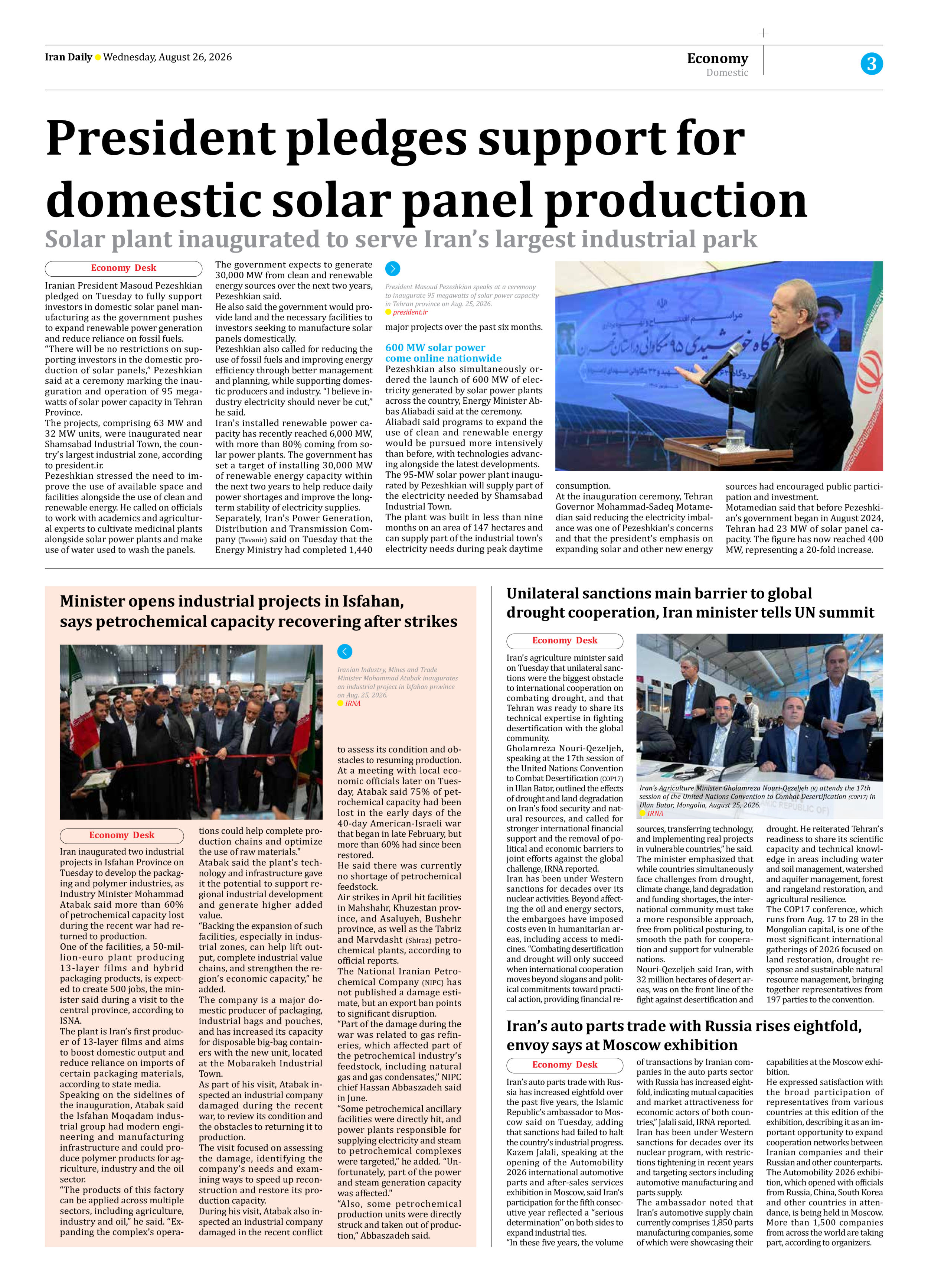
Iran inaugurated two industrial projects in Isfahan Province on Tuesday to develop the packaging and polymer industries, as Industry Minister Mohammad Atabak said more than 60% of petrochemical capacity lost during the recent war had returned to production.
One of the facilities, a 50-million-euro plant producing 13-layer films and hybrid packaging products, is expected to create 500 jobs, the minister said during a visit to the central province, according to ISNA.
The plant is Iran’s first producer of 13-layer films and aims to boost domestic output and reduce reliance on imports of certain packaging materials, according to state media.
Speaking on the sidelines of the inauguration, Atabak said the Isfahan Moqadam industrial group had modern engineering and manufacturing infrastructure and could produce polymer products for agriculture, industry and the oil sector.
“The products of this factory can be applied across multiple sectors, including agriculture, industry and oil,” he said. “Expanding the complex’s operations could help complete production chains and optimize the use of raw materials."
Atabak said the plant’s technology and infrastructure gave it the potential to support regional industrial development and generate higher added value.
“Backing the expansion of such facilities, especially in industrial zones, can help lift output, complete industrial value chains, and strengthen the region’s economic capacity,” he added.
The company is a major domestic producer of packaging, industrial bags and pouches, and has increased its capacity for disposable big-bag containers with the new unit, located at the Mobarakeh Industrial Town.
As part of his visit, Atabak inspected an industrial company damaged during the recent war, to review its condition and the obstacles to returning it to production.
The visit focused on assessing the damage, identifying the company’s needs and examining ways to speed up reconstruction and restore its production capacity.
During his visit, Atabak also inspected an industrial company damaged in the recent conflict to assess its condition and obstacles to resuming production.
At a meeting with local economic officials later on Tuesday, Atabak said 75% of petrochemical capacity had been lost in the early days of the 40-day American-Israeli war that began in late February, but more than 60% had since been restored.
He said there was currently no shortage of petrochemical feedstock.
Air strikes in April hit facilities in Mahshahr, Khuzestan province, and Asaluyeh, Bushehr province, as well as the Tabriz and Marvdasht (Shiraz) petrochemical plants, according to official reports.
The National Iranian Petrochemical Company (NIPC) has not published a damage estimate, but an export ban points to significant disruption.
“Part of the damage during the war was related to gas refineries, which affected part of the petrochemical industry’s feedstock, including natural gas and gas condensates,” NIPC chief Hassan Abbaszadeh said in June.
“Some petrochemical ancillary facilities were directly hit, and power plants responsible for supplying electricity and steam to petrochemical complexes were targeted,” he added. “Unfortunately, part of the power and steam generation capacity was affected."
“Also, some petrochemical production units were directly struck and taken out of production,” Abbaszadeh said.