







The Pretender: Young filmmaker’s portrait of Attar of Nishapur
Ramin Hosseinpour’s New Short Documentary on Attar of Nishapur
By Sadeq Dehqan
Staff writer
Ramin Hosseinpour is an Iranian film director, architect and composer, known for blending cinema with architecture and rock music. After making the experimental short films Ghanimat (2014) and Eshtiagh (2017), both of which were screened at international festivals and reached the finalist stage, he has in recent years gained a stronger presence at international festivals with Sculpture (2022), a short documentary centered on Rumi and Shams Tabrizi, for which he has received several awards.
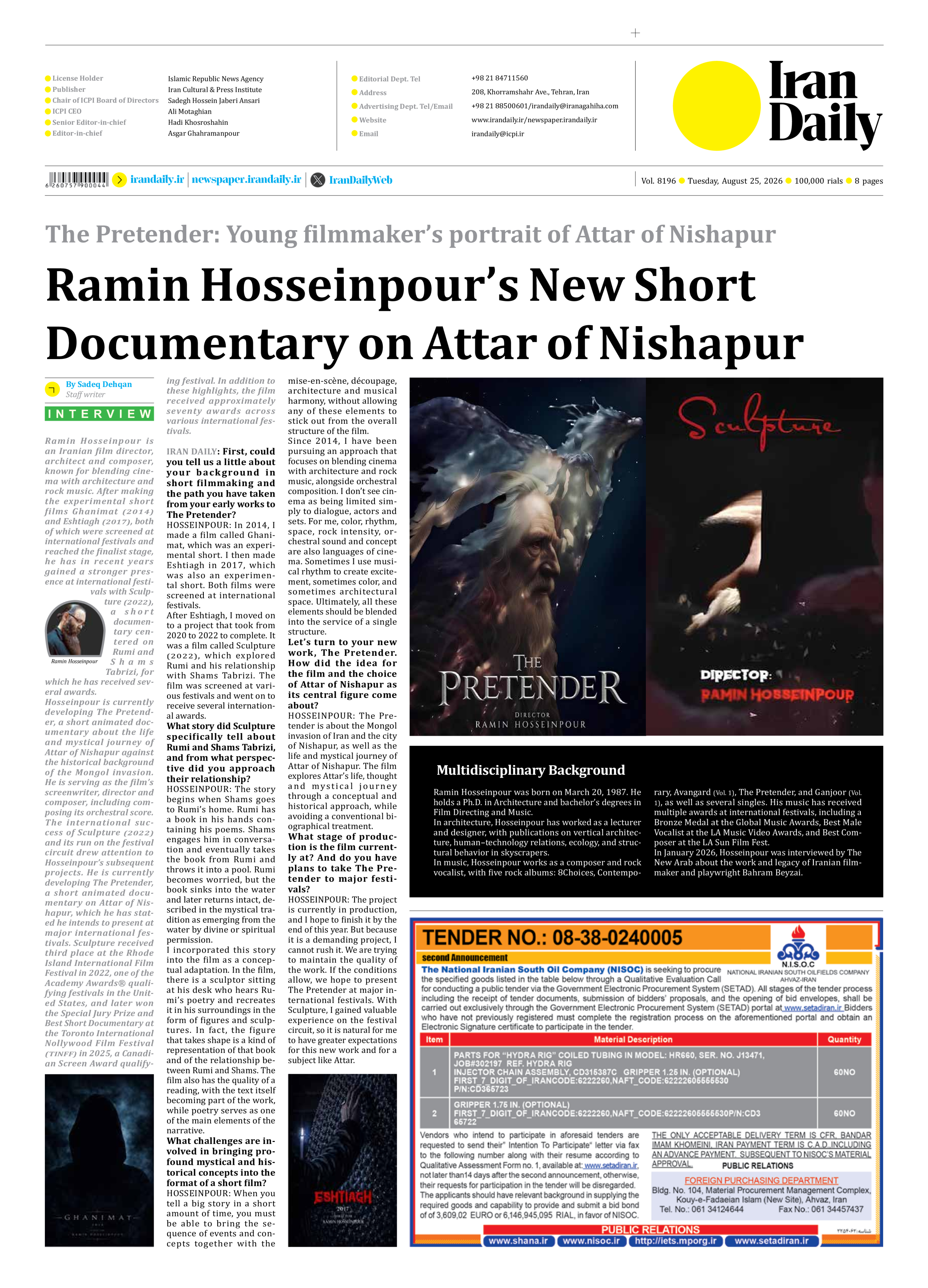
Hosseinpour is currently developing The Pretender, a short animated documentary about the life and mystical journey of Attar of Nishapur against the historical background of the Mongol invasion. He is serving as the film’s screenwriter, director and composer, including composing its orchestral score.
The international success of Sculpture (2022) and its run on the festival circuit drew attention to Hosseinpour’s subsequent projects. He is currently developing The Pretender, a short animated documentary on Attar of Nishapur, which he has stated he intends to present at major international festivals. Sculpture received third place at the Rhode Island International Film Festival in 2022, one of the Academy Awards® qualifying festivals in the United States, and later won the Special Jury Prize and Best Short Documentary at the Toronto International Nollywood Film Festival (TINFF) in 2025, a Canadian Screen Award qualifying festival. In addition to these highlights, the film received approximately seventy awards across various international festivals.
IRAN DAILY: First, could you tell us a little about your background in short filmmaking and the path you have taken from your early works to The Pretender?
HOSSEINPOUR: In 2014, I made a film called Ghanimat, which was an experimental short. I then made Eshtiagh in 2017, which was also an experimental short. Both films were screened at international festivals.
After Eshtiagh, I moved on to a project that took from 2020 to 2022 to complete. It was a film called Sculpture (2022), which explored Rumi and his relationship with Shams Tabrizi. The film was screened at various festivals and went on to receive several international awards.
What story did Sculpture specifically tell about Rumi and Shams Tabrizi, and from what perspective did you approach their relationship?
HOSSEINPOUR: The story begins when Shams goes to Rumi’s home. Rumi has a book in his hands containing his poems. Shams engages him in conversation and eventually takes the book from Rumi and throws it into a pool. Rumi becomes worried, but the book sinks into the water and later returns intact, described in the mystical tradition as emerging from the water by divine or spiritual permission.
I incorporated this story into the film as a conceptual adaptation. In the film, there is a sculptor sitting at his desk who hears Rumi’s poetry and recreates it in his surroundings in the form of figures and sculptures. In fact, the figure that takes shape is a kind of representation of that book and of the relationship between Rumi and Shams. The film also has the quality of a reading, with the text itself becoming part of the work, while poetry serves as one of the main elements of the narrative.
What challenges are involved in bringing profound mystical and historical concepts into the format of a short film?
HOSSEINPOUR: When you tell a big story in a short amount of time, you must be able to bring the sequence of events and concepts together with the mise-en-scène, découpage, architecture and musical harmony, without allowing any of these elements to stick out from the overall structure of the film.
Since 2014, I have been pursuing an approach that focuses on blending cinema with architecture and rock music, alongside orchestral composition. I don’t see cinema as being limited simply to dialogue, actors and sets. For me, color, rhythm, space, rock intensity, orchestral sound and concept are also languages of cinema. Sometimes I use musical rhythm to create excitement, sometimes color, and sometimes architectural space. Ultimately, all these elements should be blended into the service of a single structure.
Let’s turn to your new work, The Pretender. How did the idea for the film and the choice of Attar of Nishapur as its central figure come about?
HOSSEINPOUR: The Pretender is about the Mongol invasion of Iran and the city of Nishapur, as well as the life and mystical journey of Attar of Nishapur. The film explores Attar’s life, thought and mystical journey through a conceptual and historical approach, while avoiding a conventional biographical treatment.
What stage of production is the film currently at? And do you have plans to take The Pretender to major festivals?
HOSSEINPOUR: The project is currently in production, and I hope to finish it by the end of this year. But because it is a demanding project, I cannot rush it. We are trying to maintain the quality of the work. If the conditions allow, we hope to present The Pretender at major international festivals. With Sculpture, I gained valuable experience on the festival circuit, so it is natural for me to have greater expectations for this new work and for a subject like Attar.
Multidisciplinary Background
Ramin Hosseinpour was born on March 20, 1987. He holds a Ph.D. in Architecture and bachelor’s degrees in Film Directing and Music.
In architecture, Hosseinpour has worked as a lecturer and designer, with publications on vertical architecture, human–technology relations, ecology, and structural behavior in skyscrapers.
In music, Hosseinpour works as a composer and rock vocalist, with five rock albums: 8Choices, Contemporary, Avangard (Vol. 1), The Pretender, and Ganjoor (Vol. 1), as well as several singles. His music has received multiple awards at international festivals, including a Bronze Medal at the Global Music Awards, Best Male Vocalist at the LA Music Video Awards, and Best Composer at the LA Sun Film Fest.
In January 2026, Hosseinpour was interviewed by The New Arab about the work and legacy of Iranian filmmaker and playwright Bahram Beyzai.