







Why South Korea’s president skipped Washington for Silicon Valley, Brasília
Draudt-Véjares
Policy analyst
Earlier this month, South Korean President Lee Jae Myung completed the longest international tour of his presidency to date. Lee first stopped in San Francisco, then traveled to Brazil, Chile, and Argentina before a final stopover in Germany.
The tour was not a series of unrelated visits but an attempt to organize Korea’s diplomacy around the geography of its compute economy. The mainstream narrative in Washington casts Seoul’s foreign policy in terms of its need to prioritize coordination with its US security patron to alternately deter and engage Pyongyang.
But the scale of Lee’s trip and the composition of the delegation accompanying the president revealed a broader strategic ambition: Korea sees its future as extending beyond competition with North Korea and the management of the China–US rivalry. Instead, Lee aimed to establish Korea as a critical middle power and a source of crucial supply chain management amid overlapping economic and security challenges.
Industrial diplomacy and the new economic geography
Lee’s tour, augmented by a corps of industrial juggernauts, was the latest display of Korea’s industrial diplomacy — the collaborative efforts of government officials and private-sector leaders to pursue national growth and security at the nexus of industrial policy, foreign affairs, and commercial engagement. This effort responds to the convergence of economic and security challenges faced by Korea and other middle powers from America’s new and evolving tariff project, technological competition between China and the United States, and a latent energy crisis exposed and exacerbated by the closure of the Strait of Hormuz.
Korea’s strategy under Lee treats supply chain management as a necessary component of contemporary diplomacy. Contemporary industrial ecosystems depend on both domestic factors, such as national regulatory and incentive schemes, and global ones: transnational flows of resources, technology innovation and transfer, intermediate components, transport systems, telecommunications networks, and market access. In an increasingly competitive landscape, these jealously-protected strategic inputs are treated as essential to national survival.
A lot of the groundwork for Korean industrial diplomacy precedes Lee’s presidency. Korean national strategy has incorporated elements of industrial diplomacy in diverse sectors from semiconductors and batteries to ships and autos. In the United States, South Korean officials and firms have coordinated with multiple levels of government on major investments. They’ve taken advantage of Biden-era CHIPS and Science Act incentives for next-generation semiconductor fabs in Texas and worked with the state of Georgia on a cutting-edge electric and hybrid vehicle plant — the largest development deal in the state’s history. They’ve also worked with Pennsylvania on the continued expansion of Hanwha’s newly acquired Philadelphia shipyard — an investment that the Trump administration has since embraced as part of its push to rebuild US shipbuilding capacity.
As a result, Lee’s industrial policy pitches that national security increasingly depends on economic productivity, competitiveness, and prosperity rather than operating as distinct domains.
Korea’s two-part Americas strategy
Lee’s delegation pursued two complementary functions during the tour. The first was to position Korea within the various parts of the compute ecosystem: upstream with Latin American providers of critical minerals and downstream with Silicon Valley technology innovators. The second was to present Korea’s own compute ecosystem — ranging from semiconductors to language models — as a potential core partner.
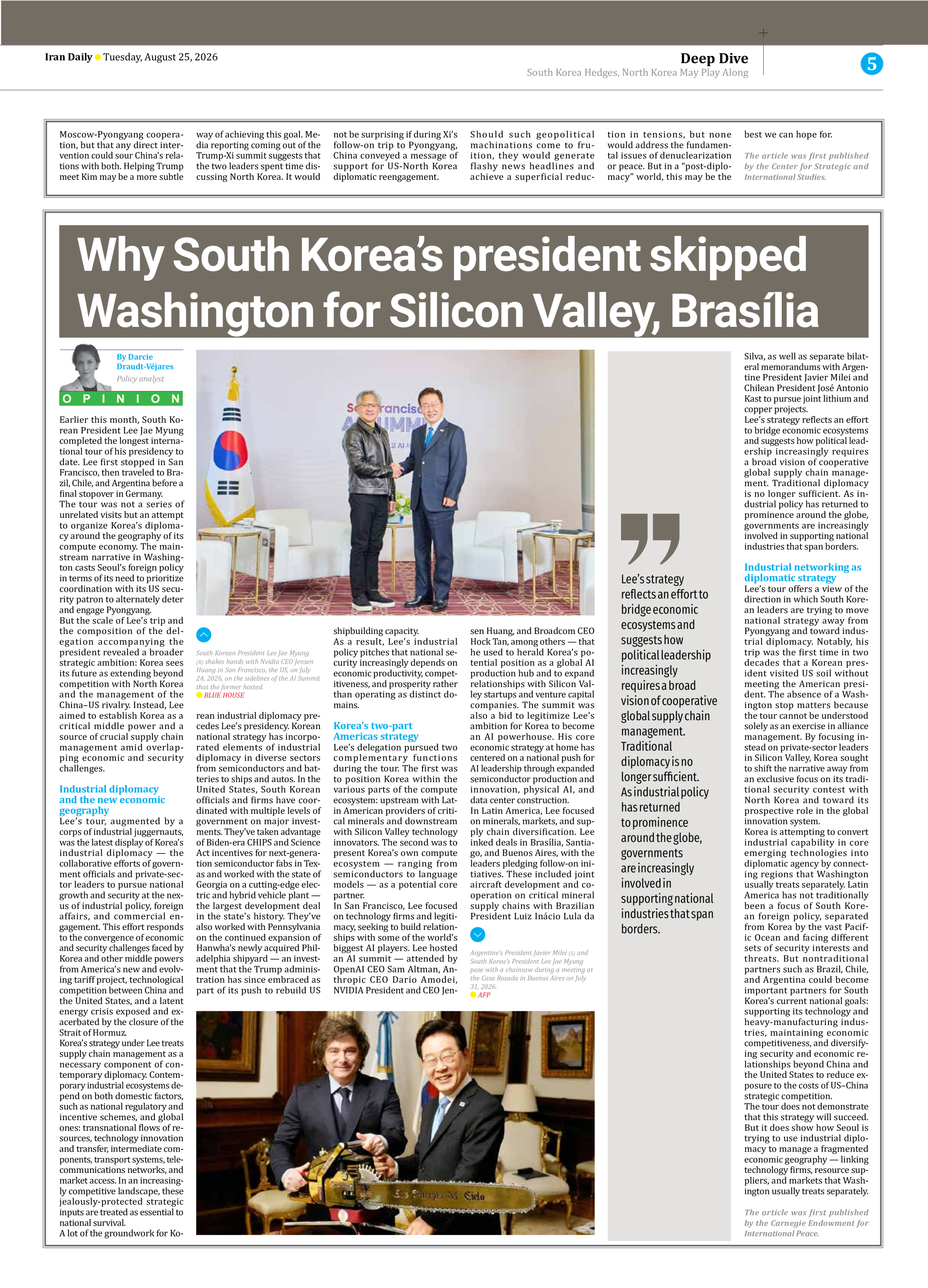
In San Francisco, Lee focused on technology firms and legitimacy, seeking to build relationships with some of the world’s biggest AI players. Lee hosted an AI summit — attended by OpenAI CEO Sam Altman, Anthropic CEO Dario Amodei, NVIDIA President and CEO Jensen Huang, and Broadcom CEO Hock Tan, among others — that he used to herald Korea’s potential position as a global AI production hub and to expand relationships with Silicon Valley startups and venture capital companies. The summit was also a bid to legitimize Lee’s ambition for Korea to become an AI powerhouse. His core economic strategy at home has centered on a national push for AI leadership through expanded semiconductor production and innovation, physical AI, and data center construction.
In Latin America, Lee focused on minerals, markets, and supply chain diversification. Lee inked deals in Brasília, Santiago, and Buenos Aires, with the leaders pledging follow-on initiatives. These included joint aircraft development and cooperation on critical mineral supply chains with Brazilian President Luiz Inácio Lula da Silva, as well as separate bilateral memorandums with Argentine President Javier Milei and Chilean President José Antonio Kast to pursue joint lithium and copper projects.
Lee’s strategy reflects an effort to bridge economic ecosystems and suggests how political leadership increasingly requires a broad vision of cooperative global supply chain management. Traditional diplomacy is no longer sufficient. As industrial policy has returned to prominence around the globe, governments are increasingly involved in supporting national industries that span borders.
Industrial networking as diplomatic strategy
Lee’s tour offers a view of the direction in which South Korean leaders are trying to move national strategy away from Pyongyang and toward industrial diplomacy. Notably, his trip was the first time in two decades that a Korean president visited US soil without meeting the American president. The absence of a Washington stop matters because the tour cannot be understood solely as an exercise in alliance management. By focusing instead on private-sector leaders in Silicon Valley, Korea sought to shift the narrative away from an exclusive focus on its traditional security contest with North Korea and toward its prospective role in the global innovation system.
Korea is attempting to convert industrial capability in core emerging technologies into diplomatic agency by connecting regions that Washington usually treats separately. Latin America has not traditionally been a focus of South Korean foreign policy, separated from Korea by the vast Pacific Ocean and facing different sets of security interests and threats. But nontraditional partners such as Brazil, Chile, and Argentina could become important partners for South Korea’s current national goals: supporting its technology and heavy-manufacturing industries, maintaining economic competitiveness, and diversifying security and economic relationships beyond China and the United States to reduce exposure to the costs of US–China strategic competition.
The tour does not demonstrate that this strategy will succeed. But it does show how Seoul is trying to use industrial diplomacy to manage a fragmented economic geography — linking technology firms, resource suppliers, and markets that Washington usually treats separately.
The article was first published by the Carnegie Endowment for
International Peace.