







Pakistani army chief in Tehran to ‘promote regional stability’
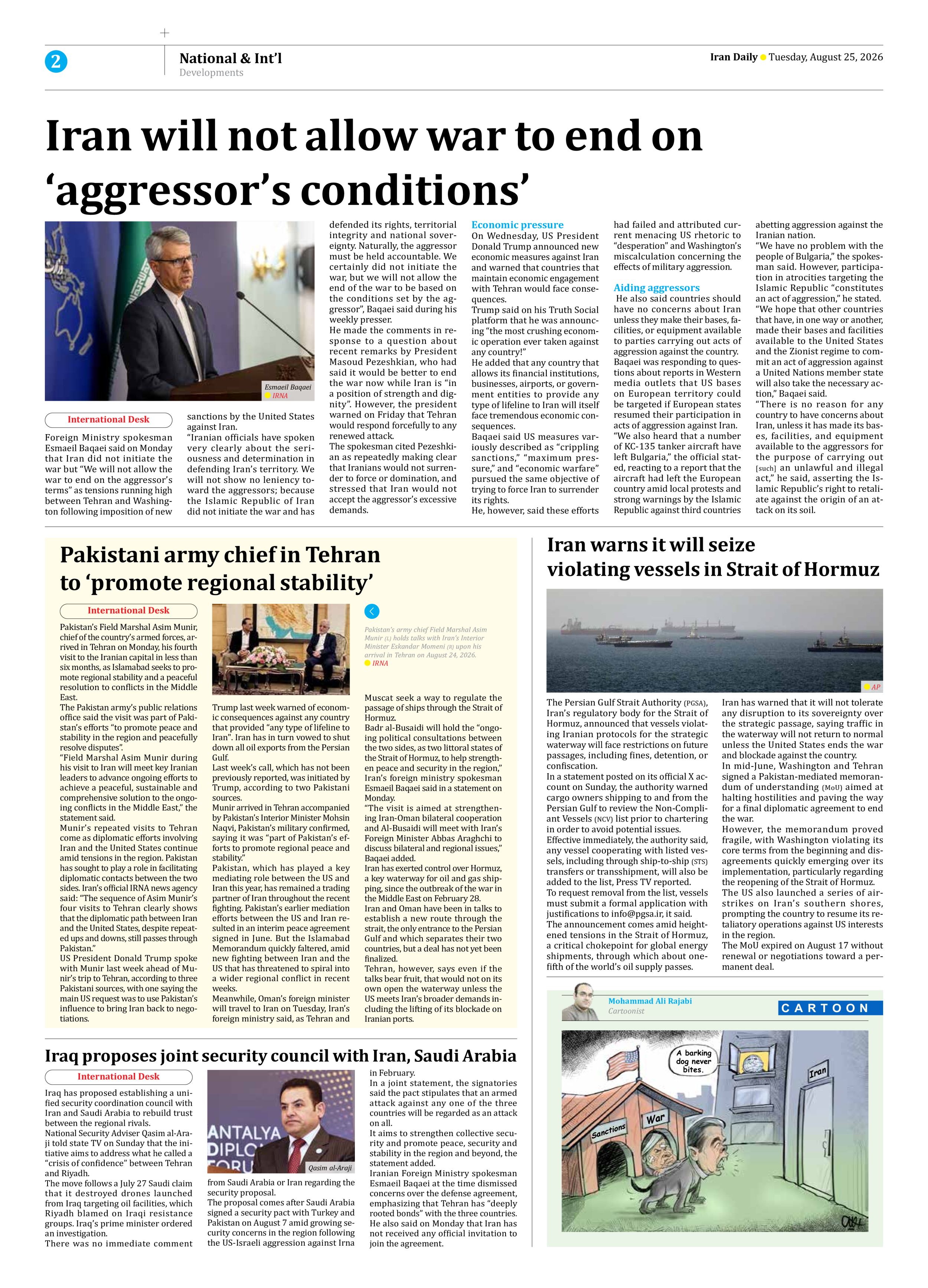
Pakistan’s Field Marshal Asim Munir, chief of the country’s armed forces, arrived in Tehran on Monday, his fourth visit to the Iranian capital in less than six months, as Islamabad seeks to promote regional stability and a peaceful resolution to conflicts in the Middle East.
The Pakistan army’s public relations office said the visit was part of Pakistan’s efforts “to promote peace and stability in the region and peacefully resolve disputes”.
“Field Marshal Asim Munir during his visit to Iran will meet key Iranian leaders to advance ongoing efforts to achieve a peaceful, sustainable and comprehensive solution to the ongoing conflicts in the Middle East,” the statement said.
Munir’s repeated visits to Tehran come as diplomatic efforts involving Iran and the United States continue amid tensions in the region. Pakistan has sought to play a role in facilitating diplomatic contacts between the two sides. Iran’s official IRNA news agency said: “The sequence of Asim Munir’s four visits to Tehran clearly shows that the diplomatic path between Iran and the United States, despite repeated ups and downs, still passes through Pakistan.”
US President Donald Trump spoke with Munir last week ahead of Munir’s trip to Tehran, according to three Pakistani sources, with one saying the main US request was to use Pakistan’s influence to bring Iran back to negotiations.
Trump last week warned of economic consequences against any country that provided “any type of lifeline to Iran". Iran has in turn vowed to shut down all oil exports from the Persian Gulf.
Last week’s call, which has not been previously reported, was initiated by Trump, according to two Pakistani sources.
Munir arrived in Tehran accompanied by Pakistan’s Interior Minister Mohsin Naqvi, Pakistan’s military confirmed, saying it was “part of Pakistan’s efforts to promote regional peace and stability.”
Pakistan, which has played a key mediating role between the US and Iran this year, has remained a trading partner of Iran throughout the recent fighting. Pakistan’s earlier mediation efforts between the US and Iran resulted in an interim peace agreement signed in June. But the Islamabad Memorandum quickly faltered, amid new fighting between Iran and the US that has threatened to spiral into a wider regional conflict in recent weeks.
Meanwhile, Oman’s foreign minister will travel to Iran on Tuesday, Iran’s foreign ministry said, as Tehran and Muscat seek a way to regulate the passage of ships through the Strait of Hormuz.
Badr al-Busaidi will hold the “ongoing political consultations between the two sides, as two littoral states of the Strait of Hormuz, to help strengthen peace and security in the region,” Iran’s foreign ministry spokesman Esmaeil Baqaei said in a statement on Monday.
“The visit is aimed at strengthening Iran-Oman bilateral cooperation and Al-Busaidi will meet with Iran’s Foreign Minister Abbas Araghchi to discuss bilateral and regional issues,” Baqaei added.
Iran has exerted control over Hormuz, a key waterway for oil and gas shipping, since the outbreak of the war in the Middle East on February 28.
Iran and Oman have been in talks to establish a new route through the strait, the only entrance to the Persian Gulf and which separates their two countries, but a deal has not yet been finalized.
Tehran, however, says even if the talks bear fruit, that would not on its own open the waterway unless the US meets Iran’s broader demands including the lifting of its blockade on Iranian ports.