







Iran marks national Physician’s Day with tributes to Avicenna
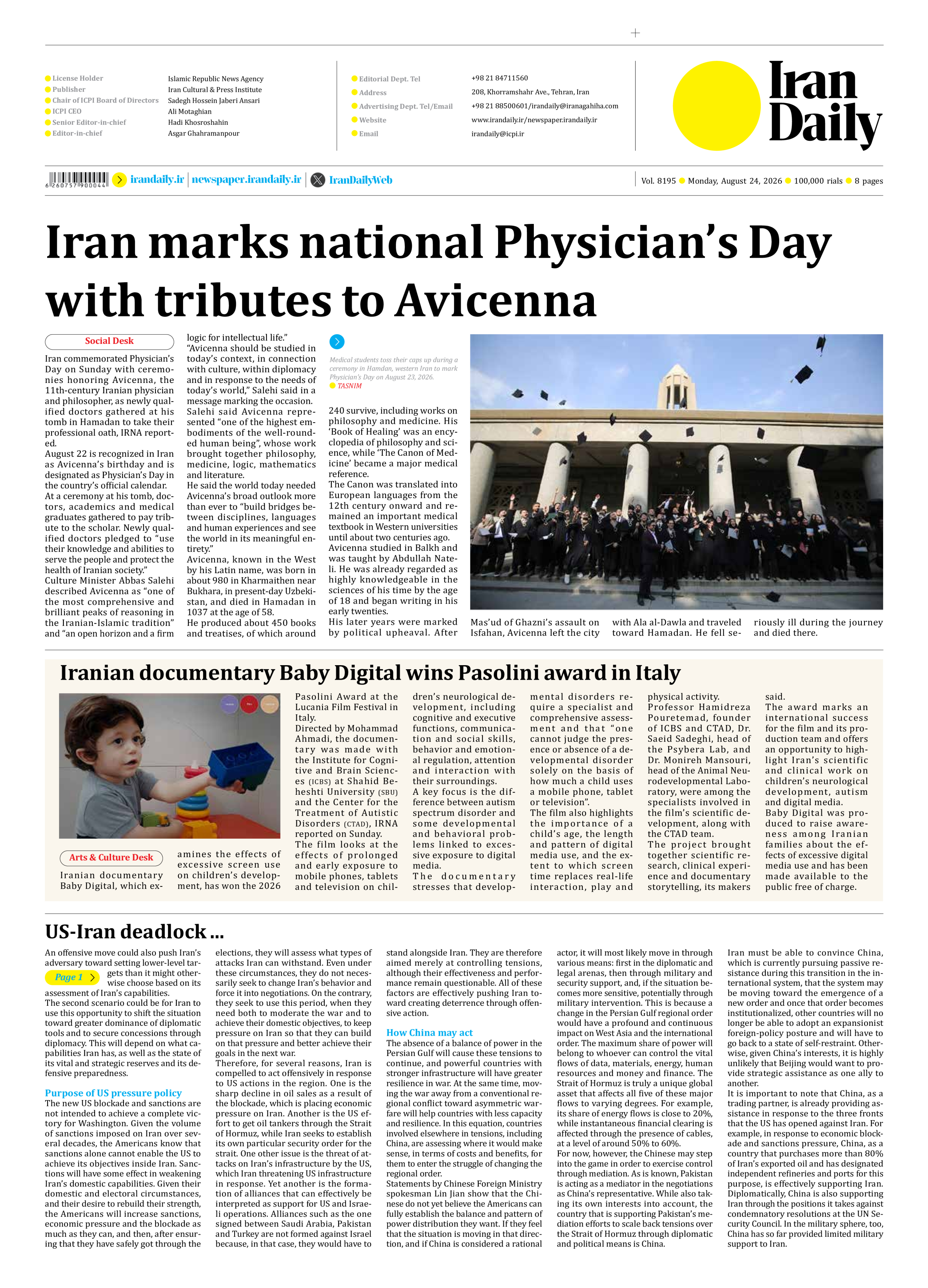
Iran commemorated Physician’s Day on Sunday with ceremonies honoring Avicenna, the 11th-century Iranian physician and philosopher, as newly qualified doctors gathered at his tomb in Hamadan to take their professional oath, IRNA reported.
August 22 is recognized in Iran as Avicenna’s birthday and is designated as Physician’s Day in the country’s official calendar.
At a ceremony at his tomb, doctors, academics and medical graduates gathered to pay tribute to the scholar. Newly qualified doctors pledged to “use their knowledge and abilities to serve the people and protect the health of Iranian society.”
Culture Minister Abbas Salehi described Avicenna as “one of the most comprehensive and brilliant peaks of reasoning in the Iranian-Islamic tradition” and “an open horizon and a firm logic for intellectual life.”
“Avicenna should be studied in today’s context, in connection with culture, within diplomacy and in response to the needs of today’s world,” Salehi said in a message marking the occasion.
Salehi said Avicenna represented “one of the highest embodiments of the well-rounded human being”, whose work brought together philosophy, medicine, logic, mathematics and literature.
He said the world today needed Avicenna’s broad outlook more than ever to “build bridges between disciplines, languages and human experiences and see the world in its meaningful entirety.”
Avicenna, known in the West by his Latin name, was born in about 980 in Kharmaithen near Bukhara, in present-day Uzbekistan, and died in Hamadan in 1037 at the age of 58.
He produced about 450 books and treatises, of which around 240 survive, including works on philosophy and medicine. His ‘Book of Healing’ was an encyclopedia of philosophy and science, while ‘The Canon of Medicine’ became a major medical reference.
The Canon was translated into European languages from the 12th century onward and remained an important medical textbook in Western universities until about two centuries ago.
Avicenna studied in Balkh and was taught by Abdullah Nateli. He was already regarded as highly knowledgeable in the sciences of his time by the age of 18 and began writing in his early twenties.
His later years were marked by political upheaval. After Mas’ud of Ghazni’s assault on Isfahan, Avicenna left the city with Ala al-Dawla and traveled toward Hamadan. He fell seriously ill during the journey and died there.