







Government backs green development in industry
287 industrial units vied for top environmental honors
Economy Desk
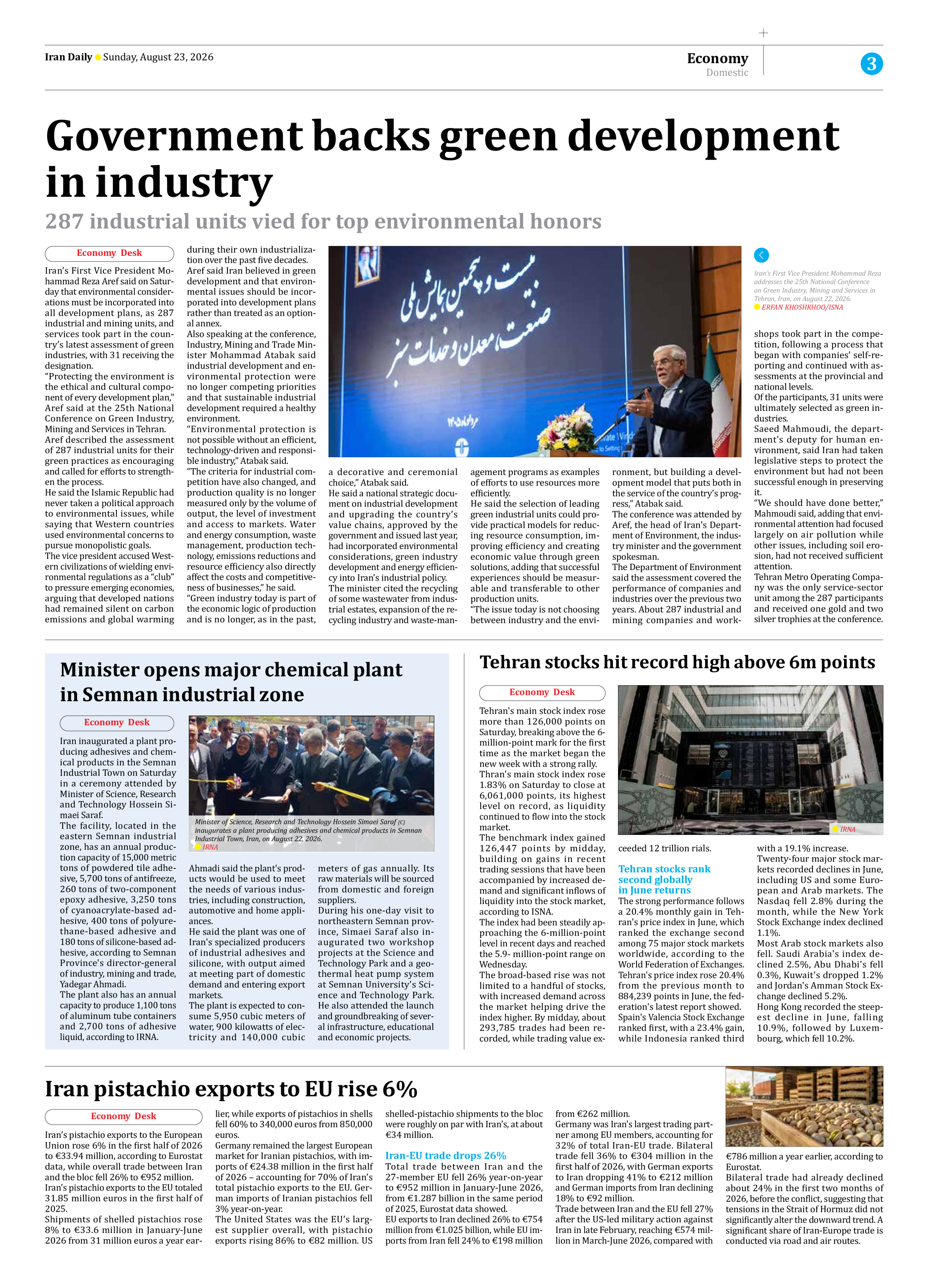
Iran’s First Vice President Mohammad Reza Aref said on Saturday that environmental considerations must be incorporated into all development plans, as 287 industrial and mining units, and services took part in the country’s latest assessment of green industries, with 31 receiving the designation.
“Protecting the environment is the ethical and cultural component of every development plan,” Aref said at the 25th National Conference on Green Industry, Mining and Services in Tehran.
Aref described the assessment of 287 industrial units for their green practices as encouraging and called for efforts to strengthen the process.
He said the Islamic Republic had never taken a political approach to environmental issues, while saying that Western countries used environmental concerns to pursue monopolistic goals.
The vice president accused Western civilizations of wielding environmental regulations as a “club” to pressure emerging economies, arguing that developed nations had remained silent on carbon emissions and global warming during their own industrialization over the past five decades.
Aref said Iran believed in green development and that environmental issues should be incorporated into development plans rather than treated as an optional annex.
Also speaking at the conference, Industry, Mining and Trade Minister Mohammad Atabak said industrial development and environmental protection were no longer competing priorities and that sustainable industrial development required a healthy environment.
“Environmental protection is not possible without an efficient, technology-driven and responsible industry,” Atabak said.
“The criteria for industrial competition have also changed, and production quality is no longer measured only by the volume of output, the level of investment and access to markets. Water and energy consumption, waste management, production technology, emissions reductions and resource efficiency also directly affect the costs and competitiveness of businesses,” he said.
“Green industry today is part of the economic logic of production and is no longer, as in the past, a decorative and ceremonial choice,” Atabak said.
He said a national strategic document on industrial development and upgrading the country’s value chains, approved by the government and issued last year, had incorporated environmental considerations, green industry development and energy efficiency into Iran’s industrial policy.
The minister cited the recycling of some wastewater from industrial estates, expansion of the recycling industry and waste-management programs as examples of efforts to use resources more efficiently.
He said the selection of leading green industrial units could provide practical models for reducing resource consumption, improving efficiency and creating economic value through green solutions, adding that successful experiences should be measurable and transferable to other production units.
“The issue today is not choosing between industry and the environment, but building a development model that puts both in the service of the country’s progress,” Atabak said.
The conference was attended by Aref, the head of Iran’s Department of Environment, the industry minister and the government spokesman.
The Department of Environment said the assessment covered the performance of companies and industries over the previous two years. About 287 industrial and mining companies and workshops took part in the competition, following a process that began with companies’ self-reporting and continued with assessments at the provincial and national levels.
Of the participants, 31 units were ultimately selected as green industries.
Saeed Mahmoudi, the department’s deputy for human environment, said Iran had taken legislative steps to protect the environment but had not been successful enough in preserving it.
“We should have done better,” Mahmoudi said, adding that environmental attention had focused largely on air pollution while other issues, including soil erosion, had not received sufficient attention.
Tehran Metro Operating Company was the only service-sector unit among the 287 participants and received one gold and two silver trophies at the conference.