







Sheikh Shaban village emerges as Iran’s Khatam hub
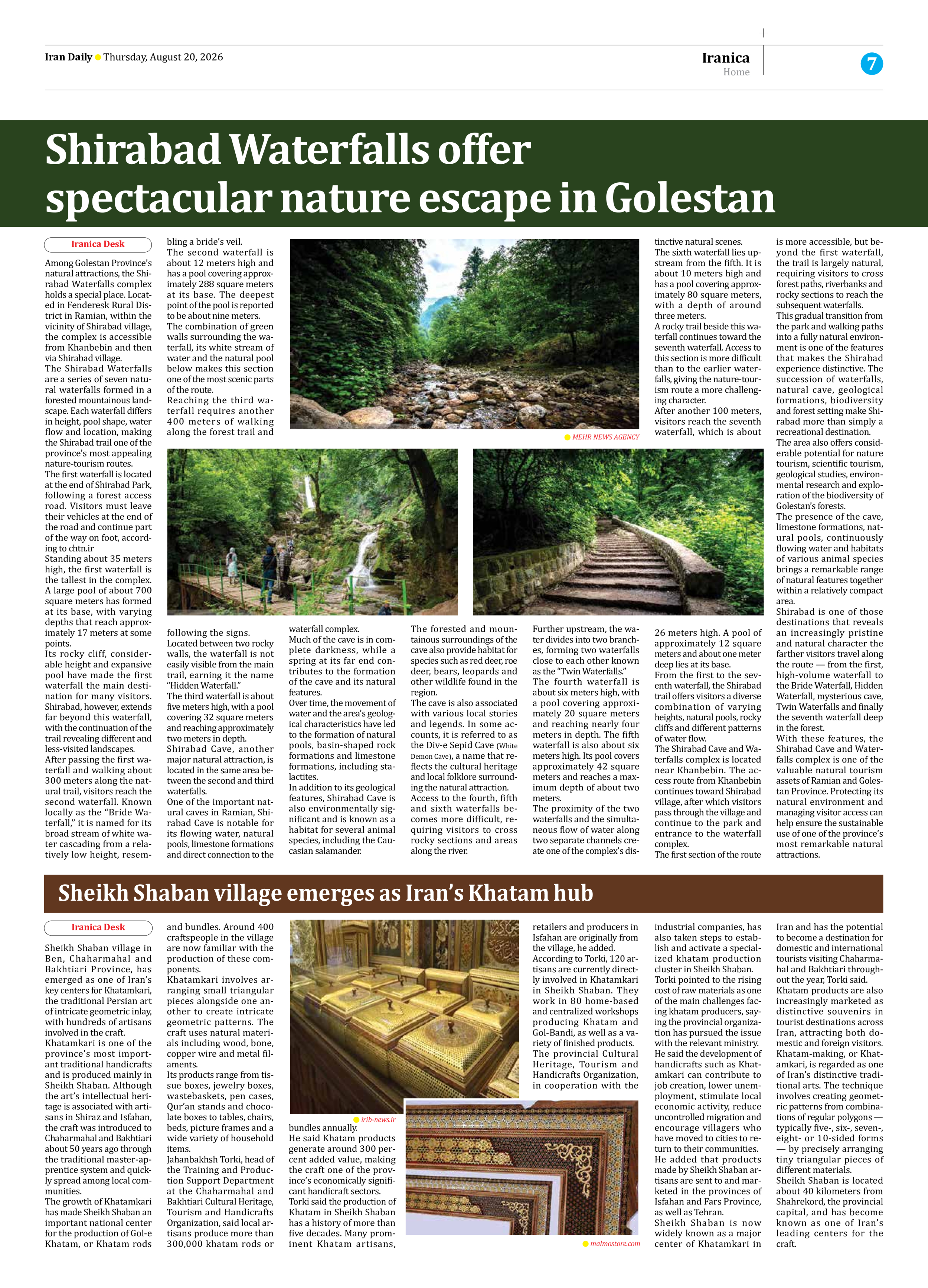
Sheikh Shaban village in Ben, Chaharmahal and Bakhtiari Province, has emerged as one of Iran’s key centers for Khatamkari, the traditional Persian art of intricate geometric inlay, with hundreds of artisans involved in the craft.
Khatamkari is one of the province’s most important traditional handicrafts and is produced mainly in Sheikh Shaban. Although the art’s intellectual heritage is associated with artisans in Shiraz and Isfahan, the craft was introduced to Chaharmahal and Bakhtiari about 50 years ago through the traditional master-apprentice system and quickly spread among local communities.
The growth of Khatamkari has made Sheikh Shaban an important national center for the production of Gol-e Khatam, or Khatam rods and bundles. Around 400 craftspeople in the village are now familiar with the production of these components.
Khatamkari involves arranging small triangular pieces alongside one another to create intricate geometric patterns. The craft uses natural materials including wood, bone, copper wire and metal filaments.
Its products range from tissue boxes, jewelry boxes, wastebaskets, pen cases, Qur’an stands and chocolate boxes to tables, chairs, beds, picture frames and a wide variety of household items.
Jahanbakhsh Torki, head of the Training and Production Support Department at the Chaharmahal and Bakhtiari Cultural Heritage, Tourism and Handicrafts Organization, said local artisans produce more than 300,000 khatam rods or bundles annually.
He said Khatam products generate around 300 percent added value, making the craft one of the province’s economically significant handicraft sectors.
Torki said the production of Khatam in Sheikh Shaban has a history of more than five decades. Many prominent Khatam artisans, retailers and producers in Isfahan are originally from the village, he added.
According to Torki, 120 artisans are currently directly involved in Khatamkari in Sheikh Shaban. They work in 80 home-based and centralized workshops producing Khatam and Gol-Bandi, as well as a variety of finished products.
The provincial Cultural Heritage, Tourism and Handicrafts Organization, in cooperation with the industrial companies, has also taken steps to establish and activate a specialized khatam production cluster in Sheikh Shaban.
Torki pointed to the rising cost of raw materials as one of the main challenges facing khatam producers, saying the provincial organization has pursued the issue with the relevant ministry.
He said the development of handicrafts such as Khatamkari can contribute to job creation, lower unemployment, stimulate local economic activity, reduce uncontrolled migration and encourage villagers who have moved to cities to return to their communities.
He added that products made by Sheikh Shaban artisans are sent to and marketed in the provinces of Isfahan and Fars Province, as well as Tehran.
Sheikh Shaban is now widely known as a major center of Khatamkari in Iran and has the potential to become a destination for domestic and international tourists visiting Chaharmahal and Bakhtiari throughout the year, Torki said.
Khatam products are also increasingly marketed as distinctive souvenirs in tourist destinations across Iran, attracting both domestic and foreign visitors.
Khatam-making, or Khatamkari, is regarded as one of Iran’s distinctive traditional arts. The technique involves creating geometric patterns from combinations of regular polygons — typically five-, six-, seven-, eight- or 10-sided forms — by precisely arranging tiny triangular pieces of different materials.
Sheikh Shaban is located about 40 kilometers from Shahrekord, the provincial capital, and has become known as one of Iran’s leading centers for the craft.