







Lie that reached Netanyahu’s podium
How fabricated quote exposed fragility of Israel’s information war
Political researcher
For years, Israeli Prime Minister Benjamin Netanyahu has sought to establish himself as one of the world’s most authoritative voices on Iran. His political career has been closely intertwined with warnings about the Islamic Republic of Iran’s so-called nuclear ambitions, its alleged threat to Israel, and the necessity of extraordinary measures to confront Tehran.
But a recent controversy has exposed a striking weakness in that narrative: a quotation attributed to the Commander-in-Chief of the Islamic Revolutionary Guard Corps (IRGC) Ahmad Vahidi travelled from an obscure social-media account outside Iran through pro-Israel online networks and Israeli media before ultimately reaching the podium of the Israeli prime minister.
The alleged statement claimed that Iran would continue pursuing nuclear weapons as long as the United States and Israel possessed them. It was precisely the kind of declaration Netanyahu could use to reinforce his longstanding argument about Iran. There was, however, a fundamental problem: no reliable evidence has emerged that Brigadier General Vahidi ever made the statement.
No Iranian news agency published it. No verified transcript or recording has surfaced. Instead, the claim was traced to an India-based X account, before being amplified by accounts aligned with pro-Israel discourse, Israeli media figures and eventually, Netanyahu himself.
The episode is therefore more than another example of social-media misinformation. It raises a much more consequential question: How did a social media rumor end up being used by Israel’s prime minister against Iran?
From social media to the Israeli PM
The alleged quotation first appeared on an India-based X account using the name “Ritikaa”. The post presented an image of Brigadier General Vahidi alongside a supposed statement about Iran’s nuclear outlook. Under normal journalistic standards, this should have been the beginning of verification, not the beginning of political amplification.
A statement allegedly made by one of Iran’s most senior military figures would ordinarily be expected to leave a substantial evidentiary trail: an Iranian media report, an official transcript, a video, an audio recording or confirmation from independent news organizations.
None appeared. Instead, the claim began circulating through accounts sympathetic to Israel and was subsequently picked up by Israeli media. The transformation was remarkable: the original source did not become more credible; it simply became more widely repeated. That distinction is at the heart of the controversy.
When online echo becomes ‘evidence’
One of the most revealing elements of the episode is the role of the account known as “Mossad Commentary”. Despite its name and use of imagery associated with Israel’s intelligence service, the account has no known official connection to Mossad. Independent investigations have repeatedly identified it as an unofficial account that has circulated misleading material.
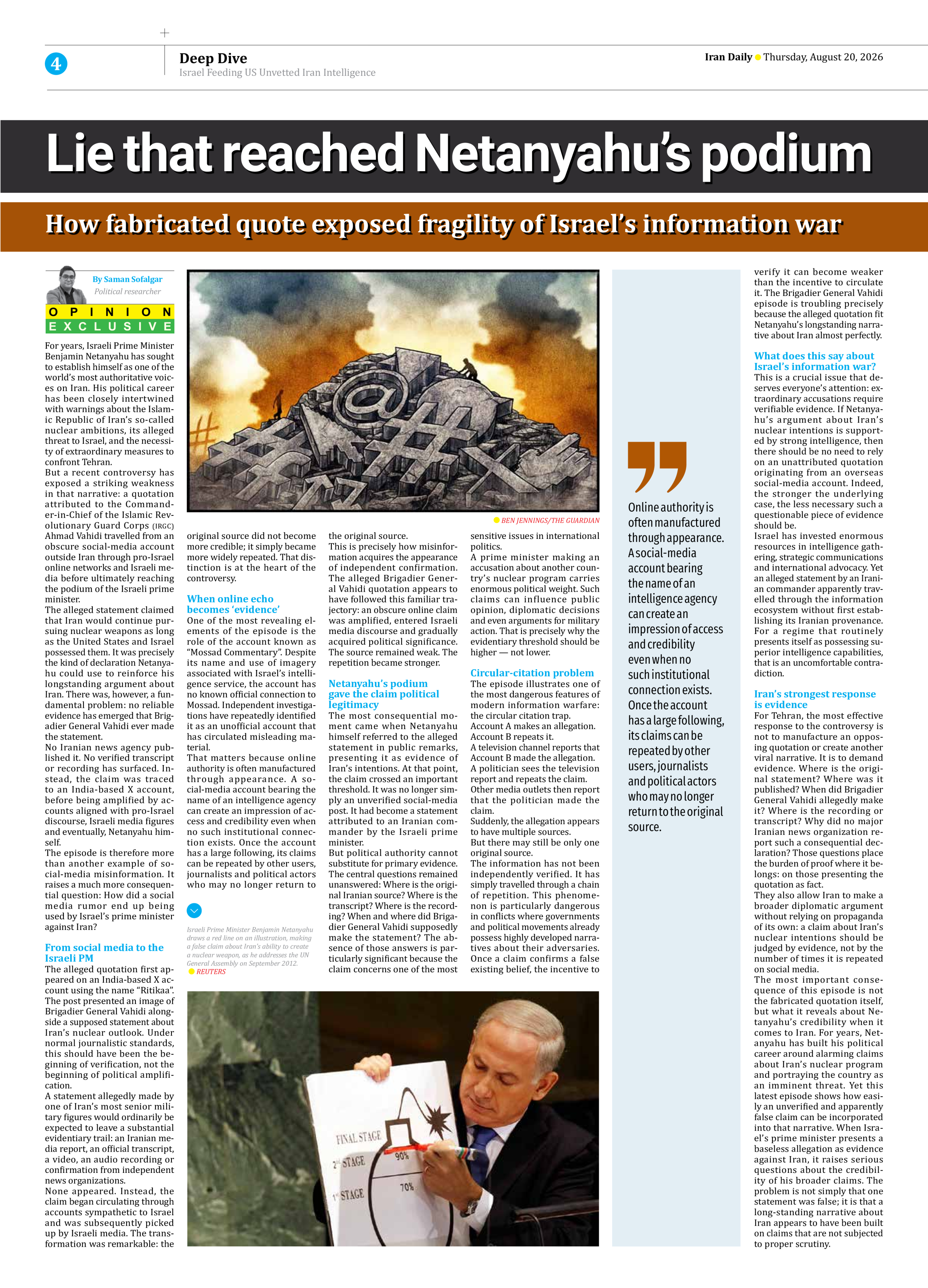
That matters because online authority is often manufactured through appearance. A social-media account bearing the name of an intelligence agency can create an impression of access and credibility even when no such institutional connection exists. Once the account has a large following, its claims can be repeated by other users, journalists and political actors who may no longer return to the original source.
This is precisely how misinformation acquires the appearance of independent confirmation. The alleged Brigadier General Vahidi quotation appears to have followed this familiar trajectory: an obscure online claim was amplified, entered Israeli media discourse and gradually acquired political significance. The source remained weak. The repetition became stronger.
Netanyahu’s podium gave the claim political legitimacy
The most consequential moment came when Netanyahu himself referred to the alleged statement in public remarks, presenting it as evidence of Iran’s intentions. At that point, the claim crossed an important threshold. It was no longer simply an unverified social-media post. It had become a statement attributed to an Iranian commander by the Israeli prime minister.
But political authority cannot substitute for primary evidence. The central questions remained unanswered: Where is the original Iranian source? Where is the transcript? Where is the recording? When and where did Brigadier General Vahidi supposedly make the statement? The absence of those answers is particularly significant because the claim concerns one of the most sensitive issues in international politics.
A prime minister making an accusation about another country’s nuclear program carries enormous political weight. Such claims can influence public opinion, diplomatic decisions and even arguments for military action. That is precisely why the evidentiary threshold should be higher — not lower.
Circular-citation problem
The episode illustrates one of the most dangerous features of modern information warfare: the circular citation trap.
Account A makes an allegation.
Account B repeats it.
A television channel reports that Account B made the allegation.
A politician sees the television report and repeats the claim.
Other media outlets then report that the politician made the claim.
Suddenly, the allegation appears to have multiple sources.
But there may still be only one original source.
The information has not been independently verified. It has simply travelled through a chain of repetition. This phenomenon is particularly dangerous in conflicts where governments and political movements already possess highly developed narratives about their adversaries. Once a claim confirms a false existing belief, the incentive to verify it can become weaker than the incentive to circulate it. The Brigadier General Vahidi episode is troubling precisely because the alleged quotation fit Netanyahu’s longstanding narrative about Iran almost perfectly.
What does this say about Israel’s information war?
This is a crucial issue that deserves everyone’s attention: extraordinary accusations require verifiable evidence. If Netanyahu’s argument about Iran’s nuclear intentions is supported by strong intelligence, then there should be no need to rely on an unattributed quotation originating from an overseas social-media account. Indeed, the stronger the underlying case, the less necessary such a questionable piece of evidence should be.
Israel has invested enormous resources in intelligence gathering, strategic communications and international advocacy. Yet an alleged statement by an Iranian commander apparently travelled through the information ecosystem without first establishing its Iranian provenance. For a regime that routinely presents itself as possessing superior intelligence capabilities, that is an uncomfortable contradiction.
Iran’s strongest response is evidence
For Tehran, the most effective response to the controversy is not to manufacture an opposing quotation or create another viral narrative. It is to demand evidence. Where is the original statement? Where was it published? When did Brigadier General Vahidi allegedly make it? Where is the recording or transcript? Why did no major Iranian news organization report such a consequential declaration? Those questions place the burden of proof where it belongs: on those presenting the quotation as fact.
They also allow Iran to make a broader diplomatic argument without relying on propaganda of its own: a claim about Iran’s nuclear intentions should be judged by evidence, not by the number of times it is repeated on social media.
The most important consequence of this episode is not the fabricated quotation itself, but what it reveals about Netanyahu’s credibility when it comes to Iran. For years, Netanyahu has built his political career around alarming claims about Iran’s nuclear program and portraying the country as an imminent threat. Yet this latest episode shows how easily an unverified and apparently false claim can be incorporated into that narrative. When Israel’s prime minister presents a baseless allegation as evidence against Iran, it raises serious questions about the credibility of his broader claims. The problem is not simply that one statement was false; it is that a long-standing narrative about Iran appears to have been built on claims that are not subjected to proper scrutiny.