





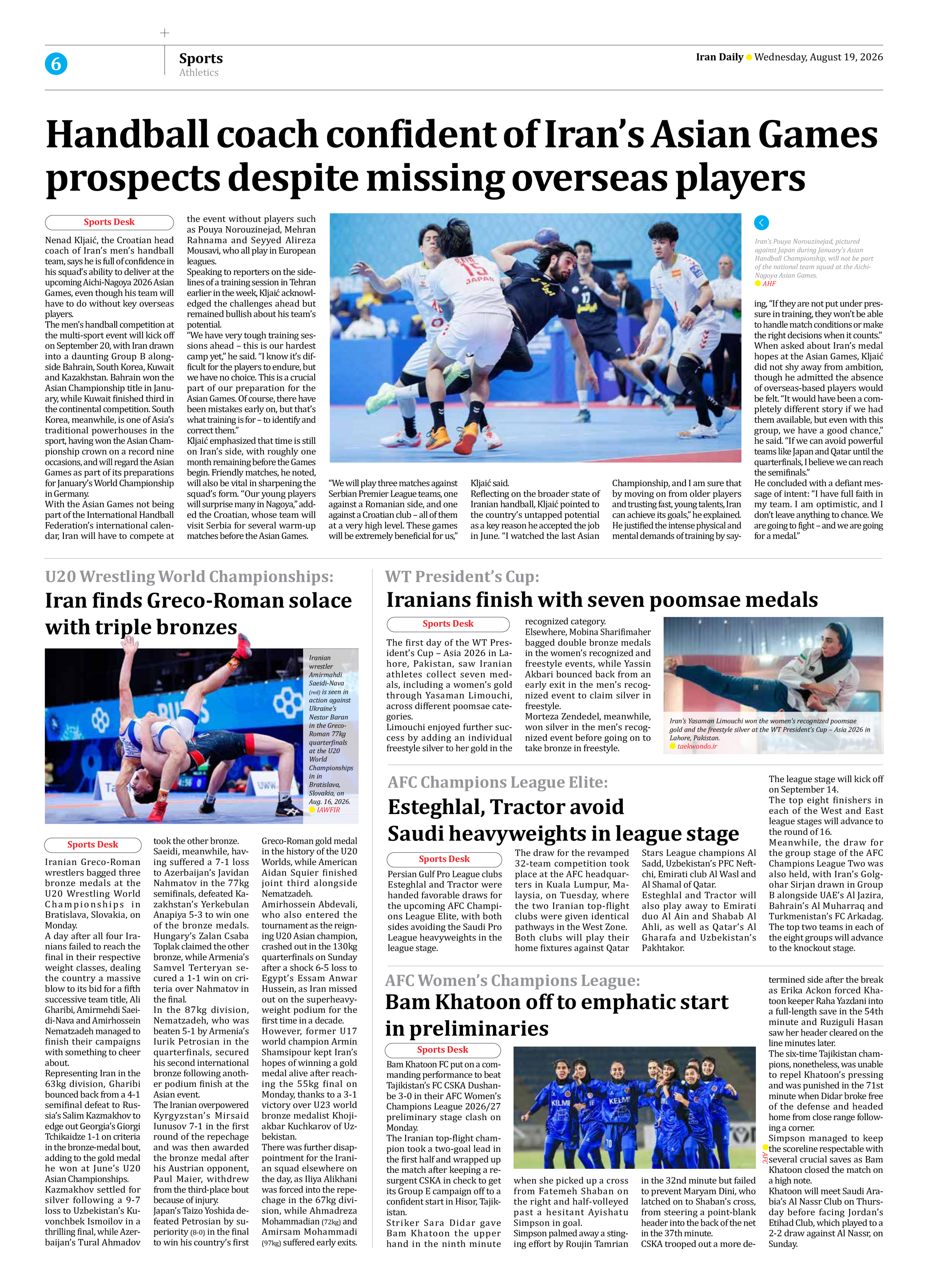


Handball coach confident of Iran’s Asian Games prospects despite missing overseas players
Nenad Kljaić, the Croatian head coach of Iran’s men’s handball team, says he is full of confidence in his squad’s ability to deliver at the upcoming Aichi-Nagoya 2026 Asian Games, even though his team will have to do without key overseas players.
The men’s handball competition at the multi-sport event will kick off on September 20, with Iran drawn into a daunting Group B alongside Bahrain, South Korea, Kuwait and Kazakhstan. Bahrain won the Asian Championship title in January, while Kuwait finished third in the continental competition. South Korea, meanwhile, is one of Asia’s traditional powerhouses in the sport, having won the Asian Championship crown on a record nine occasions, and will regard the Asian Games as part of its preparations for January’s World Championship in Germany.
With the Asian Games not being part of the International Handball Federation’s international calendar, Iran will have to compete at the event without players such as Pouya Norouzinejad, Mehran Rahnama and Seyyed Alireza Mousavi, who all play in European leagues.
Speaking to reporters on the sidelines of a training session in Tehran earlier in the week, Kljaić acknowledged the challenges ahead but remained bullish about his team’s potential.
“We have very tough training sessions ahead – this is our hardest camp yet,” he said. “I know it’s difficult for the players to endure, but we have no choice. This is a crucial part of our preparation for the Asian Games. Of course, there have been mistakes early on, but that’s what training is for – to identify and correct them.”
Kljaić emphasized that time is still on Iran’s side, with roughly one month remaining before the Games begin. Friendly matches, he noted, will also be vital in sharpening the squad’s form. “Our young players will surprise many in Nagoya,” added the Croatian, whose team will visit Serbia for several warm-up matches before the Asian Games.
“We will play three matches against Serbian Premier League teams, one against a Romanian side, and one against a Croatian club – all of them at a very high level. These games will be extremely beneficial for us,” Kljaić said.
Reflecting on the broader state of Iranian handball, Kljaić pointed to the country’s untapped potential as a key reason he accepted the job in June. “I watched the last Asian Championship, and I am sure that by moving on from older players and trusting fast, young talents, Iran can achieve its goals,” he explained. He justified the intense physical and mental demands of training by saying, “If they are not put under pressure in training, they won’t be able to handle match conditions or make the right decisions when it counts.”
When asked about Iran’s medal hopes at the Asian Games, Kljaić did not shy away from ambition, though he admitted the absence of overseas-based players would be felt. “It would have been a completely different story if we had them available, but even with this group, we have a good chance,” he said. “If we can avoid powerful teams like Japan and Qatar until the quarterfinals, I believe we can reach the semifinals.”
He concluded with a defiant message of intent: “I have full faith in my team. I am optimistic, and I don’t leave anything to chance. We are going to fight – and we are going for a medal.”