





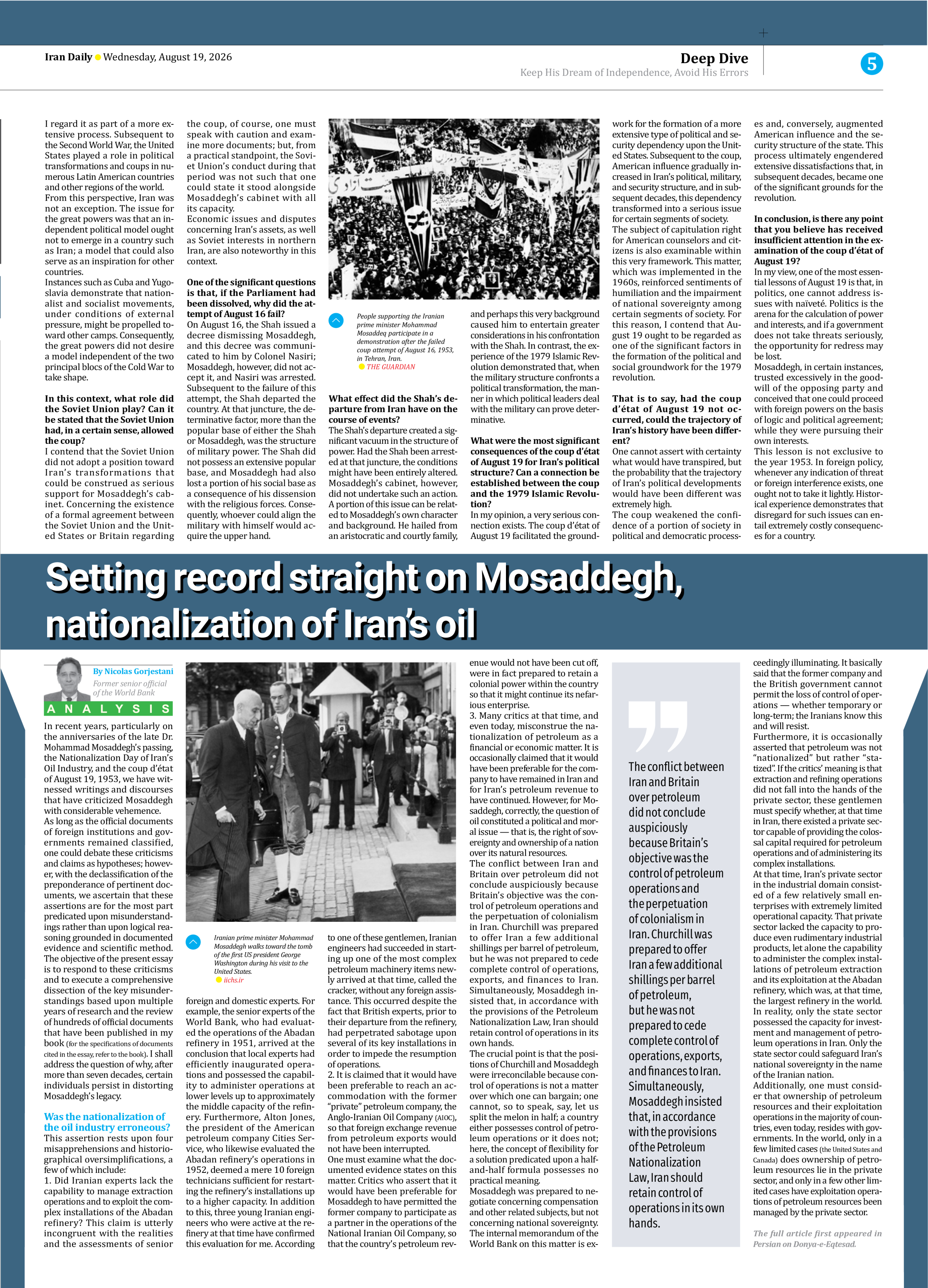


Setting record straight on Mosaddegh, nationalization of Iran’s oil
By Nicolas Gorjestani
Former senior official of the World Bank
In recent years, particularly on the anniversaries of the late Dr. Mohammad Mosaddegh’s passing, the Nationalization Day of Iran’s Oil Industry, and the coup d’état of August 19, 1953, we have witnessed writings and discourses that have criticized Mosaddegh with considerable vehemence.
As long as the official documents of foreign institutions and governments remained classified, one could debate these criticisms and claims as hypotheses; however, with the declassification of the preponderance of pertinent documents, we ascertain that these assertions are for the most part predicated upon misunderstandings rather than upon logical reasoning grounded in documented evidence and scientific method. The objective of the present essay is to respond to these criticisms and to execute a comprehensive dissection of the key misunderstandings based upon multiple years of research and the review of hundreds of official documents that have been published in my book (for the specifications of documents cited in the essay, refer to the book). I shall address the question of why, after more than seven decades, certain individuals persist in distorting Mosaddegh’s legacy.
Was the nationalization of the oil industry erroneous?
This assertion rests upon four misapprehensions and historiographical oversimplifications, a few of which include:
1. Did Iranian experts lack the capability to manage extraction operations and to exploit the complex installations of the Abadan refinery? This claim is utterly incongruent with the realities and the assessments of senior foreign and domestic experts. For example, the senior experts of the World Bank, who had evaluated the operations of the Abadan refinery in 1951, arrived at the conclusion that local experts had efficiently inaugurated operations and possessed the capability to administer operations at lower levels up to approximately the middle capacity of the refinery. Furthermore, Alton Jones, the president of the American petroleum company Cities Service, who likewise evaluated the Abadan refinery’s operations in 1952, deemed a mere 10 foreign technicians sufficient for restarting the refinery’s installations up to a higher capacity. In addition to this, three young Iranian engineers who were active at the refinery at that time have confirmed this evaluation for me. According to one of these gentlemen, Iranian engineers had succeeded in starting up one of the most complex petroleum machinery items newly arrived at that time, called the cracker, without any foreign assistance. This occurred despite the fact that British experts, prior to their departure from the refinery, had perpetrated sabotage upon several of its key installations in order to impede the resumption of operations.
2. It is claimed that it would have been preferable to reach an accommodation with the former “private” petroleum company, the Anglo-Iranian Oil Company (AIOC), so that foreign exchange revenue from petroleum exports would not have been interrupted.
One must examine what the documented evidence states on this matter. Critics who assert that it would have been preferable for Mosaddegh to have permitted the former company to participate as a partner in the operations of the National Iranian Oil Company, so that the country’s petroleum revenue would not have been cut off, were in fact prepared to retain a colonial power within the country so that it might continue its nefarious enterprise.
3. Many critics at that time, and even today, misconstrue the nationalization of petroleum as a financial or economic matter. It is occasionally claimed that it would have been preferable for the company to have remained in Iran and for Iran’s petroleum revenue to have continued. However, for Mosaddegh, correctly, the question of oil constituted a political and moral issue — that is, the right of sovereignty and ownership of a nation over its natural resources.
The conflict between Iran and Britain over petroleum did not conclude auspiciously because Britain’s objective was the control of petroleum operations and the perpetuation of colonialism in Iran. Churchill was prepared to offer Iran a few additional shillings per barrel of petroleum, but he was not prepared to cede complete control of operations, exports, and finances to Iran. Simultaneously, Mosaddegh insisted that, in accordance with the provisions of the Petroleum Nationalization Law, Iran should retain control of operations in its own hands.
The crucial point is that the positions of Churchill and Mosaddegh were irreconcilable because control of operations is not a matter over which one can bargain; one cannot, so to speak, say, let us split the melon in half; a country either possesses control of petroleum operations or it does not; here, the concept of flexibility for a solution predicated upon a half-and-half formula possesses no practical meaning.
Mosaddegh was prepared to negotiate concerning compensation and other related subjects, but not concerning national sovereignty. The internal memorandum of the World Bank on this matter is exceedingly illuminating. It basically said that the former company and the British government cannot permit the loss of control of operations — whether temporary or long-term; the Iranians know this and will resist.
Furthermore, it is occasionally asserted that petroleum was not “nationalized” but rather “statized”. If the critics’ meaning is that extraction and refining operations did not fall into the hands of the private sector, these gentlemen must specify whether, at that time in Iran, there existed a private sector capable of providing the colossal capital required for petroleum operations and of administering its complex installations.
At that time, Iran’s private sector in the industrial domain consisted of a few relatively small enterprises with extremely limited operational capacity. That private sector lacked the capacity to produce even rudimentary industrial products, let alone the capability to administer the complex installations of petroleum extraction and its exploitation at the Abadan refinery, which was, at that time, the largest refinery in the world. In reality, only the state sector possessed the capacity for investment and management of petroleum operations in Iran. Only the state sector could safeguard Iran’s national sovereignty in the name of the Iranian nation.
Additionally, one must consider that ownership of petroleum resources and their exploitation operations in the majority of countries, even today, resides with governments. In the world, only in a few limited cases (the United States and Canada) does ownership of petroleum resources lie in the private sector, and only in a few other limited cases have exploitation operations of petroleum resources been managed by the private sector.
The full article first appeared in
Persian on Donya-e-Eqtesad.