





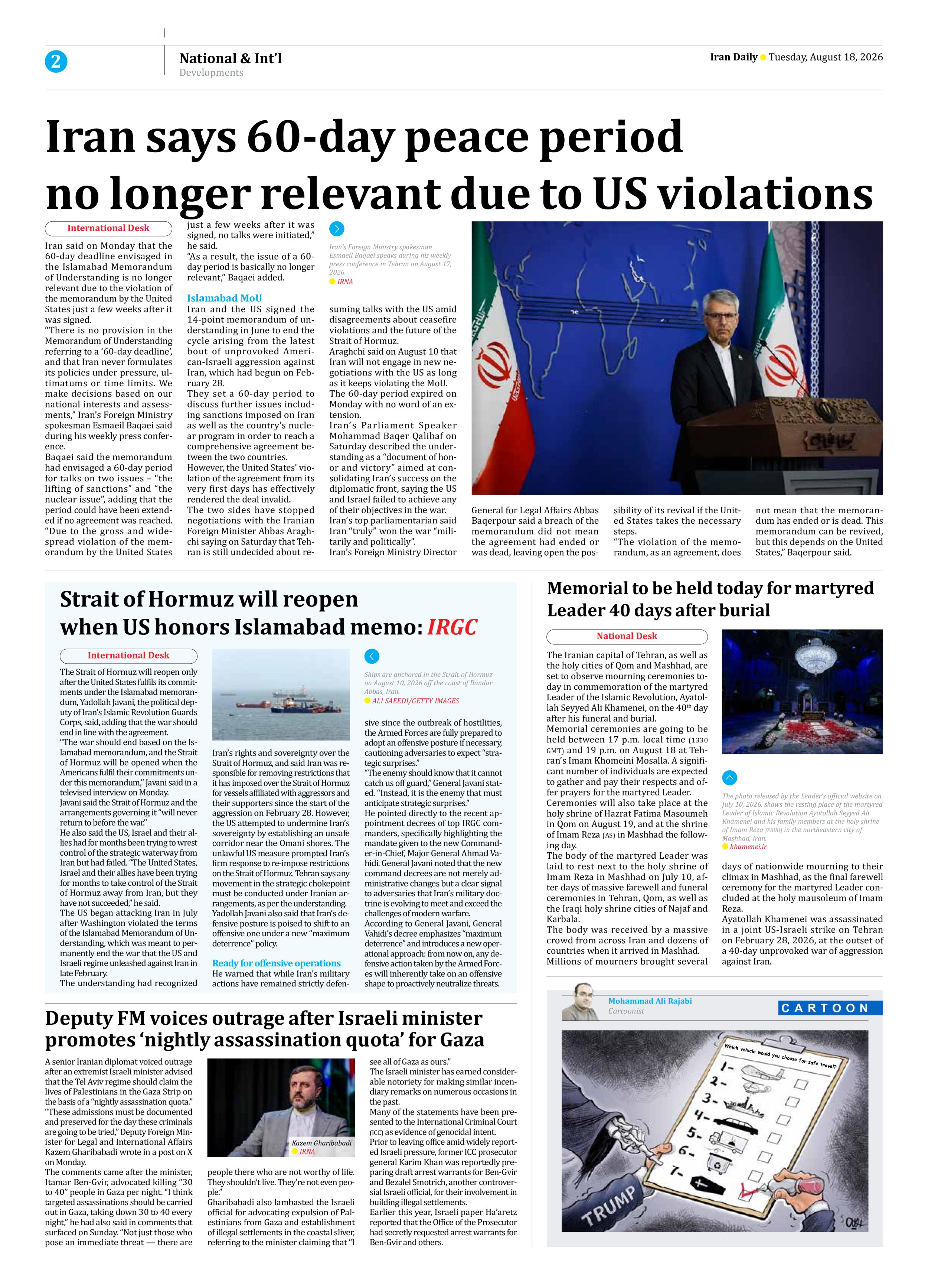


Strait of Hormuz will reopen when US honors Islamabad memo: IRGC
The Strait of Hormuz will reopen only after the United States fulfils its commitments under the Islamabad memorandum, Yadollah Javani, the political deputy of Iran’s Islamic Revolution Guards Corps, said, adding that the war should end in line with the agreement.
“The war should end based on the Islamabad memorandum, and the Strait of Hormuz will be opened when the Americans fulfil their commitments under this memorandum,” Javani said in a televised interview on Monday.
Javani said the Strait of Hormuz and the arrangements governing it “will never return to before the war.”
He also said the US, Israel and their allies had for months been trying to wrest control of the strategic waterway from Iran but had failed. “The United States, Israel and their allies have been trying for months to take control of the Strait of Hormuz away from Iran, but they have not succeeded,” he said.
The US began attacking Iran in July after Washington violated the terms of the Islamabad Memorandum of Understanding, which was meant to permanently end the war that the US and Israeli regime unleashed against Iran in late February.
The understanding had recognized Iran’s rights and sovereignty over the Strait of Hormuz, and said Iran was responsible for removing restrictions that it has imposed over the Strait of Hormuz for vessels affiliated with aggressors and their supporters since the start of the aggression on February 28. However, the US attempted to undermine Iran’s sovereignty by establishing an unsafe corridor near the Omani shores. The unlawful US measure prompted Iran’s firm response to re-impose restrictions on the Strait of Hormuz. Tehran says any movement in the strategic chokepoint must be conducted under Iranian arrangements, as per the understanding.
Yadollah Javani also said that Iran’s defensive posture is poised to shift to an offensive one under a new “maximum deterrence” policy.
Ready for offensive operations
He warned that while Iran’s military actions have remained strictly defensive since the outbreak of hostilities, the Armed Forces are fully prepared to adopt an offensive posture if necessary, cautioning adversaries to expect “strategic surprises.”
“The enemy should know that it cannot catch us off guard,” General Javani stated. “Instead, it is the enemy that must anticipate strategic surprises."
He pointed directly to the recent appointment decrees of top IRGC commanders, specifically highlighting the mandate given to the new Commander-in-Chief, Major General Ahmad Vahidi. General Javani noted that the new command decrees are not merely administrative changes but a clear signal to adversaries that Iran’s military doctrine is evolving to meet and exceed the challenges of modern warfare.
According to General Javani, General Vahidi’s decree emphasizes “maximum deterrence” and introduces a new operational approach: from now on, any defensive action taken by the Armed Forces will inherently take on an offensive shape to proactively neutralize threats.