







My cultural activities are tribute to Iran’s culture: South Korean ambassador
By Sadeq Dehqan
Staff writer
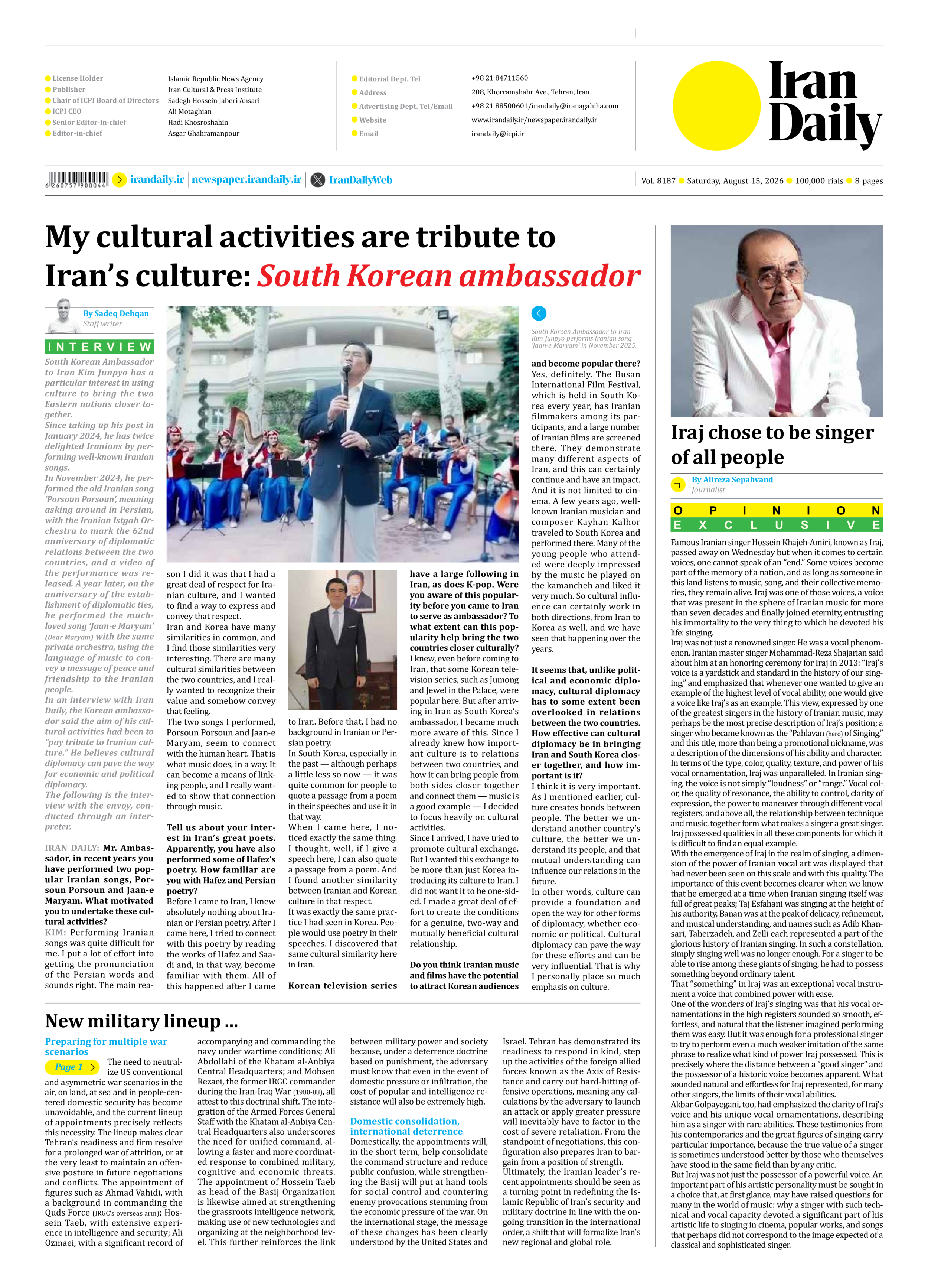
South Korean Ambassador to Iran Kim Junpyo has a particular interest in using culture to bring the two Eastern nations closer together.
Since taking up his post in January 2024, he has twice delighted Iranians by performing well-known Iranian songs.
In November 2024, he performed the old Iranian song ‘Porsoun Porsoun’, meaning asking around in Persian, with the Iranian Istgah Orchestra to mark the 62nd anniversary of diplomatic relations between the two countries, and a video of the performance was released. A year later, on the anniversary of the establishment of diplomatic ties, he performed the much-loved song ‘Jaan-e Maryam’ (Dear Maryam) with the same private orchestra, using the language of music to convey a message of peace and friendship to the Iranian people.
In an interview with Iran Daily, the Korean ambassador said the aim of his cultural activities had been to “pay tribute to Iranian culture.” He believes cultural diplomacy can pave the way for economic and political diplomacy.
The following is the interview with the envoy, conducted through an interpreter.
IRAN DAILY: Mr. Ambassador, in recent years you have performed two popular Iranian songs, Porsoun Porsoun and Jaan-e Maryam. What motivated you to undertake these cultural activities?
KIM: Performing Iranian songs was quite difficult for me. I put a lot of effort into getting the pronunciation of the Persian words and sounds right. The main reason I did it was that I had a great deal of respect for Iranian culture, and I wanted to find a way to express and convey that respect.
Iran and Korea have many similarities in common, and I find those similarities very interesting. There are many cultural similarities between the two countries, and I really wanted to recognize their value and somehow convey that feeling.
The two songs I performed, Porsoun Porsoun and Jaan-e Maryam, seem to connect with the human heart. That is what music does, in a way. It can become a means of linking people, and I really wanted to show that connection through music.
Tell us about your interest in Iran’s great poets. Apparently, you have also performed some of Hafez’s poetry. How familiar are you with Hafez and Persian poetry?
Before I came to Iran, I knew absolutely nothing about Iranian or Persian poetry. After I came here, I tried to connect with this poetry by reading the works of Hafez and Saadi and, in that way, become familiar with them. All of this happened after I came to Iran. Before that, I had no background in Iranian or Persian poetry.
In South Korea, especially in the past — although perhaps a little less so now — it was quite common for people to quote a passage from a poem in their speeches and use it in that way.
When I came here, I noticed exactly the same thing. I thought, well, if I give a speech here, I can also quote a passage from a poem. And I found another similarity between Iranian and Korean culture in that respect.
It was exactly the same practice I had seen in Korea. People would use poetry in their speeches. I discovered that same cultural similarity here in Iran.
Korean television series have a large following in Iran, as does K-pop. Were you aware of this popularity before you came to Iran to serve as ambassador? To what extent can this popularity help bring the two countries closer culturally?
I knew, even before coming to Iran, that some Korean television series, such as Jumong and Jewel in the Palace, were popular here. But after arriving in Iran as South Korea’s ambassador, I became much more aware of this. Since I already knew how important culture is to relations between two countries, and how it can bring people from both sides closer together and connect them — music is a good example — I decided to focus heavily on cultural activities.
Since I arrived, I have tried to promote cultural exchange. But I wanted this exchange to be more than just Korea introducing its culture to Iran. I did not want it to be one-sided. I made a great deal of effort to create the conditions for a genuine, two-way and mutually beneficial cultural relationship.
Do you think Iranian music and films have the potential to attract Korean audiences and become popular there?
Yes, definitely. The Busan International Film Festival, which is held in South Korea every year, has Iranian filmmakers among its participants, and a large number of Iranian films are screened there. They demonstrate many different aspects of Iran, and this can certainly continue and have an impact.
And it is not limited to cinema. A few years ago, well-known Iranian musician and composer Kayhan Kalhor traveled to South Korea and performed there. Many of the young people who attended were deeply impressed by the music he played on the kamancheh and liked it very much. So cultural influence can certainly work in both directions, from Iran to Korea as well, and we have seen that happening over the years.
It seems that, unlike political and economic diplomacy, cultural diplomacy has to some extent been overlooked in relations between the two countries. How effective can cultural diplomacy be in bringing Iran and South Korea closer together, and how important is it?
I think it is very important. As I mentioned earlier, culture creates bonds between people. The better we understand another country’s culture, the better we understand its people, and that mutual understanding can influence our relations in the future.
In other words, culture can provide a foundation and open the way for other forms of diplomacy, whether economic or political. Cultural diplomacy can pave the way for these efforts and can be very influential. That is why I personally place so much emphasis on culture.