







Cockroaches rising
How India’s youth forced a union minister to resign
By Annunthra Rangan
Senior research officer at Chennai Centre for China Studies
When the Cockroach Janta Party (CJP), a youth-led movement, called off its sit-in in the Indian capital in late July, one of its members offered a wry aside to a reporter: young Indians had power, but no organised party built to carry it forward. It was a telling choice of words because CJP itself has never been a political party in any formal sense. It is not registered with India’s Election Commission, fields no candidates and describes itself as a satirical movement rather than an electoral vehicle.
That single aside, though, captures the entire arc of the summer of 2026, a season in which a satirical Instagram page grew into the most serious challenge Modi’s government has faced in years, forced a sitting union minister out of office and still left analysts wondering whether India was about to become “the next Sri Lanka” or “the next Nepal”. It did not. It will not. But it came close enough to worry people who make a living tracking these things, left behind a movement and a set of grievances that have not gone away.
The spark was bureaucratic before it was political. In May 2026, the National Testing Agency (NTA) conducted NEET-UG, the entrance examination that decides admission to medical colleges for roughly two million aspiring doctors a year, in India. Within days, allegations surfaced that the question paper had been compromised. The government cancelled the exam and ordered a re-test for June 21, launching a CBI investigation into the leak.
What followed was not just an administrative scandal but a human one. In the weeks between the cancellation and the re-test, reports emerged of NEET aspirants dying by suicide across the country, from Ahmedabad to Rajasthan to Uttar Pradesh. It was reported at least 11 such deaths happened in the 46-day window; later reports put the toll at 13. These were not abstract statistics. They were teenagers who had spent years and families who had spent their savings, preparing for a single exam, only to watch the rug pulled out from under them through no fault of their own.
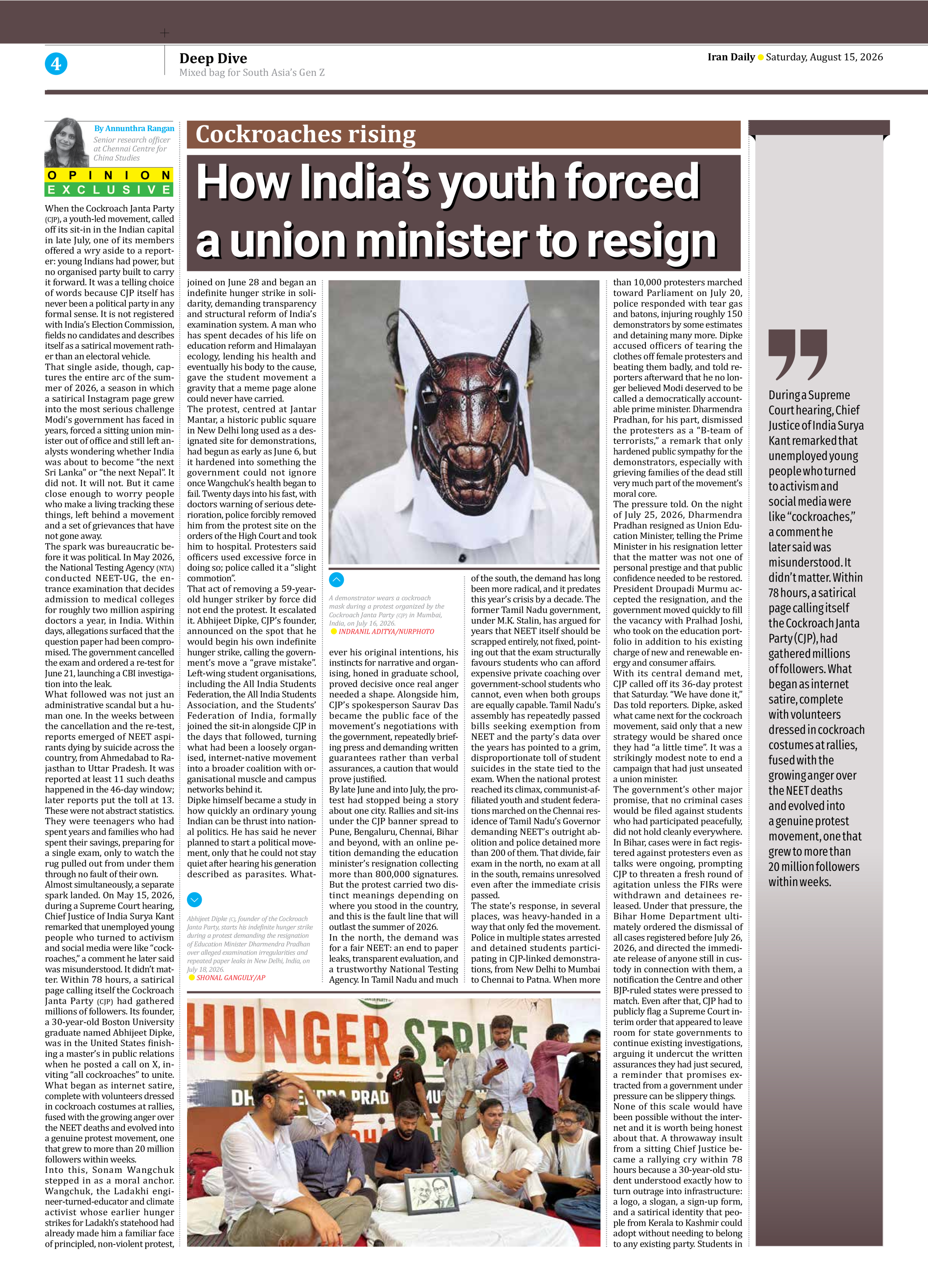
Almost simultaneously, a separate spark landed. On May 15, 2026, during a Supreme Court hearing, Chief Justice of India Surya Kant remarked that unemployed young people who turned to activism and social media were like “cockroaches,” a comment he later said was misunderstood. It didn’t matter. Within 78 hours, a satirical page calling itself the Cockroach Janta Party (CJP) had gathered millions of followers. Its founder, a 30-year-old Boston University graduate named Abhijeet Dipke, was in the United States finishing a master’s in public relations when he posted a call on X, inviting “all cockroaches” to unite. What began as internet satire, complete with volunteers dressed in cockroach costumes at rallies, fused with the growing anger over the NEET deaths and evolved into a genuine protest movement, one that grew to more than 20 million followers within weeks.
Into this, Sonam Wangchuk stepped in as a moral anchor. Wangchuk, the Ladakhi engineer-turned-educator and climate activist whose earlier hunger strikes for Ladakh’s statehood had already made him a familiar face of principled, non-violent protest, joined on June 28 and began an indefinite hunger strike in solidarity, demanding transparency and structural reform of India’s examination system. A man who has spent decades of his life on education reform and Himalayan ecology, lending his health and eventually his body to the cause, gave the student movement a gravity that a meme page alone could never have carried.
The protest, centred at Jantar Mantar, a historic public square in New Delhi long used as a designated site for demonstrations, had begun as early as June 6, but it hardened into something the government could not ignore once Wangchuk’s health began to fail. Twenty days into his fast, with doctors warning of serious deterioration, police forcibly removed him from the protest site on the orders of the High Court and took him to hospital. Protesters said officers used excessive force in doing so; police called it a “slight commotion”.
That act of removing a 59-year-old hunger striker by force did not end the protest. It escalated it. Abhijeet Dipke, CJP’s founder, announced on the spot that he would begin his own indefinite hunger strike, calling the government’s move a “grave mistake”. Left-wing student organisations, including the All India Students Federation, the All India Students Association, and the Students’ Federation of India, formally joined the sit-in alongside CJP in the days that followed, turning what had been a loosely organised, internet-native movement into a broader coalition with organisational muscle and campus networks behind it.
Dipke himself became a study in how quickly an ordinary young Indian can be thrust into national politics. He has said he never planned to start a political movement, only that he could not stay quiet after hearing his generation described as parasites. Whatever his original intentions, his instincts for narrative and organising, honed in graduate school, proved decisive once real anger needed a shape. Alongside him, CJP’s spokesperson Saurav Das became the public face of the movement’s negotiations with the government, repeatedly briefing press and demanding written guarantees rather than verbal assurances, a caution that would prove justified.
By late June and into July, the protest had stopped being a story about one city. Rallies and sit-ins under the CJP banner spread to Pune, Bengaluru, Chennai, Bihar and beyond, with an online petition demanding the education minister’s resignation collecting more than 800,000 signatures. But the protest carried two distinct meanings depending on where you stood in the country, and this is the fault line that will outlast the summer of 2026.
In the north, the demand was for a fair NEET: an end to paper leaks, transparent evaluation, and a trustworthy National Testing Agency. In Tamil Nadu and much of the south, the demand has long been more radical, and it predates this year’s crisis by a decade. The former Tamil Nadu government, under M.K. Stalin, has argued for years that NEET itself should be scrapped entirely, not fixed, pointing out that the exam structurally favours students who can afford expensive private coaching over government-school students who cannot, even when both groups are equally capable. Tamil Nadu’s assembly has repeatedly passed bills seeking exemption from NEET and the party’s data over the years has pointed to a grim, disproportionate toll of student suicides in the state tied to the exam. When the national protest reached its climax, communist-affiliated youth and student federations marched on the Chennai residence of Tamil Nadu’s Governor demanding NEET’s outright abolition and police detained more than 200 of them. That divide, fair exam in the north, no exam at all in the south, remains unresolved even after the immediate crisis passed.
The state’s response, in several places, was heavy-handed in a way that only fed the movement. Police in multiple states arrested and detained students participating in CJP-linked demonstrations, from New Delhi to Mumbai to Chennai to Patna. When more than 10,000 protesters marched toward Parliament on July 20, police responded with tear gas and batons, injuring roughly 150 demonstrators by some estimates and detaining many more. Dipke accused officers of tearing the clothes off female protesters and beating them badly, and told reporters afterward that he no longer believed Modi deserved to be called a democratically accountable prime minister. Dharmendra Pradhan, for his part, dismissed the protesters as a “B-team of terrorists,” a remark that only hardened public sympathy for the demonstrators, especially with grieving families of the dead still very much part of the movement’s moral core.
The pressure told. On the night of July 25, 2026, Dharmendra Pradhan resigned as Union Education Minister, telling the Prime Minister in his resignation letter that the matter was not one of personal prestige and that public confidence needed to be restored. President Droupadi Murmu accepted the resignation, and the government moved quickly to fill the vacancy with Pralhad Joshi, who took on the education portfolio in addition to his existing charge of new and renewable energy and consumer affairs.
With its central demand met, CJP called off its 36-day protest that Saturday. “We have done it,” Das told reporters. Dipke, asked what came next for the cockroach movement, said only that a new strategy would be shared once they had “a little time”. It was a strikingly modest note to end a campaign that had just unseated a union minister.
The government’s other major promise, that no criminal cases would be filed against students who had participated peacefully, did not hold cleanly everywhere. In Bihar, cases were in fact registered against protesters even as talks were ongoing, prompting CJP to threaten a fresh round of agitation unless the FIRs were withdrawn and detainees released. Under that pressure, the Bihar Home Department ultimately ordered the dismissal of all cases registered before July 26, 2026, and directed the immediate release of anyone still in custody in connection with them, a notification the Centre and other BJP-ruled states were pressed to match. Even after that, CJP had to publicly flag a Supreme Court interim order that appeared to leave room for state governments to continue existing investigations, arguing it undercut the written assurances they had just secured, a reminder that promises extracted from a government under pressure can be slippery things.
None of this scale would have been possible without the internet and it is worth being honest about that. A throwaway insult from a sitting Chief Justice became a rallying cry within 78 hours because a 30-year-old student understood exactly how to turn outrage into infrastructure: a logo, a slogan, a sign-up form, and a satirical identity that people from Kerala to Kashmir could adopt without needing to belong to any existing party. Students in
Gadchiroli who could never make it to a rally in the capital still said they felt heard because the protest’s grievances were being aired constantly, visibly and shareably online. Millions of followers translated into hundreds of thousands of petition signatures, and petition signatures translated into a political cost the government eventually could not ignore. Whatever else this movement was, it was a case study in how quickly a meme can become a mandate.
Pralhad Joshi now holds the education portfolio, inheriting a system whose credibility Indian students, north and south, have publicly and loudly said they no longer trust. The north’s demand for a clean, computer-based, leak-proof NEET remains the more moderate task on the table and reports suggest the ministry is looking at shifting the exam to a computer-based format by 2027 alongside new anti-paper-leak legislation. Tamil Nadu’s demand to abolish the exam altogether has not gone anywhere and shows no sign of doing so.
Foreign policy analysts who spent July drawing comparisons to the uprisings that toppled governments in Nepal, Bangladesh and Sri Lanka have mostly walked those comparisons back. The Council on Foreign Relations, among others, has argued that a more useful precedent is India’s own protest wave of the mid-1970s, which shook Indira Gandhi’s government without unseating it outright. The reasons this movement stopped short of that kind of rupture are not flattering to India’s youth, but they are honest ones: the Cockroach Janta Party’s demands stayed narrowly focused on education policy rather than broadening into a full-throated challenge to the government itself and the numbers on the street, while historic for this kind of single-issue protest, never approached the scale of India’s 2011 anti-corruption movement or the 2012 protests against sexual violence. There is also a harder political truth sitting underneath all of it: even young Indians who forced a Cabinet minister out of office have nowhere obvious to direct that energy come election time because India currently lacks an opposition strong enough to convert street anger into a governing alternative. Power was there. It just did not, in the end, find a full outlet.
India was not the only country in the region living through this in 2026. While the Cockroach Janta Party was still camped in New Delhi in mid-July, Bangladesh was going through an eerily similar reckoning of its own. Hundreds of Higher Secondary Certificate examinees blocked intersections across Dhaka and more than a dozen other districts, demanding the resignation of Education Minister A.N.M. Ehsanul Hoque Milon after his ministry refused to postpone exam papers despite severe flooding that left some students wading through water or travelling by boat to reach test centres. Anger boiled over further when an audio clip surfaced of Milon dismissing anxious parents by comparing their children to “farm chickens” who catch cold in a little rain, a remark that quickly became the protest’s rallying cry, with students chanting back that they were “not farm chickens” but the country’s future. One HSC candidate, invoking the uprising that toppled Sheikh Hasina’s government in 2024, warned the minister he was about to find out exactly what “broiler chickens” could do.
The two movements were not, strictly speaking, a case of one directly inspiring the other; they unfolded almost in parallel, only weeks apart and Bangladesh’s protesters were drawing more on their own country’s 2024 uprising than on events in India. But regional commentators, in Dhaka and elsewhere, were quick to read both as symptoms of the same underlying condition: a generation across South Asia, in India, Bangladesh and Nepal alike, that no longer trusts its examination systems, its job markets, or the adults running either and that has shown it can turn a single administrative failure into a national reckoning almost overnight. Bangladesh’s students eventually traded their demand for the minister’s resignation for a six-point reform charter once the government announced relief measures, but the message both governments received was the same: this generation is watching each other, organising fast, and no longer inclined to stay quiet.
What India’s summer of 2026 did find, in the end, was a name, a face and a slogan that a Chief Justice never intended to hand a generation: cockroaches don’t get employment, they don’t get a place in the profession, and, as it turns out, they don’t quietly go away either.