







Gov’t seeks to ease pressure on southern ports by expanding land trade routes
Iran's government is prioritizing the expansion of land border crossings and diversification of trade gateways across the country to ease pressure on southern ports, a government official said on Monday.
Hananeh Darashti, a senior official with the Presidential Strategic Department, said President Masoud Pezeshkian had placed particular emphasis on opening up border crossings.
“The president has strongly emphasized removing existing obstacles at the borders,” she said, according to IRNA.
“The overarching policy of this office is to promote the country’s logistics capabilities and move beyond the concentration of activity at southern ports, so that fully activating border crossings can unlock the potential of land-based trade.”
Iran faces renewed restrictions on maritime routes. Southern ports remain under a US naval blockade imposed by President Donald Trump in mid-April, aimed at pressuring Tehran into an agreement after a 40-day US-Israeli war that began in late February. After a pause of several weeks, the naval blockade was reinstated in mid-July. Iran is seeking to diversify its logistics corridors to counter growing restrictions on its trade routes.
Iran shares land borders with several countries, providing opportunities to diversify its foreign trade routes. Turkey, Iraq, Azerbaijan, Armenia, Turkmenistan, Afghanistan and Pakistan are among the countries that can play a role in developing Iran's land-based trade and transit.
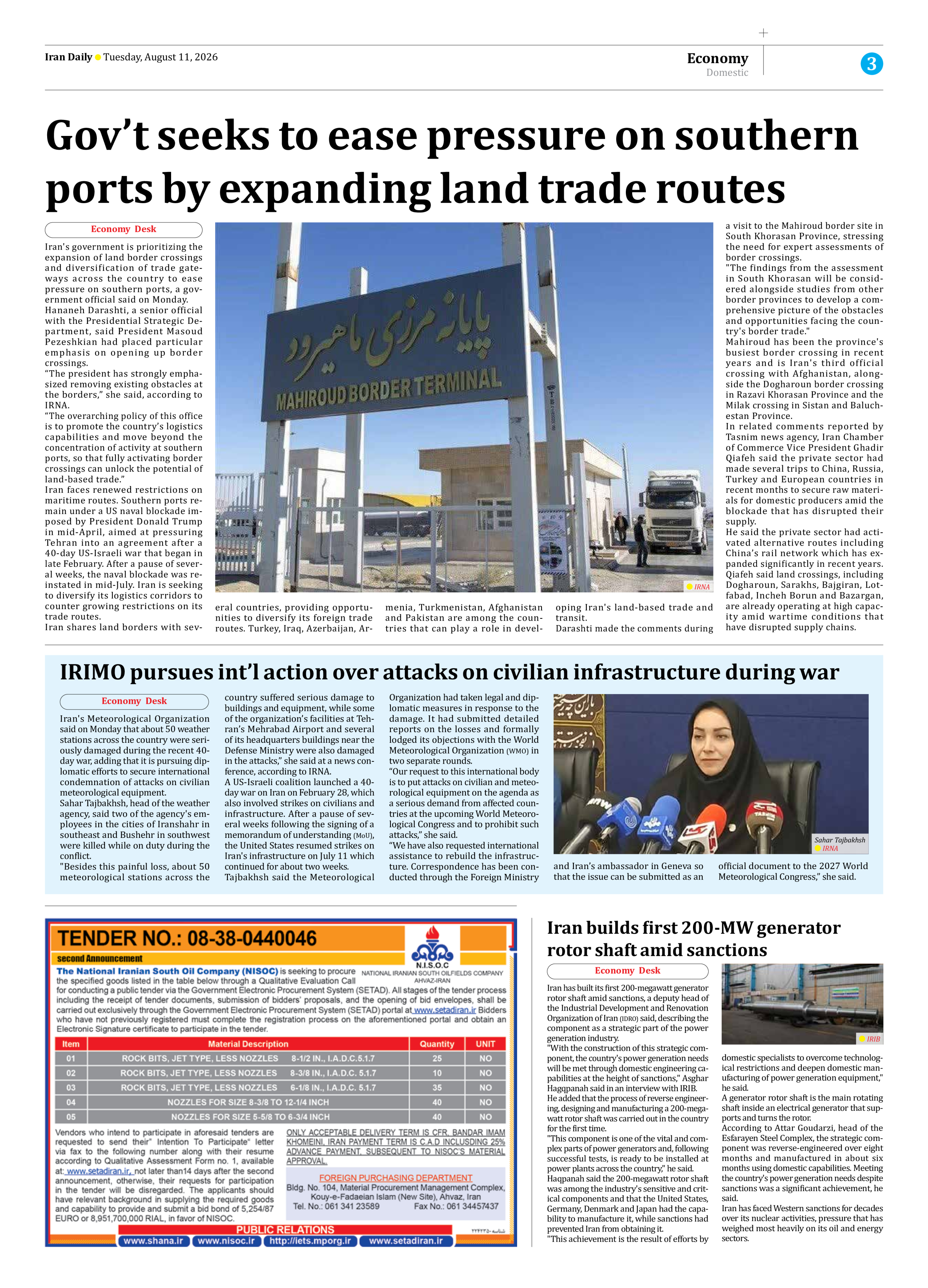
Darashti made the comments during a visit to the Mahiroud border site in South Khorasan Province, stressing the need for expert assessments of border crossings.
"The findings from the assessment in South Khorasan will be considered alongside studies from other border provinces to develop a comprehensive picture of the obstacles and opportunities facing the country's border trade."
Mahiroud has been the province's busiest border crossing in recent years and is Iran's third official crossing with Afghanistan, alongside the Dogharoun border crossing in Razavi Khorasan Province and the Milak crossing in Sistan and Baluchestan Province.
In related comments reported by Tasnim news agency, Iran Chamber of Commerce Vice President Ghadir Qiafeh said the private sector had made several trips to China, Russia, Turkey and European countries in recent months to secure raw materials for domestic producers amid the blockade that has disrupted their supply.
He said the private sector had activated alternative routes including China’s rail network which has expanded significantly in recent years.
Qiafeh said land crossings, including Dogharoun, Sarakhs, Bajgiran, Lotfabad, Incheh Borun and Bazargan, are already operating at high capacity amid wartime conditions that have disrupted supply chains.