





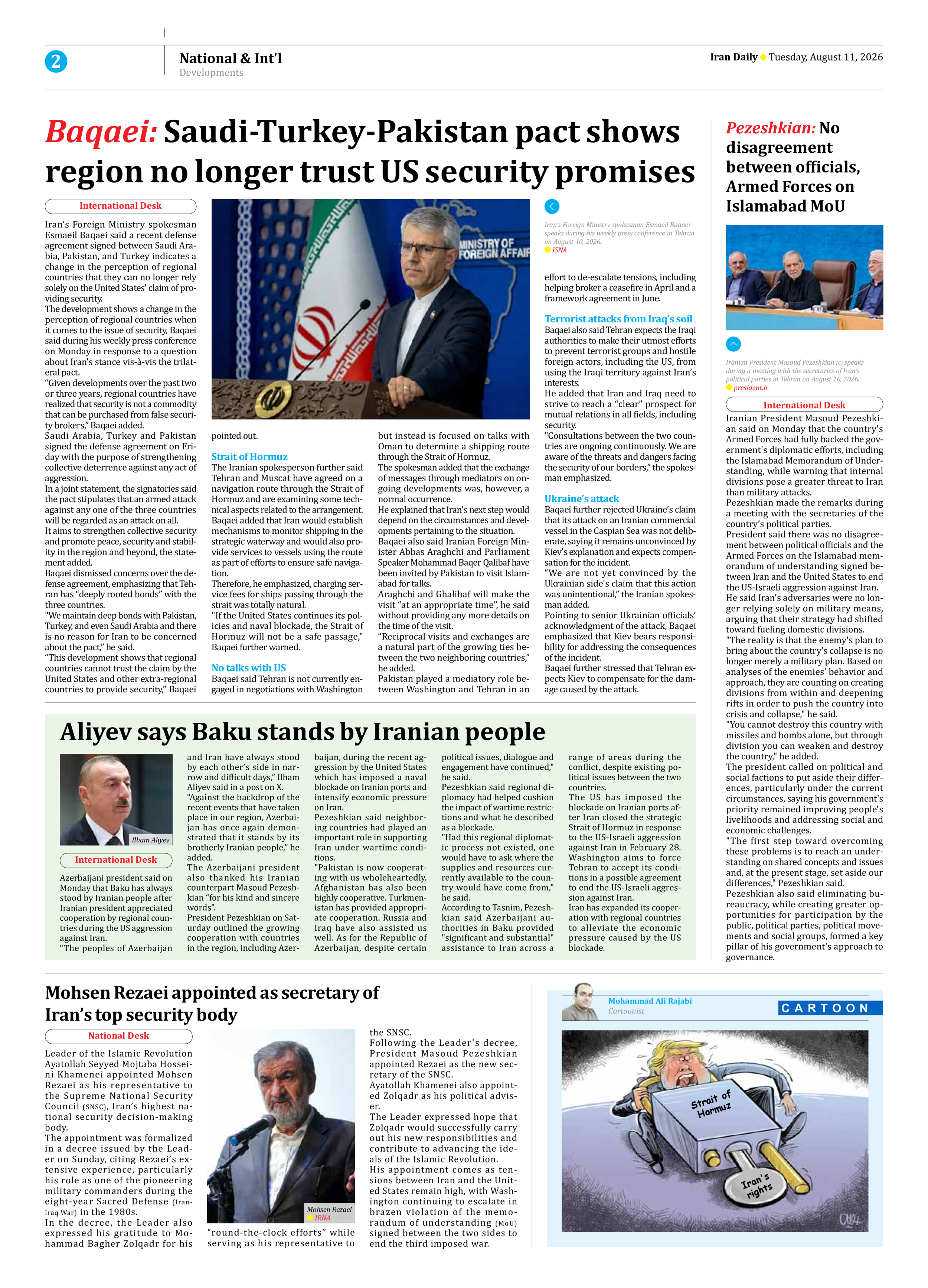


Baqaei: Saudi-Turkey-Pakistan pact shows region no longer trust US security promises
Iran’s Foreign Ministry spokesman Esmaeil Baqaei said a recent defense agreement signed between Saudi Arabia, Pakistan, and Turkey indicates a change in the perception of regional countries that they can no longer rely solely on the United States' claim of providing security.
The development shows a change in the perception of regional countries when it comes to the issue of security, Baqaei said during his weekly press conference on Monday in response to a question about Iran’s stance vis-à-vis the trilateral pact.
“Given developments over the past two or three years, regional countries have realized that security is not a commodity that can be purchased from false security brokers,” Baqaei added.
Saudi Arabia, Turkey and Pakistan signed the defense agreement on Friday with the purpose of strengthening collective deterrence against any act of aggression.
In a joint statement, the signatories said the pact stipulates that an armed attack against any one of the three countries will be regarded as an attack on all.
It aims to strengthen collective security and promote peace, security and stability in the region and beyond, the statement added.
Baqaei dismissed concerns over the defense agreement, emphasizing that Tehran has “deeply rooted bonds” with the three countries.
"We maintain deep bonds with Pakistan, Turkey, and even Saudi Arabia and there is no reason for Iran to be concerned about the pact,” he said.
“This development shows that regional countries cannot trust the claim by the United States and other extra-regional countries to provide security,” Baqaei pointed out.
Strait of Hormuz
The Iranian spokesperson further said Tehran and Muscat have agreed on a navigation route through the Strait of Hormuz and are examining some technical aspects related to the arrangement.
Baqaei added that Iran would establish mechanisms to monitor shipping in the strategic waterway and would also provide services to vessels using the route as part of efforts to ensure safe navigation.
Therefore, he emphasized, charging service fees for ships passing through the strait was totally natural.
"If the United States continues its policies and naval blockade, the Strait of Hormuz will not be a safe passage," Baqaei further warned.
No talks with US
Baqaei said Tehran is not currently engaged in negotiations with Washington but instead is focused on talks with Oman to determine a shipping route through the Strait of Hormuz.
The spokesman added that the exchange of messages through mediators on ongoing developments was, however, a normal occurrence.
He explained that Iran’s next step would depend on the circumstances and developments pertaining to the situation.
Baqaei also said Iranian Foreign Minister Abbas Araghchi and Parliament Speaker Mohammad Baqer Qalibaf have been invited by Pakistan to visit Islamabad for talks.
Araghchi and Ghalibaf will make the visit “at an appropriate time”, he said without providing any more details on the time of the visit.
“Reciprocal visits and exchanges are a natural part of the growing ties between the two neighboring countries,” he added.
Pakistan played a mediatory role between Washington and Tehran in an effort to de-escalate tensions, including helping broker a ceasefire in April and a framework agreement in June.
Terrorist attacks from Iraq’s soil
Baqaei also said Tehran expects the Iraqi authorities to make their utmost efforts to prevent terrorist groups and hostile foreign actors, including the US, from using the Iraqi territory against Iran’s interests.
He added that Iran and Iraq need to strive to reach a “clear” prospect for mutual relations in all fields, including security.
"Consultations between the two countries are ongoing continuously. We are aware of the threats and dangers facing the security of our borders,” the spokesman emphasized.
Ukraine’s attack
Baqaei further rejected Ukraine’s claim that its attack on an Iranian commercial vessel in the Caspian Sea was not deliberate, saying it remains unconvinced by Kiev’s explanation and expects compensation for the incident.
“We are not yet convinced by the Ukrainian side's claim that this action was unintentional,” the Iranian spokesman added.
Pointing to senior Ukrainian officials’ acknowledgment of the attack, Baqaei emphasized that Kiev bears responsibility for addressing the consequences of the incident.
Baqaei further stressed that Tehran expects Kiev to compensate for the damage caused by the attack.