





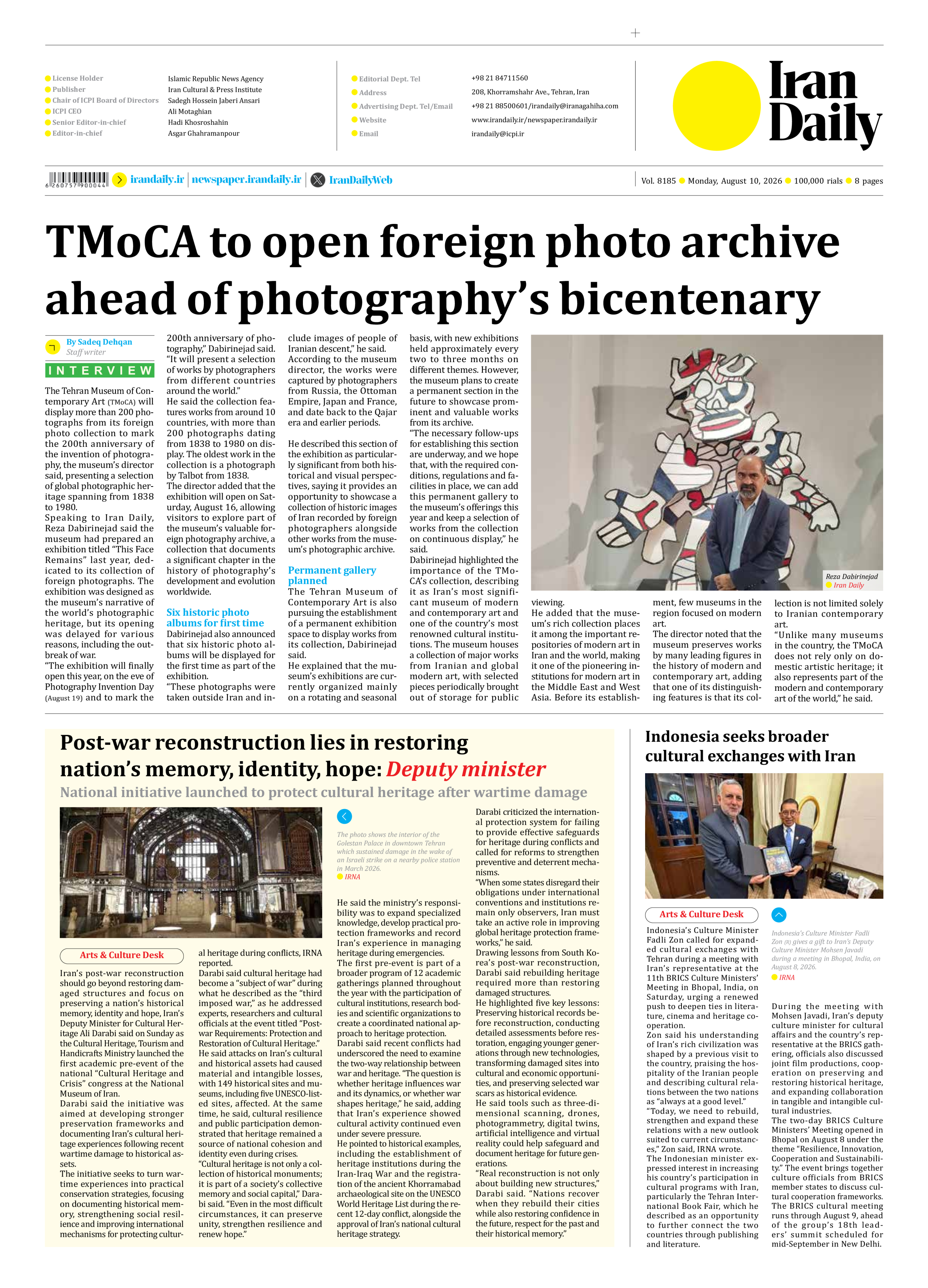


Post-war reconstruction lies in restoring nation’s memory, identity, hope: Deputy minister
National initiative launched to protect cultural heritage after wartime damage
Iran’s post-war reconstruction should go beyond restoring damaged structures and focus on preserving a nation’s historical memory, identity and hope, Iran’s Deputy Minister for Cultural Heritage Ali Darabi said on Sunday as the Cultural Heritage, Tourism and Handicrafts Ministry launched the first academic pre-event of the national “Cultural Heritage and Crisis” congress at the National Museum of Iran.
Darabi said the initiative was aimed at developing stronger preservation frameworks and documenting Iran’s cultural heritage experiences following recent wartime damage to historical assets.
The initiative seeks to turn wartime experiences into practical conservation strategies, focusing on documenting historical memory, strengthening social resilience and improving international mechanisms for protecting cultural heritage during conflicts, IRNA reported.
Darabi said cultural heritage had become a “subject of war” during what he described as the “third imposed war,” as he addressed experts, researchers and cultural officials at the event titled “Post-war Requirements: Protection and Restoration of Cultural Heritage.”
He said attacks on Iran’s cultural and historical assets had caused material and intangible losses, with 149 historical sites and museums, including five UNESCO-listed sites, affected. At the same time, he said, cultural resilience and public participation demonstrated that heritage remained a source of national cohesion and identity even during crises.
“Cultural heritage is not only a collection of historical monuments; it is part of a society’s collective memory and social capital,” Darabi said. “Even in the most difficult circumstances, it can preserve unity, strengthen resilience and renew hope.”
He said the ministry’s responsibility was to expand specialized knowledge, develop practical protection frameworks and record Iran’s experience in managing heritage during emergencies.
The first pre-event is part of a broader program of 12 academic gatherings planned throughout the year with the participation of cultural institutions, research bodies and scientific organizations to create a coordinated national approach to heritage protection.
Darabi said recent conflicts had underscored the need to examine the two-way relationship between war and heritage. “The question is whether heritage influences war and its dynamics, or whether war shapes heritage,” he said, adding that Iran’s experience showed cultural activity continued even under severe pressure.
He pointed to historical examples, including the establishment of heritage institutions during the Iran-Iraq War and the registration of the ancient Khorramabad archaeological site on the UNESCO World Heritage List during the recent 12-day conflict, alongside the approval of Iran’s national cultural heritage strategy.
Darabi criticized the international protection system for failing to provide effective safeguards for heritage during conflicts and called for reforms to strengthen preventive and deterrent mechanisms.
“When some states disregard their obligations under international conventions and institutions remain only observers, Iran must take an active role in improving global heritage protection frameworks,” he said.
Drawing lessons from South Korea’s post-war reconstruction, Darabi said rebuilding heritage required more than restoring damaged structures.
He highlighted five key lessons: Preserving historical records before reconstruction, conducting detailed assessments before restoration, engaging younger generations through new technologies, transforming damaged sites into cultural and economic opportunities, and preserving selected war scars as historical evidence.
He said tools such as three-dimensional scanning, drones, photogrammetry, digital twins, artificial intelligence and virtual reality could help safeguard and document heritage for future generations.
“Real reconstruction is not only about building new structures,” Darabi said. “Nations recover when they rebuild their cities while also restoring confidence in the future, respect for the past and their historical memory.”