







US geopolitical doctrine under spotlight in Central Asia, Caucasus
Researcher in regional studies
Developments in the Caucasus and Central Asia since 2025 should not be viewed merely as a collection of bilateral agreements, transit initiatives, or isolated economic projects. Taken together, recent US activities in these regions including mediation in political settlements, support for strategic transport corridors, expanded cooperation in critical minerals, security partnerships, and technological collaboration suggest a relatively coherent strategic logic. Accordingly, this article employs the concept of the “Trump Route Doctrine” as an analytical framework for interpreting these developments.
In strategic studies, a doctrine is more than a series of individual policies or ad hoc decisions. Rather, it is a coherent framework composed of strategic objectives, operational principles, and policy instruments that collectively guide a state’s behavior in a particular geopolitical arena. From this perspective, the pattern of US engagement in the Caucasus and Central Asia under the Trump administration can be interpreted as exhibiting the characteristics of a doctrine. Its principal objective appears to be the geopolitical and geoeconomic reconfiguration of Eurasia in favor of the United States by reducing its partners’ dependence on Chinese and Russian infrastructure while establishing a network of security and economic partnerships along the Middle Corridor.
The instruments of this doctrine extend well beyond military power. Political mediation, security guarantees, the development of transit corridors, investment in strategic mineral resources, the participation of major American corporations, technological cooperation with Israel, and the establishment of multilateral frameworks such as C5+1 and TRIPP constitute complementary components of a broader strategic approach. From this standpoint, the Trump Route should not be understood simply as a transportation corridor or an infrastructure initiative; rather, it can be viewed as an attempt to shape a new geopolitical order across Eurasia.
At the same time, it is important to distinguish between established facts and analytical interpretation. It is a matter of record that, since early 2025, the United States has expanded its political, economic, and security engagement in the Caucasus and Central Asia while concluding a series of new agreements with regional actors. However, the proposition that all of these initiatives constitute elements of a single, pre-designed doctrine is an analytical interpretation rather than an officially declared US strategy. Throughout this article, therefore, the term “Trump Route Doctrine” is used as an analytical concept designed to explain an emerging pattern of US behavior, not as the title of an official policy document.
The Caucasus: starting point of a geopolitical reconfiguration
The earliest indications of this emerging strategic pattern can be observed in the Caucasus. Although relations between Azerbaijan and Israel date back more than three decades, they gradually evolved from cultural and academic exchanges in the mid-1990s into broader cooperation encompassing security, energy, and technology. Over time, intelligence collaboration, defense procurement, and energy exports transformed the bilateral relationship into one of Israel’s most significant strategic partnerships within the Muslim world.
Cooperation in the educational and cultural sectors also expanded steadily. The university cooperation agreements signed in 2025 should be understood as the continuation of a process that had begun years earlier rather than as an isolated development. This evolution suggests that relations between Baku and Tel Aviv have been shaped by a long-term process of strategic convergence across multiple sectors rather than by short-term political decisions.
Economic indicators further reinforce this assessment. The expansion of bilateral trade, growing cooperation in the energy sector, and increasing export volumes demonstrate that the relationship has progressively developed into a multidimensional economic and security partnership. This evolution created favorable conditions for a more active US role in the geopolitical dynamics of the Caucasus — a role that entered a new phase beginning in 2025.
A major turning point can be identified in the Trump administration’s approach to the region. Unlike previous periods, during which US foreign policy largely prioritized the Middle East or East Asia, the Trump administration sought to position the Caucasus as one of the principal arenas of strategic competition with China and Russia. This shift in priorities laid the foundation for a series of political, security, and economic initiatives that will be examined in the following sections.
One of the central components of this analytical framework is the Zangezur Corridor. At first glance, the corridor appears to be nothing more than a transportation project intended to connect mainland Azerbaijan with the Nakhchivan Autonomous Republic through Armenian territory. From a geopolitical perspective, however, its significance extends well beyond transportation. The corridor has the potential to strengthen the Middle Corridor by facilitating overland connectivity between Central Asia, the Caucasus, Turkey, and Europe. In doing so, it could reduce dependence on Russian territory and redirect a portion of East-West trade away from traditional transit routes.
From this perspective, the Zangezur Corridor can be understood as more than an infrastructure project; it represents a geopolitical instrument. If the corridor is consolidated under US political and security support, Washington would gain influence over one of Eurasia’s most important strategic chokepoints — a position that, over the past two decades, has been largely dominated by Russia and, increasingly, by China.
It should be emphasized, however, that no official US policy document has identified Zangezur as the cornerstone of an American strategic doctrine. The argument advanced in this article is therefore analytical rather than declaratory. The simultaneous expansion of US political, security, and economic engagement alongside its growing support for the corridor suggests the existence of a broader strategic logic linking these initiatives.
Trump Route: beyond a transportation corridor
Within this framework, the concept of the Trump Route is employed not as the name of an official government initiative but as an analytical construct. It refers to an interconnected network of transport corridors, political agreements, security arrangements, and economic initiatives that, if fully developed, could establish a new US-backed geopolitical architecture across Eurasia.
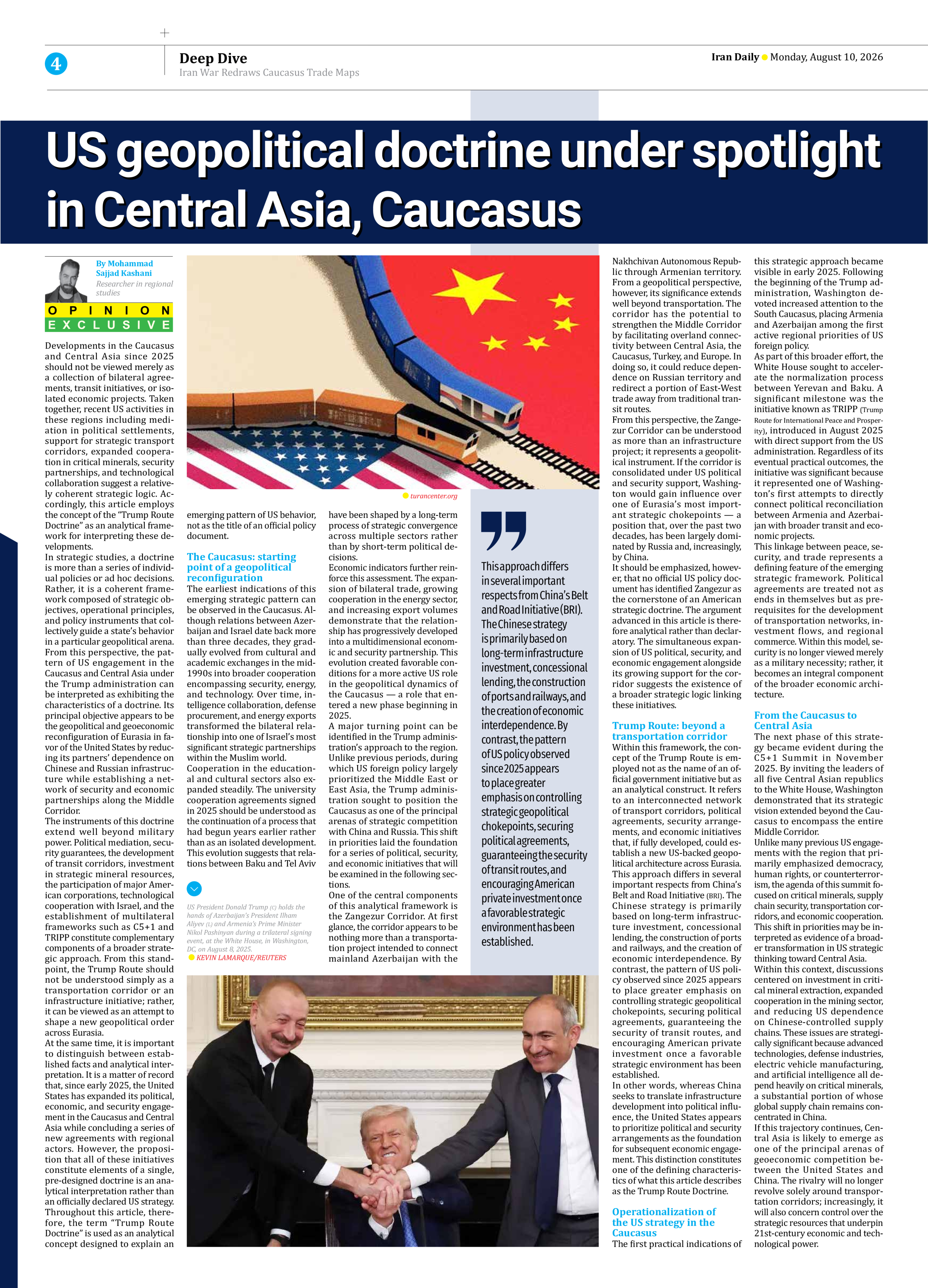
This approach differs in several important respects from China’s Belt and Road Initiative (BRI). The Chinese strategy is primarily based on long-term infrastructure investment, concessional lending, the construction of ports and railways, and the creation of economic interdependence. By contrast, the pattern of US policy observed since 2025 appears to place greater emphasis on controlling strategic geopolitical chokepoints, securing political agreements, guaranteeing the security of transit routes, and encouraging American private investment once a favorable strategic environment has been established.
In other words, whereas China seeks to translate infrastructure development into political influence, the United States appears to prioritize political and security arrangements as the foundation for subsequent economic engagement. This distinction constitutes one of the defining characteristics of what this article describes as the Trump Route Doctrine.
Operationalization of the US strategy in the Caucasus
The first practical indications of this strategic approach became visible in early 2025. Following the beginning of the Trump administration, Washington devoted increased attention to the South Caucasus, placing Armenia and Azerbaijan among the first active regional priorities of US foreign policy.
As part of this broader effort, the White House sought to accelerate the normalization process between Yerevan and Baku. A significant milestone was the initiative known as TRIPP (Trump Route for International Peace and Prosperity), introduced in August 2025 with direct support from the US administration. Regardless of its eventual practical outcomes, the initiative was significant because it represented one of Washington’s first attempts to directly connect political reconciliation between Armenia and Azerbaijan with broader transit and economic projects.
This linkage between peace, security, and trade represents a defining feature of the emerging strategic framework. Political agreements are treated not as ends in themselves but as prerequisites for the development of transportation networks, investment flows, and regional commerce. Within this model, security is no longer viewed merely as a military necessity; rather, it becomes an integral component of the broader economic architecture.
From the Caucasus to Central Asia
The next phase of this strategy became evident during the C5+1 Summit in November 2025. By inviting the leaders of all five Central Asian republics to the White House, Washington demonstrated that its strategic vision extended beyond the Caucasus to encompass the entire Middle Corridor.
Unlike many previous US engagements with the region that primarily emphasized democracy, human rights, or counterterrorism, the agenda of this summit focused on critical minerals, supply chain security, transportation corridors, and economic cooperation. This shift in priorities may be interpreted as evidence of a broader transformation in US strategic thinking toward Central Asia.
Within this context, discussions centered on investment in critical mineral extraction, expanded cooperation in the mining sector, and reducing US dependence on Chinese-controlled supply chains. These issues are strategically significant because advanced technologies, defense industries, electric vehicle manufacturing, and artificial intelligence all depend heavily on critical minerals, a substantial portion of whose global supply chain remains concentrated in China.
If this trajectory continues, Central Asia is likely to emerge as one of the principal arenas of geoeconomic competition between the United States and China. The rivalry will no longer revolve solely around transportation corridors; increasingly, it will also concern control over the strategic resources that underpin 21st-century economic and technological power.