





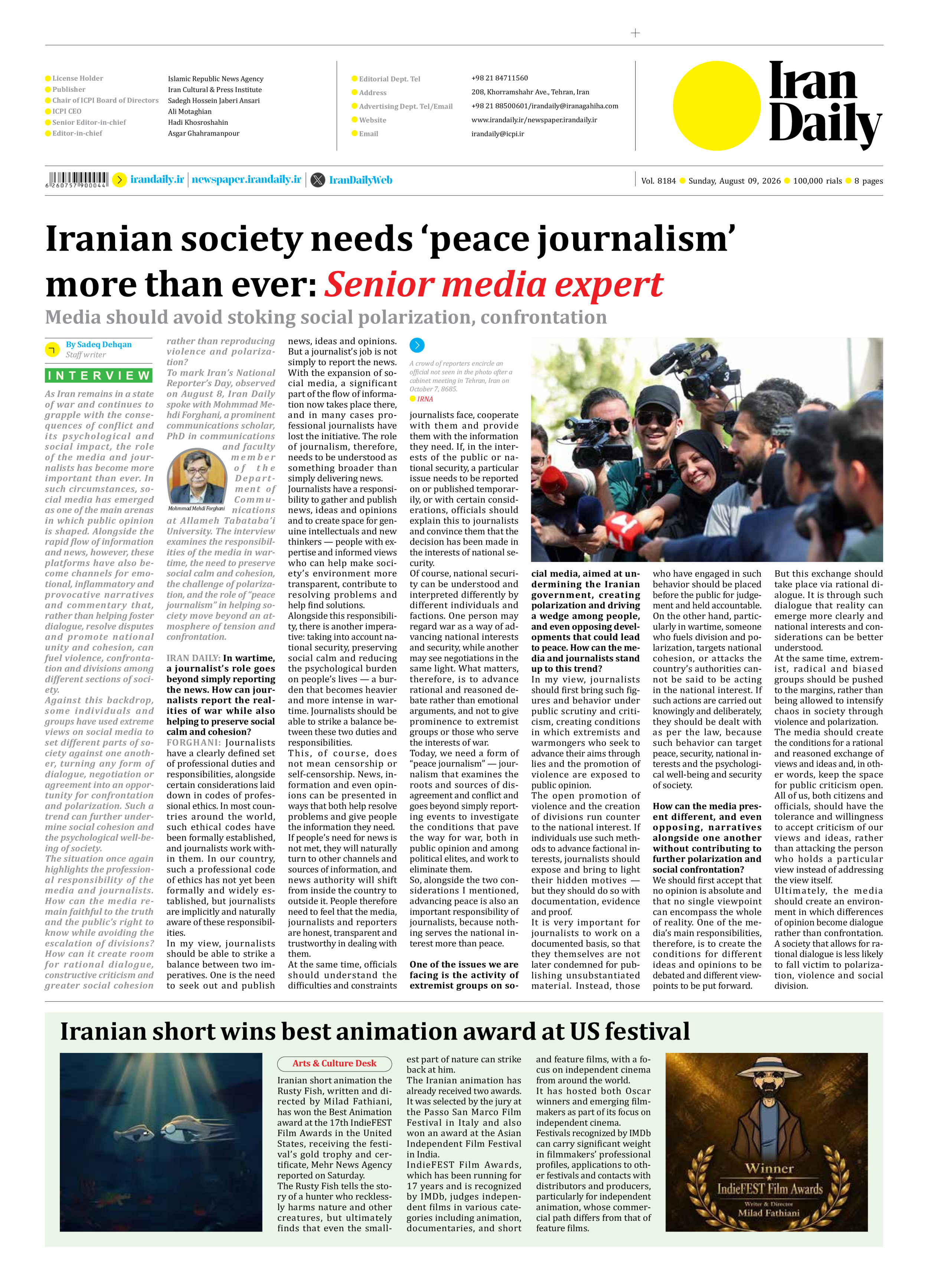


Iranian society needs ‘peace journalism’ more than ever: Senior media expert
Media should avoid stoking social polarization, confrontation
By Sadeq Dehqan
Staff writer
As Iran remains in a state of war and continues to grapple with the consequences of conflict and its psychological and social impact, the role of the media and journalists has become more important than ever. In such circumstances, social media has emerged as one of the main arenas in which public opinion is shaped. Alongside the rapid flow of information and news, however, these platforms have also become channels for emotional, inflammatory and provocative narratives and commentary that, rather than helping foster dialogue, resolve disputes and promote national unity and cohesion, can fuel violence, confrontation and divisions among different sections of society.
Against this backdrop, some individuals and groups have used extreme views on social media to set different parts of society against one another, turning any form of dialogue, negotiation or agreement into an opportunity for confrontation and polarization. Such a trend can further undermine social cohesion and the psychological well-being of society.
The situation once again highlights the professional responsibility of the media and journalists. How can the media remain faithful to the truth and the public’s right to know while avoiding the escalation of divisions? How can it create room for rational dialogue, constructive criticism and greater social cohesion rather than reproducing violence and polarization?
To mark Iran’s National Reporter’s Day, observed on August 8, Iran Daily spoke with Mohmmad Mehdi Forghani, a prominent communications scholar, PhD in communications and faculty member of the Department of Communications at Allameh Tabataba’i University. The interview examines the responsibilities of the media in wartime, the need to preserve social calm and cohesion, the challenge of polarization, and the role of “peace journalism” in helping society move beyond an atmosphere of tension and confrontation.
IRAN DAILY: In wartime, a journalist’s role goes beyond simply reporting the news. How can journalists report the realities of war while also helping to preserve social calm and cohesion?
FORGHANI: Journalists have a clearly defined set of professional duties and responsibilities, alongside certain considerations laid down in codes of professional ethics. In most countries around the world, such ethical codes have been formally established, and journalists work within them. In our country, such a professional code of ethics has not yet been formally and widely established, but journalists are implicitly and naturally aware of these responsibilities.
In my view, journalists should be able to strike a balance between two imperatives. One is the need to seek out and publish news, ideas and opinions. But a journalist’s job is not simply to report the news. With the expansion of social media, a significant part of the flow of information now takes place there, and in many cases professional journalists have lost the initiative. The role of journalism, therefore, needs to be understood as something broader than simply delivering news.
Journalists have a responsibility to gather and publish news, ideas and opinions and to create space for genuine intellectuals and new thinkers — people with expertise and informed views who can help make society’s environment more transparent, contribute to resolving problems and help find solutions.
Alongside this responsibility, there is another imperative: taking into account national security, preserving social calm and reducing the psychological burden on people’s lives — a burden that becomes heavier and more intense in wartime. Journalists should be able to strike a balance between these two duties and responsibilities.
This, of course, does not mean censorship or self-censorship. News, information and even opinions can be presented in ways that both help resolve problems and give people the information they need.
If people’s need for news is not met, they will naturally turn to other channels and sources of information, and news authority will shift from inside the country to outside it. People therefore need to feel that the media, journalists and reporters are honest, transparent and trustworthy in dealing with them.
At the same time, officials should understand the difficulties and constraints journalists face, cooperate with them and provide them with the information they need. If, in the interests of the public or national security, a particular issue needs to be reported on or published temporarily, or with certain considerations, officials should explain this to journalists and convince them that the decision has been made in the interests of national security.
Of course, national security can be understood and interpreted differently by different individuals and factions. One person may regard war as a way of advancing national interests and security, while another may see negotiations in the same light. What matters, therefore, is to advance rational and reasoned debate rather than emotional arguments, and not to give prominence to extremist groups or those who serve the interests of war.
Today, we need a form of “peace journalism” — journalism that examines the roots and sources of disagreement and conflict and goes beyond simply reporting events to investigate the conditions that pave the way for war, both in public opinion and among political elites, and work to eliminate them.
So, alongside the two considerations I mentioned, advancing peace is also an important responsibility of journalists, because nothing serves the national interest more than peace.
One of the issues we are facing is the activity of extremist groups on social media, aimed at undermining the Iranian government, creating polarization and driving a wedge among people, and even opposing developments that could lead to peace. How can the media and journalists stand up to this trend?
In my view, journalists should first bring such figures and behavior under public scrutiny and criticism, creating conditions in which extremists and warmongers who seek to advance their aims through lies and the promotion of violence are exposed to public opinion.
The open promotion of violence and the creation of divisions run counter to the national interest. If individuals use such methods to advance factional interests, journalists should expose and bring to light their hidden motives — but they should do so with documentation, evidence and proof.
It is very important for journalists to work on a documented basis, so that they themselves are not later condemned for publishing unsubstantiated material. Instead, those who have engaged in such behavior should be placed before the public for judgement and held accountable.
On the other hand, particularly in wartime, someone who fuels division and polarization, targets national cohesion, or attacks the country’s authorities cannot be said to be acting in the national interest. If such actions are carried out knowingly and deliberately, they should be dealt with as per the law, because such behavior can target peace, security, national interests and the psychological well-being and security of society.
How can the media present different, and even opposing, narratives alongside one another without contributing to further polarization and social confrontation?
We should first accept that no opinion is absolute and that no single viewpoint can encompass the whole of reality. One of the media’s main responsibilities, therefore, is to create the conditions for different ideas and opinions to be debated and different viewpoints to be put forward.
But this exchange should take place via rational dialogue. It is through such dialogue that reality can emerge more clearly and national interests and considerations can be better understood.
At the same time, extremist, radical and biased groups should be pushed to the margins, rather than being allowed to intensify chaos in society through violence and polarization.
The media should create the conditions for a rational and reasoned exchange of views and ideas and, in other words, keep the space for public criticism open. All of us, both citizens and officials, should have the tolerance and willingness to accept criticism of our views and ideas, rather than attacking the person who holds a particular view instead of addressing the view itself.
Ultimately, the media should create an environment in which differences of opinion become dialogue rather than confrontation. A society that allows for rational dialogue is less likely to fall victim to polarization, violence and social division.