





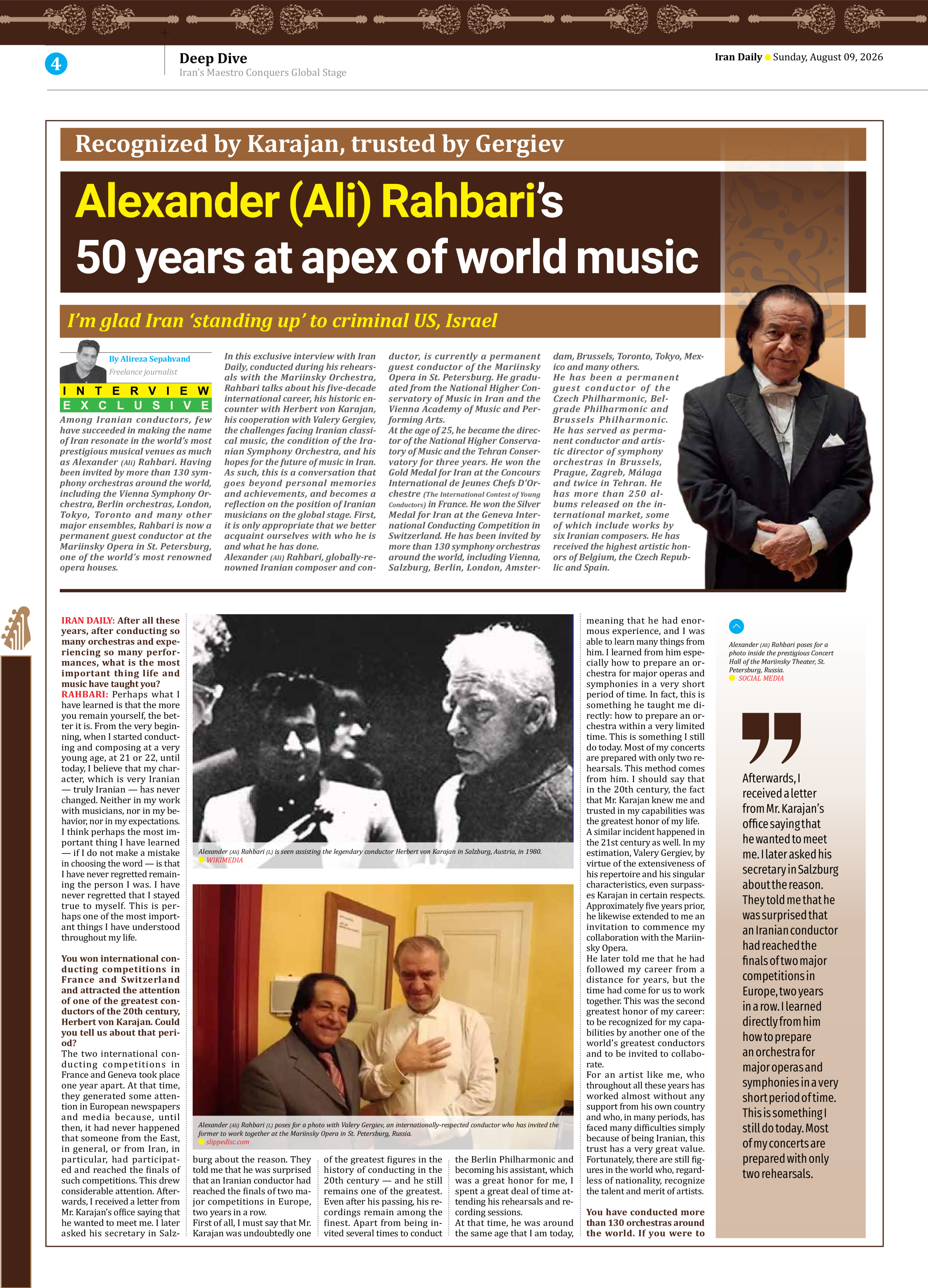


Recognized by Karajan, trusted by Gergiev
Alexander (Ali) Rahbari’s 50 years at apex of world music
I’m glad Iran ‘standing up’ to criminal US, Israel
Among Iranian conductors, few have succeeded in making the name of Iran resonate in the world’s most prestigious musical venues as much as Alexander (Ali) Rahbari. Having been invited by more than 130 symphony orchestras around the world, including the Vienna Symphony Orchestra, Berlin orchestras, London, Tokyo, Toronto and many other major ensembles, Rahbari is now a permanent guest conductor at the Mariinsky Opera in St. Petersburg, one of the world’s most renowned opera houses. In this exclusive interview with Iran Daily, conducted during his rehearsals with the Mariinsky Orchestra, Rahbari talks about his five-decade international career, his historic encounter with Herbert von Karajan, his cooperation with Valery Gergiev, the challenges facing Iranian classical music, the condition of the Iranian Symphony Orchestra, and his hopes for the future of music in Iran. As such, this is a conversation that goes beyond personal memories and achievements, and becomes a reflection on the position of Iranian musicians on the global stage. First, it is only appropriate that we better acquaint ourselves with who he is and what he has done. Alexander (Ali) Rahbari, globally-renowned Iranian composer and conductor, is currently a permanent guest conductor of the Mariinsky Opera in St. Petersburg. He graduated from the National Higher Conservatory of Music in Iran and the Vienna Academy of Music and Performing Arts. At the age of 25, he became the director of the National Higher Conservatory of Music and the Tehran Conservatory for three years. He won the Gold Medal for Iran at the Concours International de Jeunes Chefs D’Orchestre (The International Contest of Young Conductors) in France. He won the Silver Medal for Iran at the Geneva International Conducting Competition in Switzerland. He has been invited by more than 130 symphony orchestras around the world, including Vienna, Salzburg, Berlin, London, Amsterdam, Brussels, Toronto, Tokyo, Mexico and many others. He has been a permanent guest conductor of the Czech Philharmonic, Belgrade Philharmonic and Brussels Philharmonic. He has served as permanent conductor and artistic director of symphony orchestras in Brussels, Prague, Zagreb, Málaga and twice in Tehran. He has more than 250 albums released on the international market, some of which include works by six Iranian composers. He has received the highest artistic honors of Belgium, the Czech Republic and Spain.
By Alireza Sepahvand
Freelance journalist
IRAN DAILY: After all these years, after conducting so many orchestras and experiencing so many performances, what is the most important thing life and music have taught you?
RAHBARI: Perhaps what I have learned is that the more you remain yourself, the better it is. From the very beginning, when I started conducting and composing at a very young age, at 21 or 22, until today, I believe that my character, which is very Iranian — truly Iranian — has never changed. Neither in my work with musicians, nor in my behavior, nor in my expectations. I think perhaps the most important thing I have learned — if I do not make a mistake in choosing the word — is that I have never regretted remaining the person I was. I have never regretted that I stayed true to myself. This is perhaps one of the most important things I have understood throughout my life.
You won international conducting competitions in France and Switzerland and attracted the attention of one of the greatest conductors of the 20th century, Herbert von Karajan. Could you tell us about that period?
The two international conducting competitions in France and Geneva took place one year apart. At that time, they generated some attention in European newspapers and media because, until then, it had never happened that someone from the East, in general, or from Iran, in particular, had participated and reached the finals of such competitions. This drew considerable attention. Afterwards, I received a letter from Mr. Karajan’s office saying that he wanted to meet me. I later asked his secretary in Salzburg about the reason. They told me that he was surprised that an Iranian conductor had reached the finals of two major competitions in Europe, two years in a row.
First of all, I must say that Mr. Karajan was undoubtedly one of the greatest figures in the history of conducting in the 20th century — and he still remains one of the greatest. Even after his passing, his recordings remain among the finest. Apart from being invited several times to conduct the Berlin Philharmonic and becoming his assistant, which was a great honor for me, I spent a great deal of time attending his rehearsals and recording sessions.
At that time, he was around the same age that I am today, meaning that he had enormous experience, and I was able to learn many things from him. I learned from him especially how to prepare an orchestra for major operas and symphonies in a very short period of time. In fact, this is something he taught me directly: how to prepare an orchestra within a very limited time. This is something I still do today. Most of my concerts are prepared with only two rehearsals. This method comes from him. I should say that in the 20th century, the fact that Mr. Karajan knew me and trusted in my capabilities was the greatest honor of my life.
A similar incident happened in the 21st century as well. In my estimation, Valery Gergiev, by virtue of the extensiveness of his repertoire and his singular characteristics, even surpasses Karajan in certain respects. Approximately five years prior, he likewise extended to me an invitation to commence my collaboration with the Mariinsky Opera.
He later told me that he had followed my career from a distance for years, but the time had come for us to work together. This was the second greatest honor of my career: to be recognized for my capabilities by another one of the world’s greatest conductors and to be invited to collaborate.
For an artist like me, who throughout all these years has worked almost without any support from his own country and who, in many periods, has faced many difficulties simply because of being Iranian, this trust has a very great value. Fortunately, there are still figures in the world who, regardless of nationality, recognize the talent and merit of artists.
You have conducted more than 130 orchestras around the world. If you were to describe the characteristic of a great and professional orchestra in one sentence, what would that characteristic be?
The characteristic of a good orchestra is very simple. It has one essential feature that, unfortunately, has not yet happened in Iran. That is, the musicians must unanimously want to have a conductor at a very high level and must want to constantly maintain and improve their own artistic level.
An orchestra is teamwork. Exactly like a football team in which all members work together for victory. I have worked with great orchestras in Vienna, Berlin, Paris, Toronto, Tokyo, London, and many other important music centers around the world, but in all of them I have encountered one common characteristic: you are facing a team; a team that wants to be the best.
This has not yet happened in Iran. In Iran, decisions regarding orchestra musicians are usually influenced by institutions such as the House of Music, the Music Office, or the Rudaki Foundation. Of course, I believe none of these organizations are necessarily to blame because their main expertise is not managing a professional orchestra at a global level.
We have very good musicians in Iran. There are many valuable talents, but one day, these very musicians must want to build a great orchestra themselves. If you study the history of the world’s great orchestras, you will see that in many cases, it was the musicians themselves who caused an orchestra to rise to a higher level.
The conductor is important, but it is not only the conductor who builds an orchestra. The conductor is actually the artistic director, but the musicians must want that team to succeed. Just as in football, if the players of a team do not want to win, no coach can make that team a champion; the same is true in an orchestra. The musicians must want to raise their own level.
You have had experience collaborating with and knowing some of the greatest conductors in the world. Tell us about Valery Gergiev’s view of you and the position of your collaboration with the Mariinsky Opera.
About 12 years ago, in Vienna and in the presence of several major Austrian artistic figures, Valery Gergiev said that: “I have known this conductor for about 40 years; since the time when I myself was the director of the Rotterdam Orchestra and he was the director of the Brussels Orchestra.” He said that during those years, he had watched my performances through Belgian television, which could also be watched in the Netherlands, and that he knew who I was and what activities I had carried out.
For me, this was truly a great honor because as a professional conductor, I know the level at which Gergiev stands and the great position he holds in the world of classical music. My honor is that about 40 years after Karajan, a figure like Gergiev invited me to work at the Mariinsky, a place which I believe is one of the most important music centers in the world.
Gergiev gave me the opportunity to conduct between 7 and 12 concerts a year at the Mariinsky, an orchestra that has more than 400 official musicians and is considered one of the largest and most prestigious musical institutions in the world. A few weeks from now, my sixth artistic season of collaboration with the Mariinsky in St. Petersburg will begin.
I have a very good relationship with Gergiev. I love him very much, and during these years, our relationship has become very close and sincere. As an Iranian, as a conductor, and as a composer, I cannot imagine a higher position than this.
The Mariinsky is the very place where many of the great Russian composers have presented their works, and being present in such an institution is a great honor for me. One of the important features of this collaboration is that at the Mariinsky, I have a great deal of artistic freedom; I choose the programs myself, I choose the soloists myself, and I even make decisions about the timing of performances. After many years in which I have served seven times as an artistic director in different parts of the world, I think this is the highest position a conductor can achieve. Here, everything is provided for a professional conductor: a great artistic director who is not involved in non-artistic issues, jealousy, or unhealthy relationships; wonderful audiences; halls that are always full; and one of the best musical environments in the world. I truly do not know what could be better than this for a conductor.
Considering the events of recent years and the sanctions imposed on some artists and musicians, what is your view on cultural sanctions?
I am fundamentally opposed to sanctions, especially sports and cultural sanctions. In my opinion, sanctions have never been the right solution. Sanctions, in many cases, are not very different from directly harming people.
In the experience of sanctions against countries such as Iraq or Iran and some other countries, it has repeatedly been seen that the ordinary people, especially children, have not been able to receive their medicines and essential needs on time, and many have suffered because of these conditions.
Cultural sanctions are also wrong to the same extent. In today’s world, there is an obvious double standard; some countries and artists are easily sanctioned, while such decisions are not made against others.
In my opinion, sanctioning Russian musicians was a very big mistake. Especially when at the same time, we see that such restrictions are not imposed on artists from some other countries, this raises serious questions.
Art and music must go beyond political issues. Music belongs to human beings, and artists should not be punished because of their nationality or the political circumstances of their country.
Why have Iranian symphonic works, despite having talented composers, still not achieved their deserved position in the world?
This issue has two main reasons. The first reason is that we have very powerful composers in classical music, but many of them, because they have not learned Iranian music deeply and properly, try to give their works a national identity only by adding some apparently Iranian elements. However, the result is not always successful because sometimes this effort causes their music to resemble an incomplete interpretation of Armenian, Turkish, or other regional musical cultures rather than a true Iranian musical language.
The second reason, which in my opinion is more important, is the lack of serious support for introducing these works at the international level. This support does not necessarily have to come only from the government; even the music community and musicians themselves should make more efforts to introduce valuable Iranian works.
More than 40 years ago, around 50 years ago, I recorded six works by Iranian composers in the city of Nuremberg, Germany, and introduced them to the international market. These works were welcomed and are still present in the global market. But unfortunately, no serious support was provided by Iranian cultural institutions in this field. We have very good composers who can truly be introduced at a global level, but they lack support. Countries such as South Korea, China, and Russia support their composers and conductors. They try to introduce their best artists to the world, but regarding Iranian artists, such organized support does not exist.
Among your own compositions, which works do you consider closer to your Iranian identity, and which ones do you think are your most important pieces?
The works I have written for My Mother Persia, around 12 or 13 pieces, are very Iranian. The reason is that I learned traditional Iranian music from childhood, and this music became deeply rooted within me. Although my main success has been in Western music and conducting, the reality is that a very large part of my childhood was spent with traditional Iranian music. Therefore, these Iranian elements naturally appear in my works.
If I were to mention only one or two works among my compositions, perhaps the piece Persian Blood, which I wrote at the age of 19, is one of the most important ones. This piece is about 10 minutes long, and its first performance took place in Vienna.
Another work is Nohe-Khan (The Lament Singer) for violin and orchestra, which I wrote at the age of 20. A few years ago, I worked on it again, and it has now been released internationally and has received positive reactions. These two pieces are especially important to me.
Of course, I have also written several operas that have not yet been performed, as well as other works that have not had the opportunity for public performance. Many people ask me why I have not conducted my own works. My answer is that throughout all the years when I was responsible for an orchestra, I never wanted to use my position to perform my own personal works. When you are the director of an orchestra, there are many composers waiting for their works to be performed, and I did not want to take that opportunity away from others. However, now that I work mostly as a guest conductor, I allow myself to conduct some of my own works as well. In recent years, several of these works have been performed, the most important of which was the performance of Nohe-Khan at the Mariinsky. I have also conducted the work Also Sprach Zarathustra (German for: Thus Spoke Zarathustra).
You have collaborated with many of the greatest opera singers and classical music artists in the world and have recorded more than 40 operas. Do you still have a particular dream in the field of music?
Yes, I have worked with the best tenors and the greatest singers in the world. I have experienced very good days and have made many valuable recordings. I think I have recorded more than 40 operas.
But if I want to talk about my dream today, I must say that at the moment I am very satisfied with the programs I have. The concerts I conduct at the Mariinsky and the collaborations I have with five orchestras in China are very valuable to me. These orchestras are at a very high level, and I am very happy about these collaborations. Under the current circumstances, I feel that what I am doing is enough for me.
Thomas Bernhard, the great Austrian writer, has a sentence that essentially claims that whatever you are at the age of 18, a few years or a few decades later, you will only become several times that same person; therefore, it is important who you are at the age of 18. If I want to answer this question from this perspective, I must say that if I were 20 years old again today, I hope I could do the same things that I did at that age: write pieces such as Persian Blood and Nohe-Khan, and at the age of 20-something become the head of two music conservatories and the director of two orchestras. I do not think I could follow such a path again today.
Therefore, I believe that my 20s were such a powerful period that even today, it is difficult for me to imagine returning to that time. The experience I have gained during the past 50 years does not necessarily mean that if I were young again, I could write better or perform better. I strongly believe that the period between 18 and 25 years of age is a very important and decisive period for many people, especially those who have had greater talent, interest, and opportunities from childhood.
Despite your extensive international achievements, you believe that you have not been recognized in Iran as much as you should have been. How do you think history will judge your position?
I think that if one day, history of music looks back at the past, it will say that a great deal of neglect was directed toward me and that my activities were not given the attention they deserved. Of course, my work has received a great deal of attention in the world, but I feel that in my own country, they have not yet fully understood what I have done and what path I have followed. The day when my works are examined, my recordings are listened to, and my activities are studied in books and educational centers, they will see what has happened.
Countries such as China, South Korea, and Turkey have always tried to find their best artists and see how they can use their abilities to introduce their culture and enhance their country’s reputation. But in Iran, unfortunately, in some cases, efforts have been made to prevent successful artists abroad from having the opportunity to return and work inside the country. The result has been that the people of Iran have not been able to benefit from the abilities of their own artists. We have first-class composers, we have conductors, we have highly talented musicians, but a large part of the Iranian society cannot benefit from their abilities. The reason for this issue is the existence of several small and weak institutions that believe the presence of these individuals is not in their interest. But this neglect will one day attract a great deal of attention, and history will judge it.
How do you evaluate the situation of the Iranian Symphony Orchestra? Why, despite its long history, has this orchestra still not reached a global position?
Unfortunately, as I have always said, the Iranian Symphony Orchestra has faced a fundamental problem throughout the past 100 years. This orchestra has a history older than many orchestras in Asian countries such as South Korea and China, and it is even older than many orchestras in other countries, but it has never been treated as a professional and national institution.
The main problem has been that the Symphony Orchestra has not been treated like football. In Iran, people know football and can recognize its good and bad aspects. Even ministers and senior officials have knowledge about football, but regarding the Symphony Orchestra, which in many countries of the world has a position equal to football, such an understanding has not existed. In major countries such as France and Austria, a symphony orchestra has the same importance as an important football team. But in Iran, the selection of the conductor, artistic director, and manager of this institution has never been approached professionally. From the past until today, sometimes someone has been chosen to conduct simply because he was available, had time, or the conditions allowed his presence.
I have always emphasized that a good conductor is never unemployed because a professional conductor is always working somewhere. This mistake, with different levels of intensity, existed both before and after the Islamic Revolution, and the result has been that the Iranian Symphony Orchestra, despite having many talents, has remained stagnant for years. And stagnation ultimately leads to falling behind. If today we compare the Iranian Orchestra with the orchestras of China, South Korea, or Turkey, unfortunately there is a very large gap. Perhaps we are 50 or 60 years behind because that professional transformation that should have happened has not taken place in Iran.
However, I believe that the main problem is not the musicians themselves; rather, the musicians must want this situation to change. I know many very good Iranian musicians. When I came to Iran 22 years ago and then again 12 years ago, on both occasions, I observed that these same musicians were able, within one week to 10 days, to show themselves at an international level. This means that the talent exists.
Twelve years ago, when the Iranian Orchestra was invited to China, the reason for this invitation was that in a short period of time, we showed one of the great music managers in China that these musicians had the ability to perform at an international level. They were not only invited to China, but the possibility of their presence in Europe and Austria could also have been created. But unfortunately, because of wrong decisions and unprofessional management, individuals were sent to China by some institutions who did not have sufficient experience and knowledge. Even the Chinese wrote to me with disappointment and said that such an approach was not appropriate, and after that, no further invitation was made.
With this method, it is impossible to build a world-class orchestra. I hope that one day a minister, a cultural official, or a professional music group will decide to create an orchestra at a global level. This can even be achieved in a short period of time. Perhaps within one month, the foundations of a powerful orchestra could be created. At that point, it can be shown that Iran’s cultural identity is no less significant than football. Football may lose one day and win another day, but a symphony orchestra is the cultural heritage of a nation.
Finally, I would like to say this as well: of course, it is not related to the subject and main focus of our conversation, but it remained in my heart and I had to say it: “I am happy that Iran has stood against the criminal United States and Israel.”