







Visit Kataleh Khor Cave for wonders of underground world
Hidden beneath the limestone mountains of northwestern Iran, Kataleh Khor Cave stands as one of the country’s most remarkable geological formations, offering visitors a rare glimpse into millions of years of natural history while serving as one of Zanjan Province’s leading tourist attractions.
Located near the town of Garmab in Khodabandeh, the cave is renowned for its vast chambers, intricate limestone formations, mysterious underground passages and consistently cool temperature. Beyond its scenic appeal, the site is valued for its geological, scientific and environmental significance, attracting tourists, researchers and nature enthusiasts alike.
The journey to the cave takes visitors through the mountainous landscapes of the region, adding to its appeal as a destination for nature tourism, according to chtn.ir.
The name “Kataleh Khor” has several interpretations in the local dialect, with one common meaning translated as “Mountain of the Sun.”
Although local residents had long been familiar with the cave’s entrance, it was officially identified in 1952 by a group of mountaineers. Since then, geological surveys and speleological studies have continued to highlight the cave’s scientific importance and tourism potential.
Kataleh Khor Cave was formed through the gradual dissolution of limestone over extended geological periods. Groundwater seeped into fractures in the rock, slowly carving out an extensive network of underground passages, chambers and cavities over millions of years.
Mineral-rich water has continued to shape the cave’s interior through the deposition of limestone, creating an array of spectacular formations. These include stalactites, stalagmites, columns, flowstones, draperies and cauliflower-like calcite formations, each formed drop by drop over countless centuries.
Geologists believe the cave’s primary structure dates back to ancient geological eras, although the growth of its limestone formations remains an ongoing process. Every drop of mineral-rich water that falls from the cave’s ceiling deposits a microscopic layer of calcite, gradually creating new formations over time.
One of Kataleh Khor’s defining characteristics is its complex, multi-level structure. Studies indicate that the cave consists of several interconnected underground levels, commonly described as a seven-level cave system.
These levels developed as underground waterways expanded through different layers of limestone. Some passages run horizontally while others descend vertically, creating an intricate network of tunnels and chambers.
Much of the cave remains unexplored. Many corridors and lower levels are still inaccessible because of difficult terrain, technical challenges and conservation requirements. Access to these areas is generally limited to professional caving teams equipped with specialized gear.
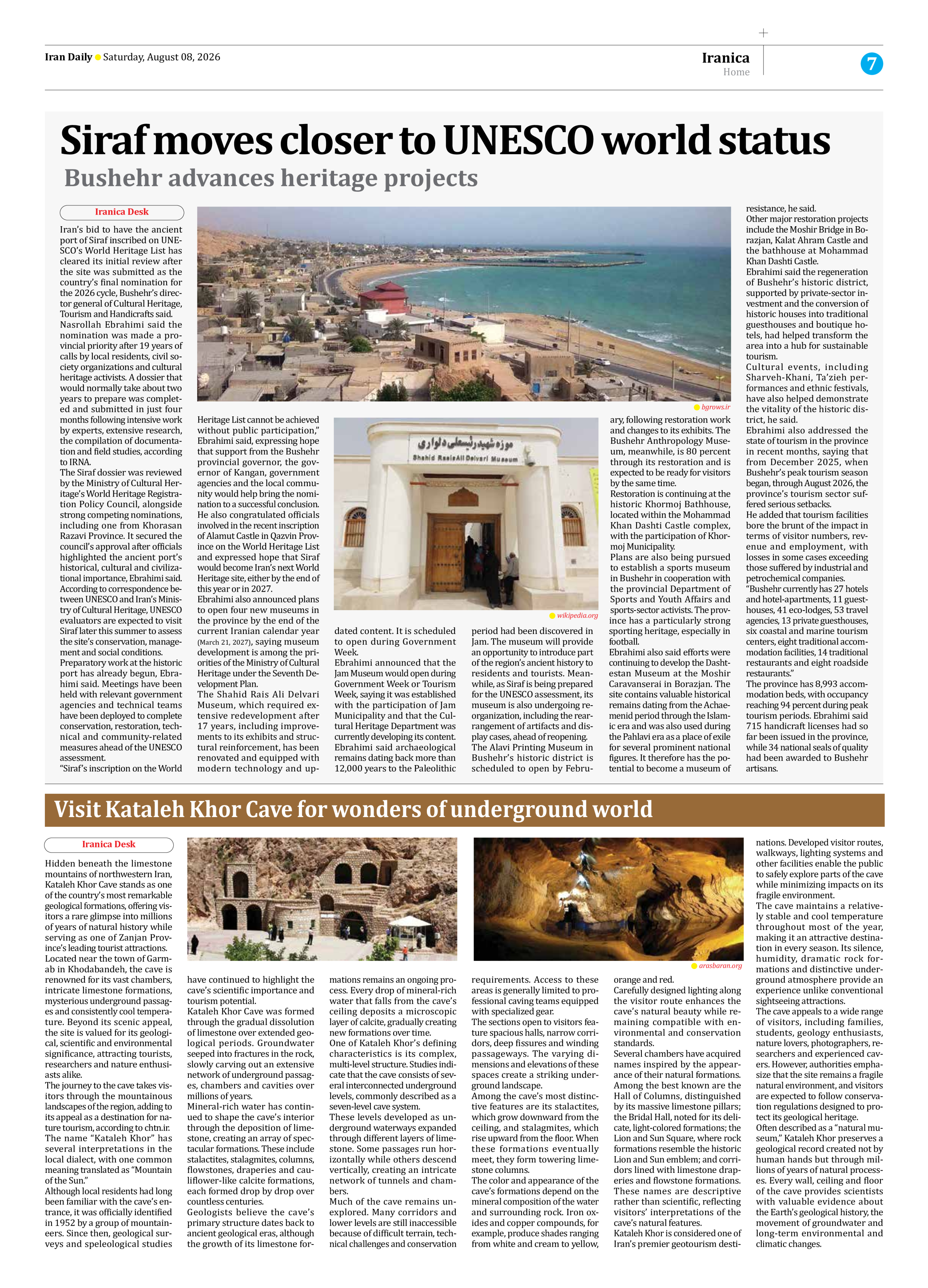
The sections open to visitors feature spacious halls, narrow corridors, deep fissures and winding passageways. The varying dimensions and elevations of these spaces create a striking underground landscape.
Among the cave’s most distinctive features are its stalactites, which grow downward from the ceiling, and stalagmites, which rise upward from the floor. When these formations eventually meet, they form towering limestone columns.
The color and appearance of the cave’s formations depend on the mineral composition of the water and surrounding rock. Iron oxides and copper compounds, for example, produce shades ranging from white and cream to yellow, orange and red.
Carefully designed lighting along the visitor route enhances the cave’s natural beauty while remaining compatible with environmental and conservation standards.
Several chambers have acquired names inspired by the appearance of their natural formations. Among the best known are the Hall of Columns, distinguished by its massive limestone pillars; the Bridal Hall, noted for its delicate, light-colored formations; the Lion and Sun Square, where rock formations resemble the historic Lion and Sun emblem; and corridors lined with limestone draperies and flowstone formations. These names are descriptive rather than scientific, reflecting visitors’ interpretations of the cave’s natural features.
Kataleh Khor is considered one of Iran’s premier geotourism destinations. Developed visitor routes, walkways, lighting systems and other facilities enable the public to safely explore parts of the cave while minimizing impacts on its fragile environment.
The cave maintains a relatively stable and cool temperature throughout most of the year, making it an attractive destination in every season. Its silence, humidity, dramatic rock formations and distinctive underground atmosphere provide an experience unlike conventional sightseeing attractions.
The cave appeals to a wide range of visitors, including families, students, geology enthusiasts, nature lovers, photographers, researchers and experienced cavers. However, authorities emphasize that the site remains a fragile natural environment, and visitors are expected to follow conservation regulations designed to protect its geological heritage.
Often described as a “natural museum,” Kataleh Khor preserves a geological record created not by human hands but through millions of years of natural processes. Every wall, ceiling and floor of the cave provides scientists with valuable evidence about the Earth’s geological history, the movement of groundwater and long-term environmental and climatic changes.