





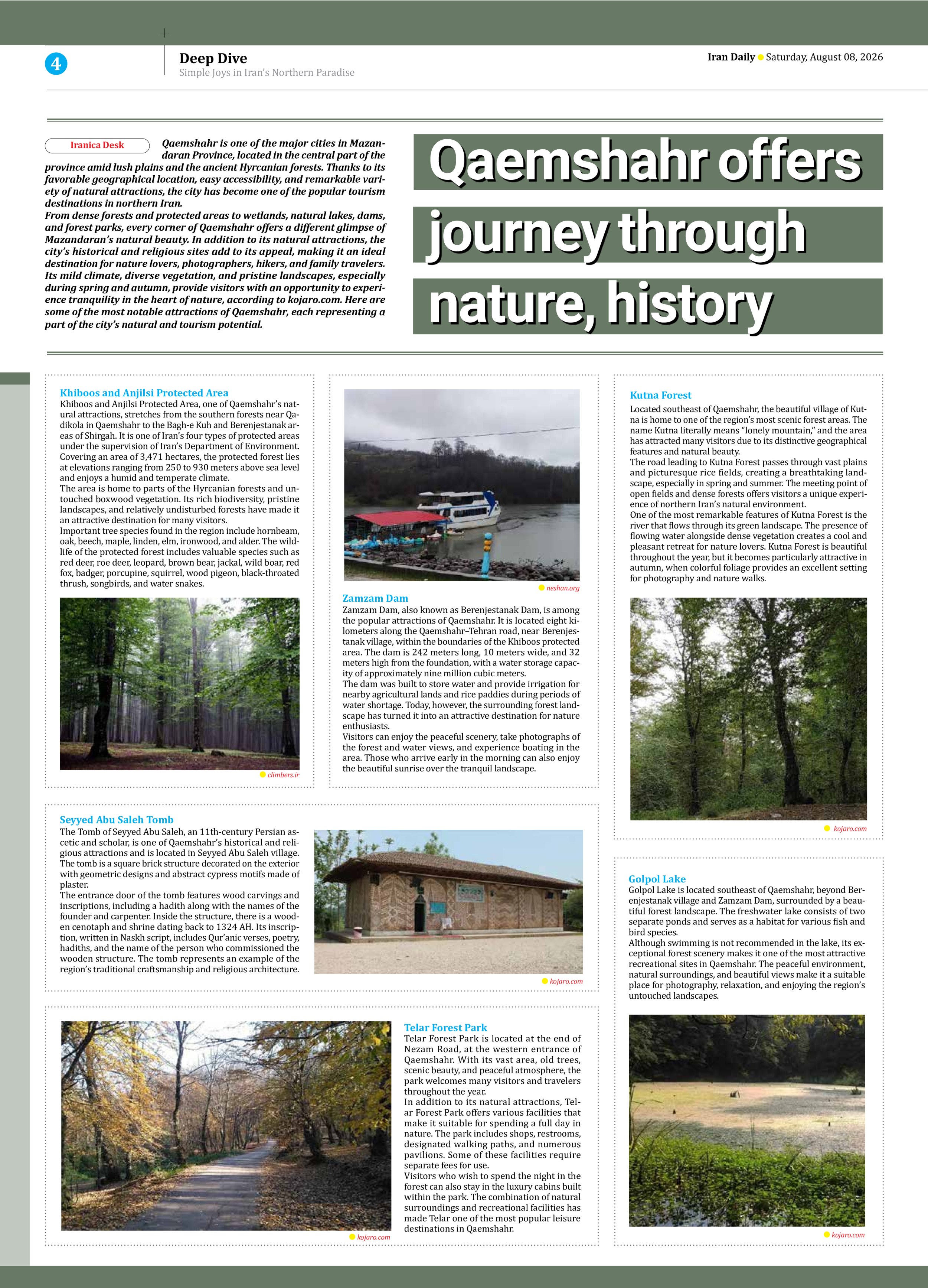


Qaemshahr offers journey through nature, history
Qaemshahr is one of the major cities in Mazandaran Province, located in the central part of the province amid lush plains and the ancient Hyrcanian forests. Thanks to its favorable geographical location, easy accessibility, and remarkable variety of natural attractions, the city has become one of the popular tourism destinations in northern Iran. From dense forests and protected areas to wetlands, natural lakes, dams, and forest parks, every corner of Qaemshahr offers a different glimpse of Mazandaran’s natural beauty. In addition to its natural attractions, the city’s historical and religious sites add to its appeal, making it an ideal destination for nature lovers, photographers, hikers, and family travelers. Its mild climate, diverse vegetation, and pristine landscapes, especially during spring and autumn, provide visitors with an opportunity to experience tranquility in the heart of nature, according to kojaro.com. Here are some of the most notable attractions of Qaemshahr, each representing a part of the city’s natural and tourism potential.
Khiboos and Anjilsi Protected Area
Khiboos and Anjilsi Protected Area, one of Qaemshahr’s natural attractions, stretches from the southern forests near Qadikola in Qaemshahr to the Bagh-e Kuh and Berenjestanak areas of Shirgah. It is one of Iran’s four types of protected areas under the supervision of Iran’s Department of Environment. Covering an area of 3,471 hectares, the protected forest lies at elevations ranging from 250 to 930 meters above sea level and enjoys a humid and temperate climate.
The area is home to parts of the Hyrcanian forests and untouched boxwood vegetation. Its rich biodiversity, pristine landscapes, and relatively undisturbed forests have made it an attractive destination for many visitors.
Important tree species found in the region include hornbeam, oak, beech, maple, linden, elm, ironwood, and alder. The wildlife of the protected forest includes valuable species such as red deer, roe deer, leopard, brown bear, jackal, wild boar, red fox, badger, porcupine, squirrel, wood pigeon, black-throated thrush, songbirds, and water snakes.
Zamzam Dam
Zamzam Dam, also known as Berenjestanak Dam, is among the popular attractions of Qaemshahr. It is located eight kilometers along the Qaemshahr–Tehran road, near Berenjestanak village, within the boundaries of the Khiboos protected area. The dam is 242 meters long, 10 meters wide, and 32 meters high from the foundation, with a water storage capacity of approximately nine million cubic meters.
The dam was built to store water and provide irrigation for nearby agricultural lands and rice paddies during periods of water shortage. Today, however, the surrounding forest landscape has turned it into an attractive destination for nature enthusiasts.
Visitors can enjoy the peaceful scenery, take photographs of the forest and water views, and experience boating in the area. Those who arrive early in the morning can also enjoy the beautiful sunrise over the tranquil landscape.
Kutna Forest
Located southeast of Qaemshahr, the beautiful village of Kutna is home to one of the region’s most scenic forest areas. The name Kutna literally means “lonely mountain,” and the area has attracted many visitors due to its distinctive geographical features and natural beauty.
The road leading to Kutna Forest passes through vast plains and picturesque rice fields, creating a breathtaking landscape, especially in spring and summer. The meeting point of open fields and dense forests offers visitors a unique experience of northern Iran’s natural environment.
One of the most remarkable features of Kutna Forest is the river that flows through its green landscape. The presence of flowing water alongside dense vegetation creates a cool and pleasant retreat for nature lovers. Kutna Forest is beautiful throughout the year, but it becomes particularly attractive in autumn, when colorful foliage provides an excellent setting for photography and nature walks.
Seyyed Abu Saleh Tomb
The Tomb of Seyyed Abu Saleh, an 11th-century Persian ascetic and scholar, is one of Qaemshahr’s historical and religious attractions and is located in Seyyed Abu Saleh village. The tomb is a square brick structure decorated on the exterior with geometric designs and abstract cypress motifs made of plaster.
The entrance door of the tomb features wood carvings and inscriptions, including a hadith along with the names of the founder and carpenter. Inside the structure, there is a wooden cenotaph and shrine dating back to 1324 AH. Its inscription, written in Naskh script, includes Qur’anic verses, poetry, hadiths, and the name of the person who commissioned the wooden structure. The tomb represents an example of the region’s traditional craftsmanship and religious architecture.
Golpol Lake
Golpol Lake is located southeast of Qaemshahr, beyond Berenjestanak village and Zamzam Dam, surrounded by a beautiful forest landscape. The freshwater lake consists of two separate ponds and serves as a habitat for various fish and bird species.
Although swimming is not recommended in the lake, its exceptional forest scenery makes it one of the most attractive recreational sites in Qaemshahr. The peaceful environment, natural surroundings, and beautiful views make it a suitable place for photography, relaxation, and enjoying the region’s untouched landscapes.
Telar Forest Park
Telar Forest Park is located at the end of Nezam Road, at the western entrance of Qaemshahr. With its vast area, old trees, scenic beauty, and peaceful atmosphere, the park welcomes many visitors and travelers throughout the year.
In addition to its natural attractions, Telar Forest Park offers various facilities that make it suitable for spending a full day in nature. The park includes shops, restrooms, designated walking paths, and numerous pavilions. Some of these facilities require separate fees for use.
Visitors who wish to spend the night in the forest can also stay in the luxury cabins built within the park. The combination of natural surroundings and recreational facilities has made Telar one of the most popular leisure destinations in Qaemshahr.
Valiasr Park
Located in the center of Qaemshahr, Valiasr Park has become a popular gathering place for families and visitors due to its pleasant environment and suitable facilities. The park is designed to provide a safe and enjoyable space where parents can allow their children to play and spend leisure time.
Dedicated children’s play areas, walking paths, and seating spaces have made the park a suitable destination for families throughout the day and evening.
Gerd Kuh
The Gerd Kuh Hill is an archeological site located in the Jamanan district of Qaemshahr. Jamanan was historically a center of local governance and today serves as the main entrance route to the villages of Bozorg Qadikola and Ahangar Kola.
Gerd Kuh consists of three large ancient mounds, the highest of which rises 26 meters above the surrounding area. The antiquity of these mounds is estimated to date back to the Iron Age. Archaeological excavations in the area have uncovered a cemetery dating back to approximately 2,500 BCE, along with artifacts such as pottery vessels from the Sassanid and Parthian periods.
Archaeological evidence suggests that the hills were used for military purposes during the Sassanid era and after the Arab conquest of Iran. The tallest mound, standing 26 meters high, is believed to have functioned as a military fortress.
Located southeast of Qaemshahr, the Gerd Kuh was registered on Iran’s National Heritage List in 2003 as one of the country’s historical monuments.
Karchang Wetland
Karchang Wetland, with an area of about 12 hectares, is one of Qaemshahr’s lesser-known natural attractions. In recent years, the wetland has experienced a decline in water levels due to reduced rainfall; however, it remains a worthwhile destination for nature lovers.
Because relatively few tourists are aware of this wetland, it has maintained a peaceful and pristine atmosphere. Visitors can enjoy the surrounding nature in a quiet environment away from crowded tourist areas. Karchang Wetland is also known as Karchang Pond.
With its diverse natural landscapes, forests, wetlands, and cultural heritage sites, Qaemshahr offers visitors a unique opportunity to experience the beauty of Mazandaran and discover one of northern Iran’s attractive yet less-explored destinations.