







Iran urges deeper EAEU ties, offers trade, energy capacity
Iran called for deeper economic engagement with the Eurasian Economic Union (EAEU) on Friday and offered to leverage its trade and energy capabilities both bilaterally and within the bloc, while urging full implementation of a free trade agreement and closer financial and transport ties.
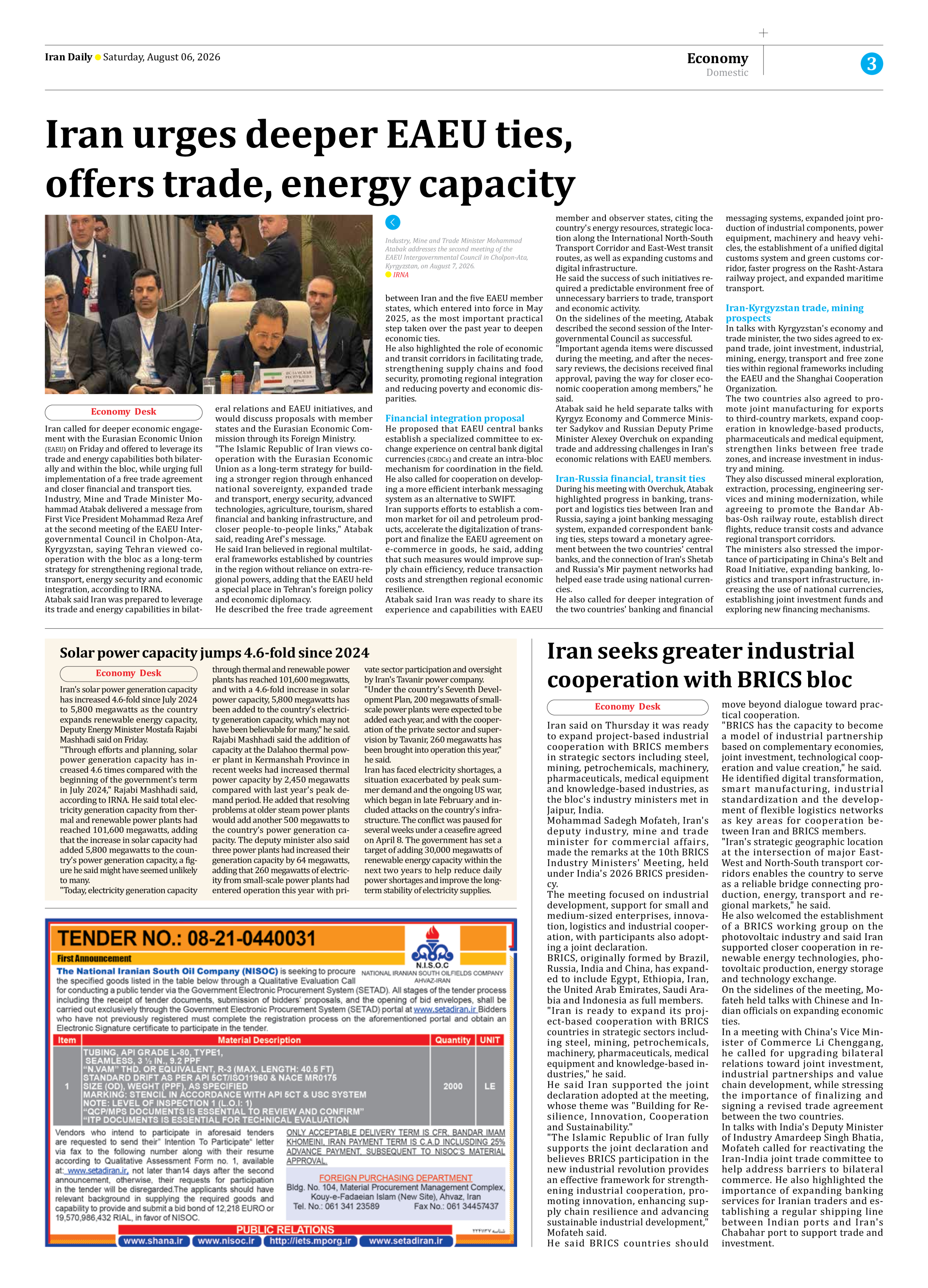
Industry, Mine and Trade Minister Mohammad Atabak delivered a message from First Vice President Mohammad Reza Aref at the second meeting of the EAEU Intergovernmental Council in Cholpon-Ata, Kyrgyzstan, saying Tehran viewed cooperation with the bloc as a long-term strategy for strengthening regional trade, transport, energy security and economic integration, according to IRNA.
Atabak said Iran was prepared to leverage its trade and energy capabilities in bilateral relations and EAEU initiatives, and would discuss proposals with member states and the Eurasian Economic Commission through its Foreign Ministry.
"The Islamic Republic of Iran views cooperation with the Eurasian Economic Union as a long-term strategy for building a stronger region through enhanced national sovereignty, expanded trade and transport, energy security, advanced technologies, agriculture, tourism, shared financial and banking infrastructure, and closer people-to-people links," Atabak said, reading Aref's message.
He said Iran believed in regional multilateral frameworks established by countries in the region without reliance on extra-regional powers, adding that the EAEU held a special place in Tehran's foreign policy and economic diplomacy.
He described the free trade agreement between Iran and the five EAEU member states, which entered into force in May 2025, as the most important practical step taken over the past year to deepen economic ties.
He also highlighted the role of economic and transit corridors in facilitating trade, strengthening supply chains and food security, promoting regional integration and reducing poverty and economic disparities.
Financial integration proposal
He proposed that EAEU central banks establish a specialized committee to exchange experience on central bank digital currencies (CBDCs) and create an intra-bloc mechanism for coordination in the field. He also called for cooperation on developing a more efficient interbank messaging system as an alternative to SWIFT.
Iran supports efforts to establish a common market for oil and petroleum products, accelerate the digitalization of transport and finalize the EAEU agreement on e-commerce in goods, he said, adding that such measures would improve supply chain efficiency, reduce transaction costs and strengthen regional economic resilience.
Atabak said Iran was ready to share its experience and capabilities with EAEU member and observer states, citing the country's energy resources, strategic location along the International North-South Transport Corridor and East-West transit routes, as well as expanding customs and digital infrastructure.
He said the success of such initiatives required a predictable environment free of unnecessary barriers to trade, transport and economic activity.
On the sidelines of the meeting, Atabak described the second session of the Intergovernmental Council as successful.
"Important agenda items were discussed during the meeting, and after the necessary reviews, the decisions received final approval, paving the way for closer economic cooperation among members," he said.
Atabak said he held separate talks with Kyrgyz Economy and Commerce Minister Sadykov and Russian Deputy Prime Minister Alexey Overchuk on expanding trade and addressing challenges in Iran's economic relations with EAEU members.
Iran-Russia financial, transit ties
During his meeting with Overchuk, Atabak highlighted progress in banking, transport and logistics ties between Iran and Russia, saying a joint banking messaging system, expanded correspondent banking ties, steps toward a monetary agreement between the two countries' central banks, and the connection of Iran's Shetab and Russia's Mir payment networks had helped ease trade using national currencies.
He also called for deeper integration of the two countries' banking and financial messaging systems, expanded joint production of industrial components, power equipment, machinery and heavy vehicles, the establishment of a unified digital customs system and green customs corridor, faster progress on the Rasht-Astara railway project, and expanded maritime transport.
Iran-Kyrgyzstan trade, mining prospects
In talks with Kyrgyzstan's economy and trade minister, the two sides agreed to expand trade, joint investment, industrial, mining, energy, transport and free zone ties within regional frameworks including the EAEU and the Shanghai Cooperation Organization.
The two countries also agreed to promote joint manufacturing for exports to third-country markets, expand cooperation in knowledge-based products, pharmaceuticals and medical equipment, strengthen links between free trade zones, and increase investment in industry and mining.
They also discussed mineral exploration, extraction, processing, engineering services and mining modernization, while agreeing to promote the Bandar Abbas-Osh railway route, establish direct flights, reduce transit costs and advance regional transport corridors.
The ministers also stressed the importance of participating in China's Belt and Road Initiative, expanding banking, logistics and transport infrastructure, increasing the use of national currencies, establishing joint investment funds and exploring new financing mechanisms.