







Copy in clipboard...
Pakistan reaffirms support for Kashmir’s self-determination
Pakistan reaffirmed its unwavering support for the right to self-determination of the people of Jammu and Kashmir, complaining that binding resolutions adopted by the United Nations Security Council on the disputed territory have not been implemented so far.
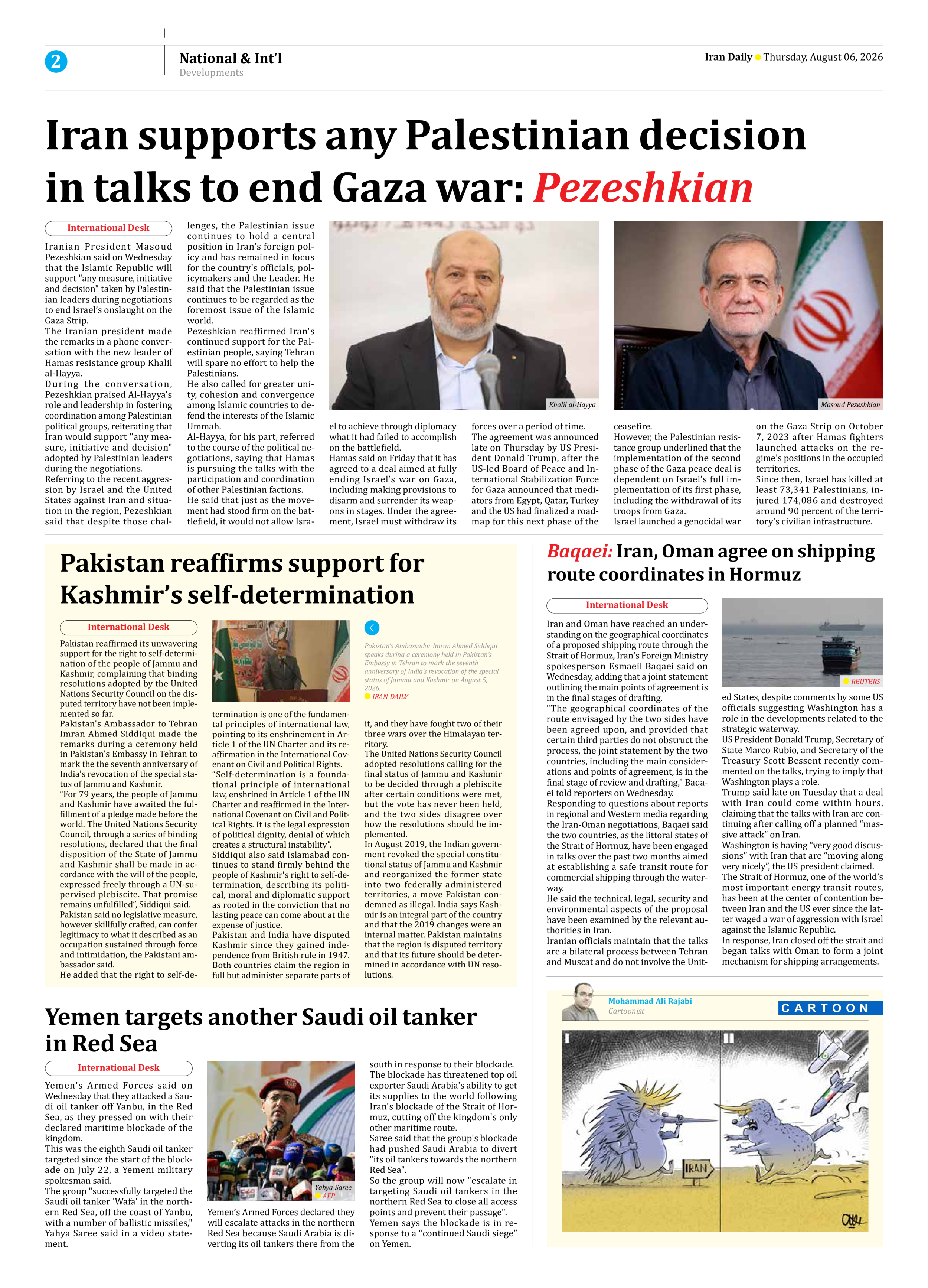
Pakistan’s Ambassador to Tehran Imran Ahmed Siddiqui made the remarks during a ceremony held in Pakistan’s Embassy in Tehran to mark the the seventh anniversary of India’s revocation of the special status of Jammu and Kashmir.
“For 79 years, the people of Jammu and Kashmir have awaited the fulfillment of a pledge made before the world. The United Nations Security Council, through a series of binding resolutions, declared that the final disposition of the State of Jammu and Kashmir shall be made in accordance with the will of the people, expressed freely through a UN-supervised plebiscite. That promise remains unfulfilled”, Siddiqui said.
Pakistan said no legislative measure, however skillfully crafted, can confer legitimacy to what it described as an occupation sustained through force and intimidation, the Pakistani ambassador said.
He added that the right to self-determination is one of the fundamental principles of international law, pointing to its enshrinement in Article 1 of the UN Charter and its reaffirmation in the International Covenant on Civil and Political Rights.
“Self-determination is a foundational principle of international law, enshrined in Article 1 of the UN Charter and reaffirmed in the International Covenant on Civil and Political Rights. It is the legal expression of political dignity, denial of which creates a structural instability”.
Siddiqui also said Islamabad continues to stand firmly behind the people of Kashmir's right to self-determination, describing its political, moral and diplomatic support as rooted in the conviction that no lasting peace can come about at the expense of justice.
Pakistan and India have disputed Kashmir since they gained independence from British rule in 1947. Both countries claim the region in full but administer separate parts of it, and they have fought two of their three wars over the Himalayan territory.
The United Nations Security Council adopted resolutions calling for the final status of Jammu and Kashmir to be decided through a plebiscite after certain conditions were met, but the vote has never been held, and the two sides disagree over how the resolutions should be implemented.
In August 2019, the Indian government revoked the special constitutional status of Jammu and Kashmir and reorganized the former state into two federally administered territories, a move Pakistan condemned as illegal. India says Kashmir is an integral part of the country and that the 2019 changes were an internal matter. Pakistan maintains that the region is disputed territory and that its future should be determined in accordance with UN resolutions.