





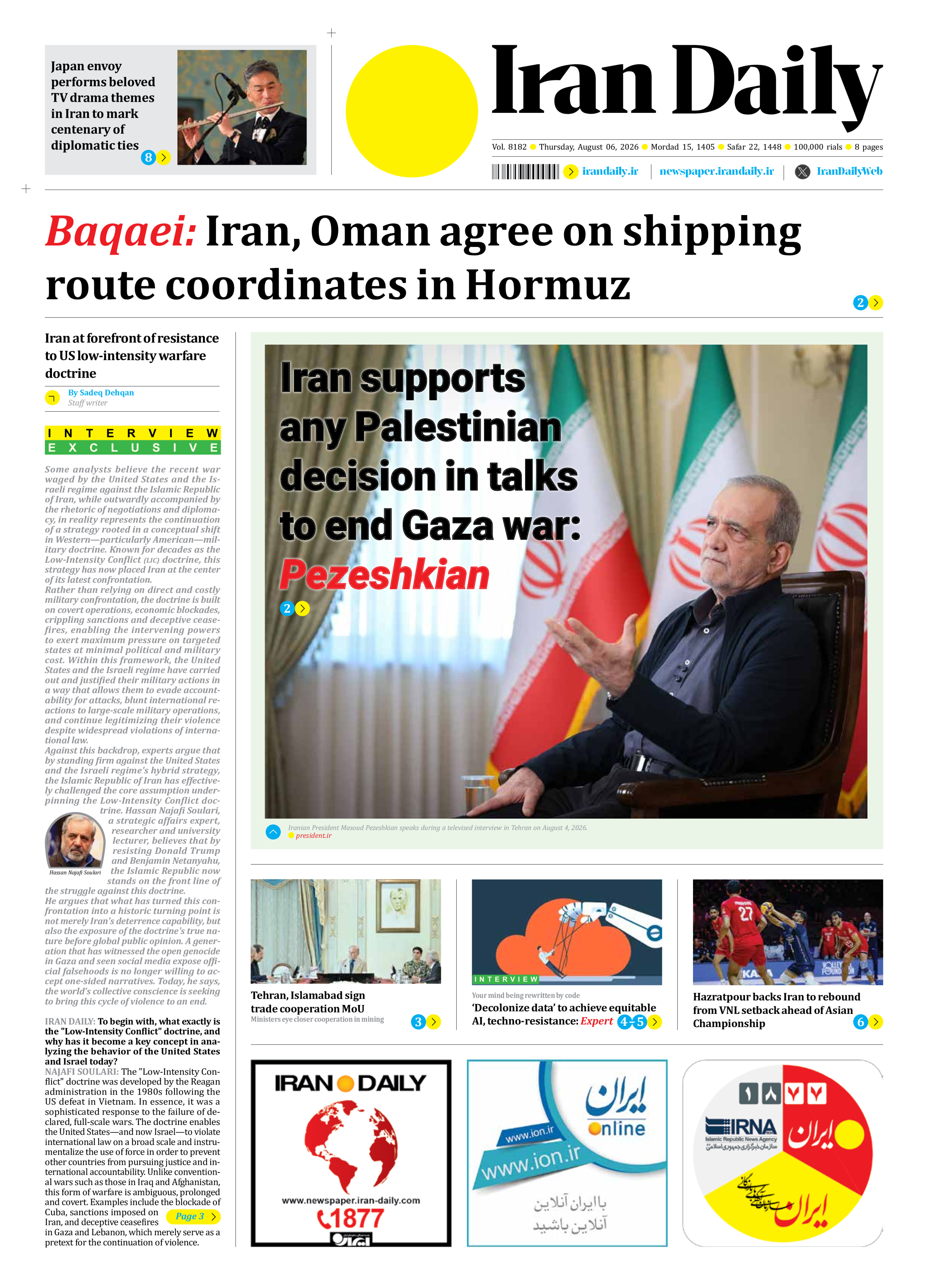


Iran at forefront of resistance to US low-intensity warfare doctrine
By Sadeq Dehqan
Staff writer
Some analysts believe the recent war waged by the United States and the Israeli regime against the Islamic Republic of Iran, while outwardly accompanied by the rhetoric of negotiations and diplomacy, in reality represents the continuation of a strategy rooted in a conceptual shift in Western—particularly American—military doctrine. Known for decades as the Low-Intensity Conflict (LIC) doctrine, this strategy has now placed Iran at the center of its latest confrontation.
Rather than relying on direct and costly military confrontation, the doctrine is built on covert operations, economic blockades, crippling sanctions and deceptive ceasefires, enabling the intervening powers to exert maximum pressure on targeted states at minimal political and military cost. Within this framework, the United States and the Israeli regime have carried out and justified their military actions in a way that allows them to evade accountability for attacks, blunt international reactions to large-scale military operations, and continue legitimizing their violence despite widespread violations of international law.
Against this backdrop, experts argue that by standing firm against the United States and the Israeli regime's hybrid strategy, the Islamic Republic of Iran has effectively challenged the core assumption underpinning the Low-Intensity Conflict doctrine. Hassan Najafi Soulari, a strategic affairs expert, researcher and university lecturer, believes that by resisting Donald Trump and Benjamin Netanyahu, the Islamic Republic now stands on the front line of the struggle against this doctrine.
He argues that what has turned this confrontation into a historic turning point is not merely Iran's deterrence capability, but also the exposure of the doctrine's true nature before global public opinion. A generation that has witnessed the open genocide in Gaza and seen social media expose official falsehoods is no longer willing to accept one-sided narratives. Today, he says, the world's collective conscience is seeking to bring this cycle of violence to an end.
IRAN DAILY: To begin with, what exactly is the "Low-Intensity Conflict" doctrine, and why has it become a key concept in analyzing the behavior of the United States and Israel today?
Najafi Soulari: The "Low-Intensity Conflict" doctrine was developed by the Reagan administration in the 1980s following the US defeat in Vietnam. In essence, it was a sophisticated response to the failure of declared, full-scale wars. The doctrine enables the United States—and now Israel—to violate international law on a broad scale and instrumentalize the use of force in order to prevent other countries from pursuing justice and international accountability. Unlike conventional wars such as those in Iraq and Afghanistan, this form of warfare is ambiguous, prolonged and covert. Examples include the blockade of Cuba, sanctions imposed on Iran, and deceptive ceasefires in Gaza and Lebanon, which merely serve as a pretext for the continuation of violence.
Page 3