







Takht-e Soleyman remains symbol of UNESCO heritage
Twenty-three years have passed since Takht-e Soleyman, home to the Azar Goshnasp Fire Temple, was inscribed on UNESCO’s World Heritage List, an achievement that ended a 24-year pause in the international registration of Iranian heritage sites and making it Iran’s fourth UNESCO World Heritage Site.
The archaeological site of Takht-e Soleyman, one of the most important religious and political centers of the Sassanid Empire, was inscribed on UNESCO’s World Heritage List on July 5, 2003, during the 27th session of the World Heritage Committee in Paris. The site had previously been registered on Iran’s National Heritage List in 1937, according to ISNA.
The inscription marked a turning point for Iran’s cultural heritage on the international stage. After the inscription of Persepolis, Naqsh-e Jahan Square in Isfahan and Chogha Zanbil in 1979, no Iranian site had been added to the World Heritage List for nearly 24 years. Takht-e Soleyman reopened the path for the international recognition of Iran’s historical monuments.
UNESCO recognizes Takht-e Soleyman as a masterpiece of human creativity whose architecture reflects outstanding achievements of the Sassanid period. The site bears exceptional testimony to a vanished civilization whose political, religious and artistic influence extended across much of Southwest and Central Asia.
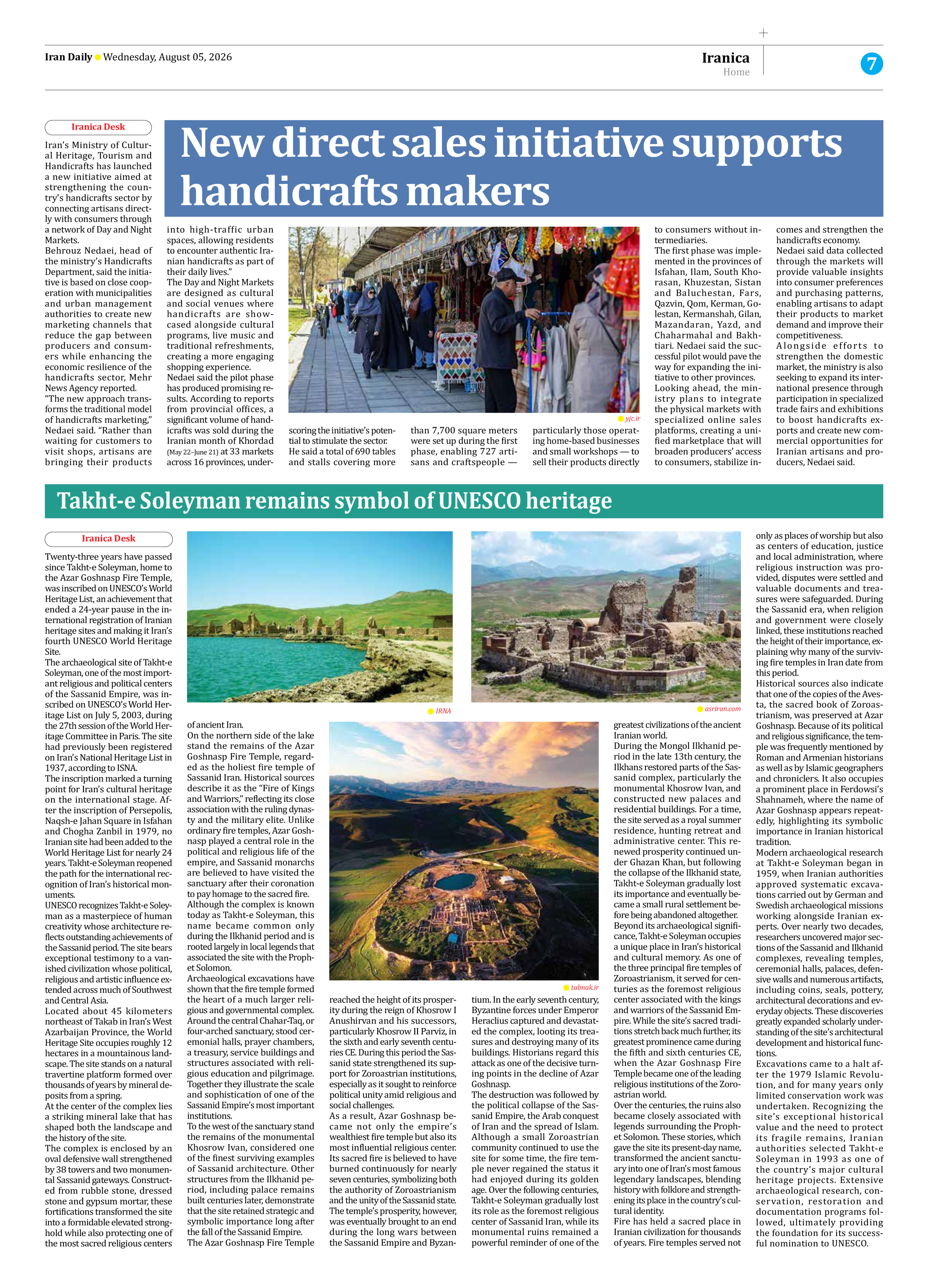
Located about 45 kilometers northeast of Takab in Iran’s West Azarbaijan Province, the World Heritage Site occupies roughly 12 hectares in a mountainous landscape. The site stands on a natural travertine platform formed over thousands of years by mineral deposits from a spring.
At the center of the complex lies a striking mineral lake that has shaped both the landscape and the history of the site.
The complex is enclosed by an oval defensive wall strengthened by 38 towers and two monumental Sassanid gateways. Constructed from rubble stone, dressed stone and gypsum mortar, these fortifications transformed the site into a formidable elevated stronghold while also protecting one of the most sacred religious centers of ancient Iran.
On the northern side of the lake stand the remains of the Azar Goshnasp Fire Temple, regarded as the holiest fire temple of Sassanid Iran. Historical sources describe it as the “Fire of Kings and Warriors,” reflecting its close association with the ruling dynasty and the military elite. Unlike ordinary fire temples, Azar Goshnasp played a central role in the political and religious life of the empire, and Sassanid monarchs are believed to have visited the sanctuary after their coronation to pay homage to the sacred fire.
Although the complex is known today as Takht-e Soleyman, this name became common only during the Ilkhanid period and is rooted largely in local legends that associated the site with the Prophet Solomon.
Archaeological excavations have shown that the fire temple formed the heart of a much larger religious and governmental complex. Around the central Chahar-Taq, or four-arched sanctuary, stood ceremonial halls, prayer chambers, a treasury, service buildings and structures associated with religious education and pilgrimage. Together they illustrate the scale and sophistication of one of the Sassanid Empire’s most important institutions.
To the west of the sanctuary stand the remains of the monumental Khosrow Ivan, considered one of the finest surviving examples of Sassanid architecture. Other structures from the Ilkhanid period, including palace remains built centuries later, demonstrate that the site retained strategic and symbolic importance long after the fall of the Sassanid Empire.
The Azar Goshnasp Fire Temple reached the height of its prosperity during the reign of Khosrow I Anushirvan and his successors, particularly Khosrow II Parviz, in the sixth and early seventh centuries CE. During this period the Sassanid state strengthened its support for Zoroastrian institutions, especially as it sought to reinforce political unity amid religious and social challenges.
As a result, Azar Goshnasp became not only the empire’s wealthiest fire temple but also its most influential religious center. Its sacred fire is believed to have burned continuously for nearly seven centuries, symbolizing both the authority of Zoroastrianism and the unity of the Sassanid state.
The temple’s prosperity, however, was eventually brought to an end during the long wars between the Sassanid Empire and Byzantium. In the early seventh century, Byzantine forces under Emperor Heraclius captured and devastated the complex, looting its treasures and destroying many of its buildings. Historians regard this attack as one of the decisive turning points in the decline of Azar Goshnasp.
The destruction was followed by the political collapse of the Sassanid Empire, the Arab conquest of Iran and the spread of Islam. Although a small Zoroastrian community continued to use the site for some time, the fire temple never regained the status it had enjoyed during its golden age. Over the following centuries, Takht-e Soleyman gradually lost its role as the foremost religious center of Sassanid Iran, while its monumental ruins remained a powerful reminder of one of the greatest civilizations of the ancient Iranian world.
During the Mongol Ilkhanid period in the late 13th century, the Ilkhans restored parts of the Sassanid complex, particularly the monumental Khosrow Ivan, and constructed new palaces and residential buildings. For a time, the site served as a royal summer residence, hunting retreat and administrative center. This renewed prosperity continued under Ghazan Khan, but following the collapse of the Ilkhanid state, Takht-e Soleyman gradually lost its importance and eventually became a small rural settlement before being abandoned altogether.
Beyond its archaeological significance, Takht-e Soleyman occupies a unique place in Iran’s historical and cultural memory. As one of the three principal fire temples of Zoroastrianism, it served for centuries as the foremost religious center associated with the kings and warriors of the Sassanid Empire. While the site’s sacred traditions stretch back much further, its greatest prominence came during the fifth and sixth centuries CE, when the Azar Goshnasp Fire Temple became one of the leading religious institutions of the Zoroastrian world.
Over the centuries, the ruins also became closely associated with legends surrounding the Prophet Solomon. These stories, which gave the site its present-day name, transformed the ancient sanctuary into one of Iran’s most famous legendary landscapes, blending history with folklore and strengthening its place in the country’s cultural identity.
Fire has held a sacred place in Iranian civilization for thousands of years. Fire temples served not only as places of worship but also as centers of education, justice and local administration, where religious instruction was provided, disputes were settled and valuable documents and treasures were safeguarded. During the Sassanid era, when religion and government were closely linked, these institutions reached the height of their importance, explaining why many of the surviving fire temples in Iran date from this period.
Historical sources also indicate that one of the copies of the Avesta, the sacred book of Zoroastrianism, was preserved at Azar Goshnasp. Because of its political and religious significance, the temple was frequently mentioned by Roman and Armenian historians as well as by Islamic geographers and chroniclers. It also occupies a prominent place in Ferdowsi’s Shahnameh, where the name of Azar Goshnasp appears repeatedly, highlighting its symbolic importance in Iranian historical tradition.
Modern archaeological research at Takht-e Soleyman began in 1959, when Iranian authorities approved systematic excavations carried out by German and Swedish archaeological missions working alongside Iranian experts. Over nearly two decades, researchers uncovered major sections of the Sassanid and Ilkhanid complexes, revealing temples, ceremonial halls, palaces, defensive walls and numerous artifacts, including coins, seals, pottery, architectural decorations and everyday objects. These discoveries greatly expanded scholarly understanding of the site’s architectural development and historical functions.
Excavations came to a halt after the 1979 Islamic Revolution, and for many years only limited conservation work was undertaken. Recognizing the site’s exceptional historical value and the need to protect its fragile remains, Iranian authorities selected Takht-e Soleyman in 1993 as one of the country’s major cultural heritage projects. Extensive archaeological research, conservation, restoration and documentation programs followed, ultimately providing the foundation for its successful nomination to UNESCO.