







Expansion of war Washington’s new strategy vis-à-vis Tehran
Saudi Arabia’s entry into conflict watershed moment
Strategic affairs analyst
The assault upon the Iranian vessel, perpetrated by Ukraine, and the recent strikes against Iraq are signs of an expanding conflict between Iran and the United States, and appear to herald the opening of additional fronts against Iran with the objective of intensifying pressure upon Tehran. In actuality, the United States and Israel endeavor to open novel paths and methods for exerting pressure upon Iran. It is said that during a meeting between Benjamin Netanyahu, the prime minister of the Israeli regime, and Donald Trump, the president of the United States, at the White House, this very subject — namely, innovative methods for applying pressure upon Iran — was deliberated; nevertheless, its particulars have not yet leaked to the outside.
Apparently, the Americans, in response to Iran’s strategy of expanding the war’s geography, are reciprocally attempting to broaden the war’s geography as well. Indications thereof comprise, on the one hand, Ukraine’s attack upon the Iranian maritime asset and, on the other, the joint American-Saudi strikes against the Popular Mobilization Forces’ headquarters in Iraq.
In my estimation, this constitutes a watershed moment within this confrontation. Heretofore, the Americans and regional states, at minimum, exercised caution regarding direct entry into engagement with the Axis of Resistance, endeavoring either to have Israel execute such operations or to conduct clandestine activities; however, the recent assaults by the United States and Saudi Arabia against Popular Mobilization Forces’ installations, resulting in the martyrdom of several of its members, appear to indicate a novel approach in confronting Iran on the part of the United States.
The American and Saudi strikes against the Popular Mobilization Forces are consequential from multiple perspectives. First, Saudi Arabia has explicitly acknowledged its participation in these attacks — a matter of considerable importance. Previously, Saudi Arabia attempted to refrain from adopting an explicit and transparent posture regarding this issue and, so to speak, to proceed with prudence; yet its commission of this act conveys the message that it stands prepared to attack the Axis of Resistance in other locations as well, should necessity arise, which shall likely manifest in subsequent confrontations within Yemen.
On the other hand, the message is that any point from which unmanned aerial vehicles are dispatched toward Saudi Arabia shall be targeted by that kingdom. Another message, likewise salient, is the collaboration between Saudi Arabia and the United States. We know that after Trump declared his intention to conduct the operation for “liberating” vessels in the Strait of Hormuz, Saudi Arabia and Qatar refrained from cooperating with the United States, asserting that such action might precipitate an exacerbation of the regional crisis. Consequently, when Saudi Arabia undertakes joint military action with the United States against the Popular Mobilization Forces, this may bear the significance and implication that it no longer harbors its previous concerns and, in effect, wishes to communicate to Iran its readiness for escalation and its potential entry into direct confrontation with Iran should this trajectory persist.
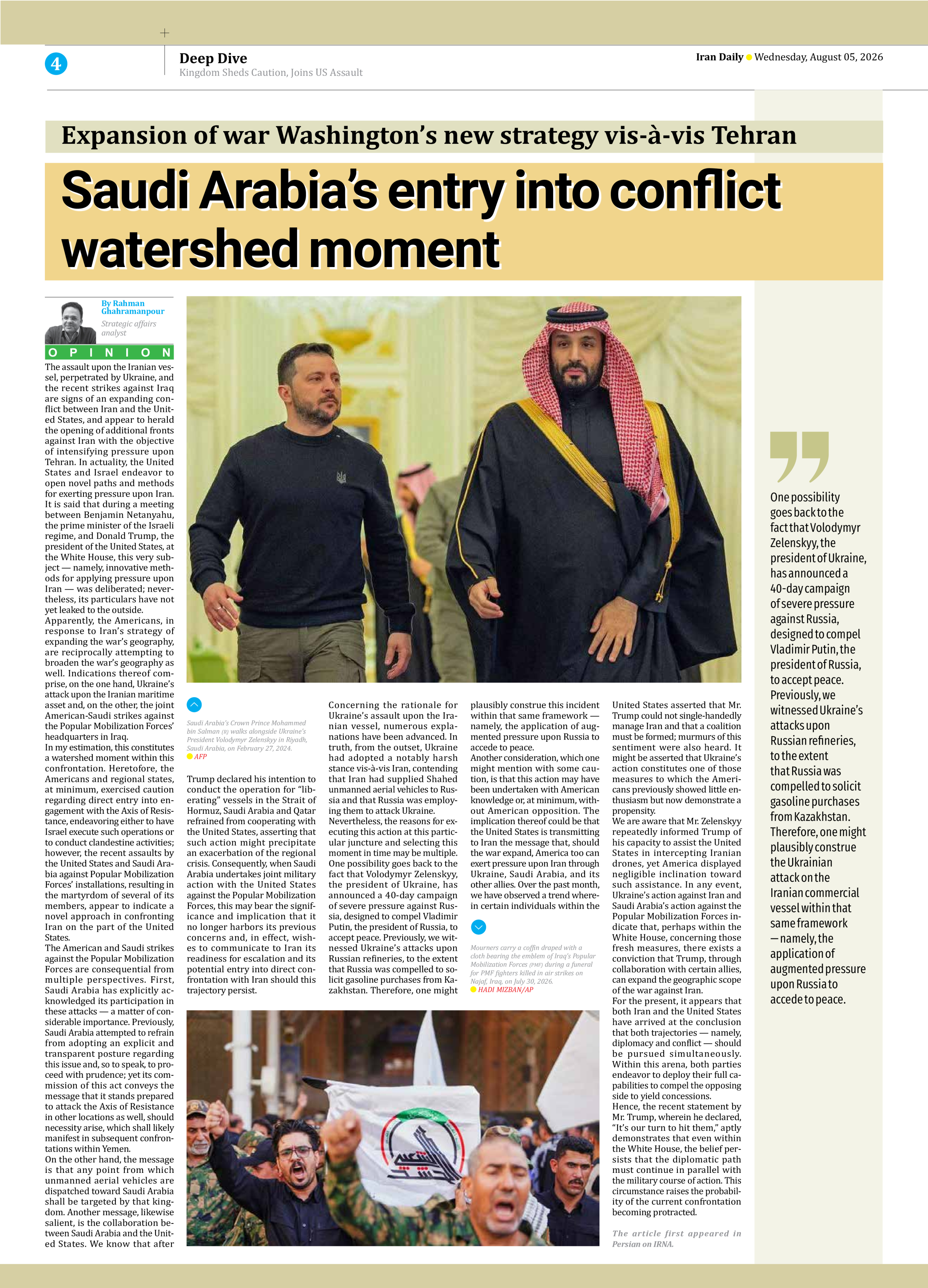
Concerning the rationale for Ukraine’s assault upon the Iranian vessel, numerous explanations have been advanced. In truth, from the outset, Ukraine had adopted a notably harsh stance vis-à-vis Iran, contending that Iran had supplied Shahed unmanned aerial vehicles to Russia and that Russia was employing them to attack Ukraine.
Nevertheless, the reasons for executing this action at this particular juncture and selecting this moment in time may be multiple. One possibility goes back to the fact that Volodymyr Zelenskyy, the president of Ukraine, has announced a 40-day campaign of severe pressure against Russia, designed to compel Vladimir Putin, the president of Russia, to accept peace. Previously, we witnessed Ukraine’s attacks upon Russian refineries, to the extent that Russia was compelled to solicit gasoline purchases from Kazakhstan. Therefore, one might plausibly construe this incident within that same framework — namely, the application of augmented pressure upon Russia to accede to peace.
Another consideration, which one might mention with some caution, is that this action may have been undertaken with American knowledge or, at minimum, without American opposition. The implication thereof could be that the United States is transmitting to Iran the message that, should the war expand, America too can exert pressure upon Iran through Ukraine, Saudi Arabia, and its other allies. Over the past month, we have observed a trend wherein certain individuals within the United States asserted that Mr. Trump could not single-handedly manage Iran and that a coalition must be formed; murmurs of this sentiment were also heard. It might be asserted that Ukraine’s action constitutes one of those measures to which the Americans previously showed little enthusiasm but now demonstrate a propensity.
We are aware that Mr. Zelenskyy repeatedly informed Trump of his capacity to assist the United States in intercepting Iranian drones, yet America displayed negligible inclination toward such assistance. In any event, Ukraine’s action against Iran and Saudi Arabia’s action against the Popular Mobilization Forces indicate that, perhaps within the White House, concerning those fresh measures, there exists a conviction that Trump, through collaboration with certain allies, can expand the geographic scope of the war against Iran.
For the present, it appears that both Iran and the United States have arrived at the conclusion that both trajectories — namely, diplomacy and conflict — should be pursued simultaneously. Within this arena, both parties endeavor to deploy their full capabilities to compel the opposing side to yield concessions.
Hence, the recent statement by Mr. Trump, wherein he declared, “It’s our turn to hit them,” aptly demonstrates that even within the White House, the belief persists that the diplomatic path must continue in parallel with the military course of action. This circumstance raises the probability of the current confrontation becoming protracted.
The article first appeared in Persian on IRNA.