







Iran, Pakistan advance toward $10b trade target at economic talks
Neighbors to discuss finalizing free trade deal at joint commission
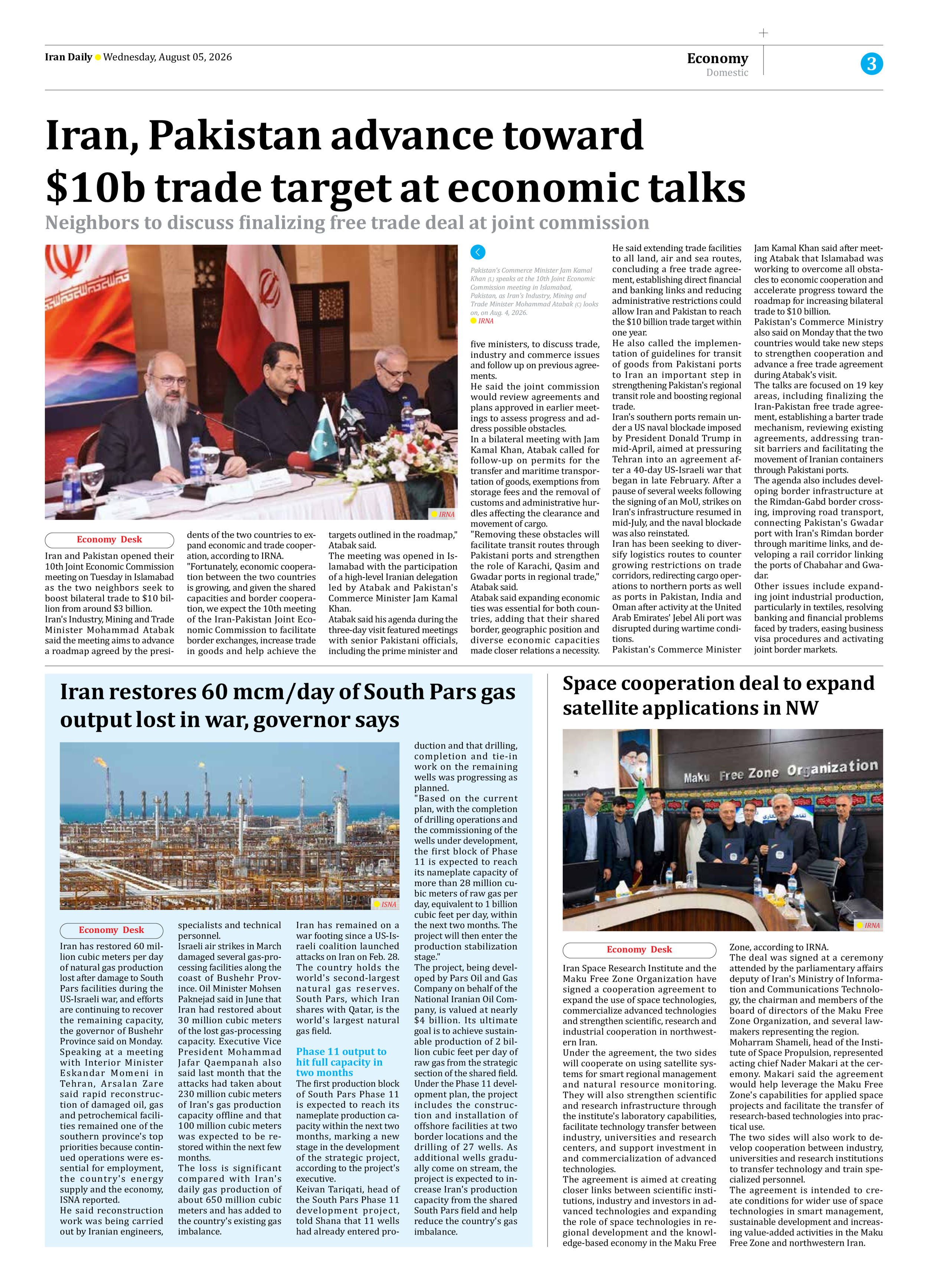
Iran and Pakistan opened their 10th Joint Economic Commission meeting on Tuesday in Islamabad as the two neighbors seek to boost bilateral trade to $10 billion from around $3 billion.
Iran's Industry, Mining and Trade Minister Mohammad Atabak said the meeting aims to advance a roadmap agreed by the presidents of the two countries to expand economic and trade cooperation, according to IRNA.
"Fortunately, economic cooperation between the two countries is growing, and given the shared capacities and border cooperation, we expect the 10th meeting of the Iran-Pakistan Joint Economic Commission to facilitate border exchanges, increase trade in goods and help achieve the targets outlined in the roadmap," Atabak said.
The meeting was opened in Islamabad with the participation of a high-level Iranian delegation led by Atabak and Pakistan's Commerce Minister Jam Kamal Khan.
Atabak said his agenda during the three-day visit featured meetings with senior Pakistani officials, including the prime minister and five ministers, to discuss trade, industry and commerce issues and follow up on previous agreements.
He said the joint commission would review agreements and plans approved in earlier meetings to assess progress and address possible obstacles.
In a bilateral meeting with Jam Kamal Khan, Atabak called for follow-up on permits for the transfer and maritime transportation of goods, exemptions from storage fees and the removal of customs and administrative hurdles affecting the clearance and movement of cargo.
"Removing these obstacles will facilitate transit routes through Pakistani ports and strengthen the role of Karachi, Qasim and Gwadar ports in regional trade," Atabak said.
Atabak said expanding economic ties was essential for both countries, adding that their shared border, geographic position and diverse economic capacities made closer relations a necessity.
He said extending trade facilities to all land, air and sea routes, concluding a free trade agreement, establishing direct financial and banking links and reducing administrative restrictions could allow Iran and Pakistan to reach the $10 billion trade target within one year.
He also called the implementation of guidelines for transit of goods from Pakistani ports to Iran an important step in strengthening Pakistan's regional transit role and boosting regional trade.
Iran's southern ports remain under a US naval blockade imposed by President Donald Trump in mid-April, aimed at pressuring Tehran into an agreement after a 40-day US-Israeli war that began in late February. After a pause of several weeks following the signing of an MoU, strikes on Iran's infrastructure resumed in mid-July, and the naval blockade was also reinstated.
Iran has been seeking to diversify logistics routes to counter growing restrictions on trade corridors, redirecting cargo operations to northern ports as well as ports in Pakistan, India and Oman after activity at the United Arab Emirates' Jebel Ali port was disrupted during wartime conditions.
Pakistan's Commerce Minister Jam Kamal Khan said after meeting Atabak that Islamabad was working to overcome all obstacles to economic cooperation and accelerate progress toward the roadmap for increasing bilateral trade to $10 billion.
Pakistan's Commerce Ministry also said on Monday that the two countries would take new steps to strengthen cooperation and advance a free trade agreement during Atabak's visit.
The talks are focused on 19 key areas, including finalizing the Iran-Pakistan free trade agreement, establishing a barter trade mechanism, reviewing existing agreements, addressing transit barriers and facilitating the movement of Iranian containers through Pakistani ports.
The agenda also includes developing border infrastructure at the Rimdan-Gabd border crossing, improving road transport, connecting Pakistan's Gwadar port with Iran's Rimdan border through maritime links, and developing a rail corridor linking the ports of Chabahar and Gwadar.
Other issues include expanding joint industrial production, particularly in textiles, resolving banking and financial problems faced by traders, easing business visa procedures and activating joint border markets.