





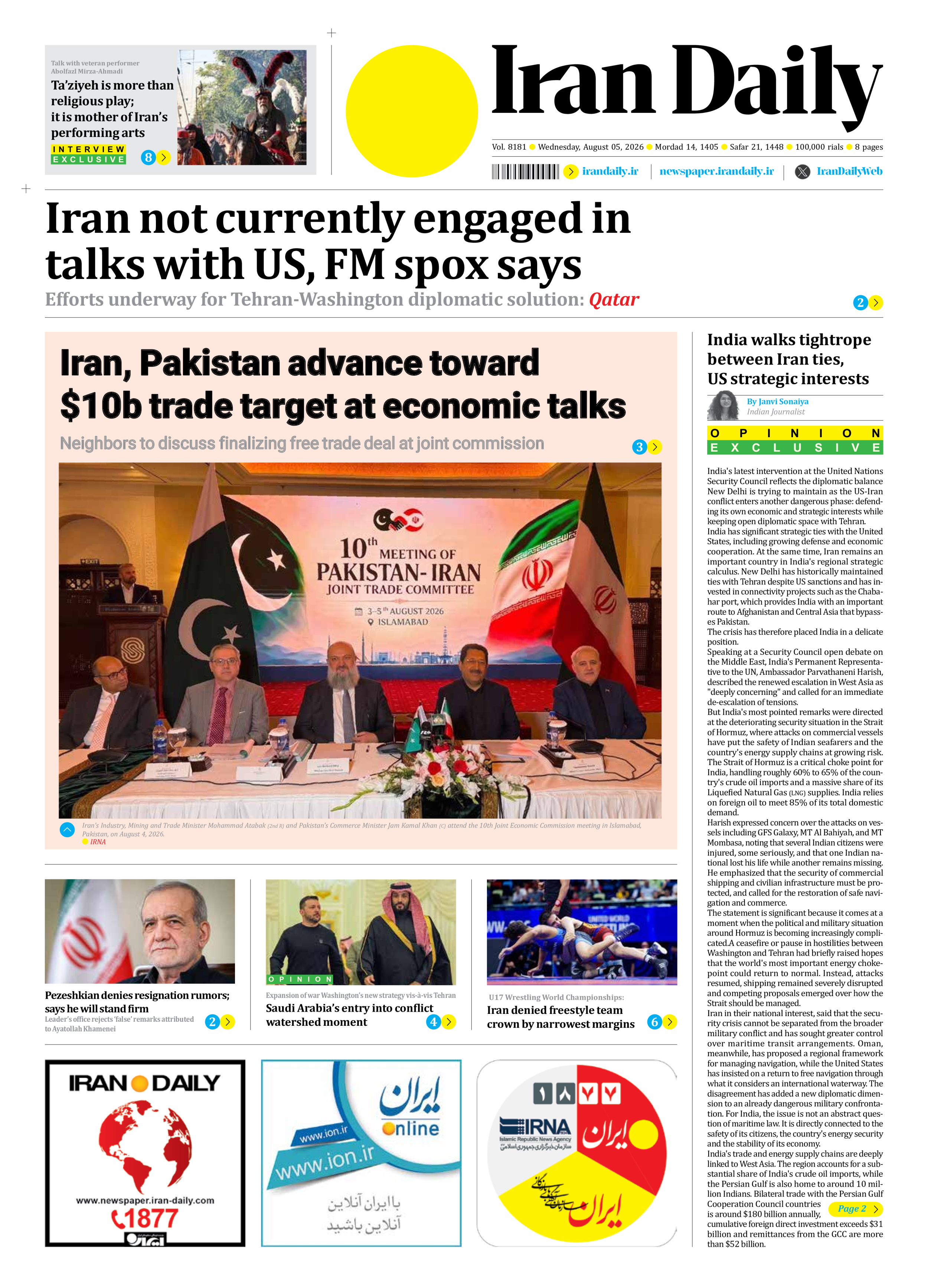


India walks tightrope between Iran ties, US strategic interests
By Janvi Sonaiya
Indian Journalist
India's latest intervention at the United Nations Security Council reflects the diplomatic balance New Delhi is trying to maintain as the US-Iran conflict enters another dangerous phase: defending its own economic and strategic interests while keeping open diplomatic space with Tehran.
India has significant strategic ties with the United States, including growing defense and economic cooperation. At the same time, Iran remains an important country in India's regional strategic calculus. New Delhi has historically maintained ties with Tehran despite US sanctions and has invested in connectivity projects such as the Chabahar port, which provides India with an important route to Afghanistan and Central Asia that bypasses Pakistan.
The crisis has therefore placed India in a delicate position.
Speaking at a Security Council open debate on the Middle East, India's Permanent Representative to the UN, Ambassador Parvathaneni Harish, described the renewed escalation in West Asia as "deeply concerning" and called for an immediate de-escalation of tensions.
But India's most pointed remarks were directed at the deteriorating security situation in the Strait of Hormuz, where attacks on commercial vessels have put the safety of Indian seafarers and the country's energy supply chains at growing risk. The Strait of Hormuz is a critical choke point for India, handling roughly 60% to 65% of the country's crude oil imports and a massive share of its Liquefied Natural Gas (LNG) supplies. India relies on foreign oil to meet 85% of its total domestic demand.
Harish expressed concern over the attacks on vessels including GFS Galaxy, MT Al Bahiyah, and MT Mombasa, noting that several Indian citizens were injured, some seriously, and that one Indian national lost his life while another remains missing.
He emphasized that the security of commercial shipping and civilian infrastructure must be protected, and called for the restoration of safe navigation and commerce.
The statement is significant because it comes at a moment when the political and military situation around Hormuz is becoming increasingly complicated.A ceasefire or pause in hostilities between Washington and Tehran had briefly raised hopes that the world's most important energy chokepoint could return to normal. Instead, attacks resumed, shipping remained severely disrupted and competing proposals emerged over how the Strait should be managed.
Iran in their national interest, said that the security crisis cannot be separated from the broader military conflict and has sought greater control over maritime transit arrangements. Oman, meanwhile, has proposed a regional framework for managing navigation, while the United States has insisted on a return to free navigation through what it considers an international waterway. The disagreement has added a new diplomatic dimension to an already dangerous military confrontation. For India, the issue is not an abstract question of maritime law. It is directly connected to the safety of its citizens, the country's energy security and the stability of its economy.
India's trade and energy supply chains are deeply linked to West Asia. The region accounts for a substantial share of India's crude oil imports, while the Persian Gulf is also home to around 10 million Indians. Bilateral trade with the Persian Gulf Cooperation Council countries is around $180 billion annually, cumulative foreign direct investment exceeds $31 billion and remittances from the GCC are more than $52 billion.
Page 2