







Copy in clipboard...
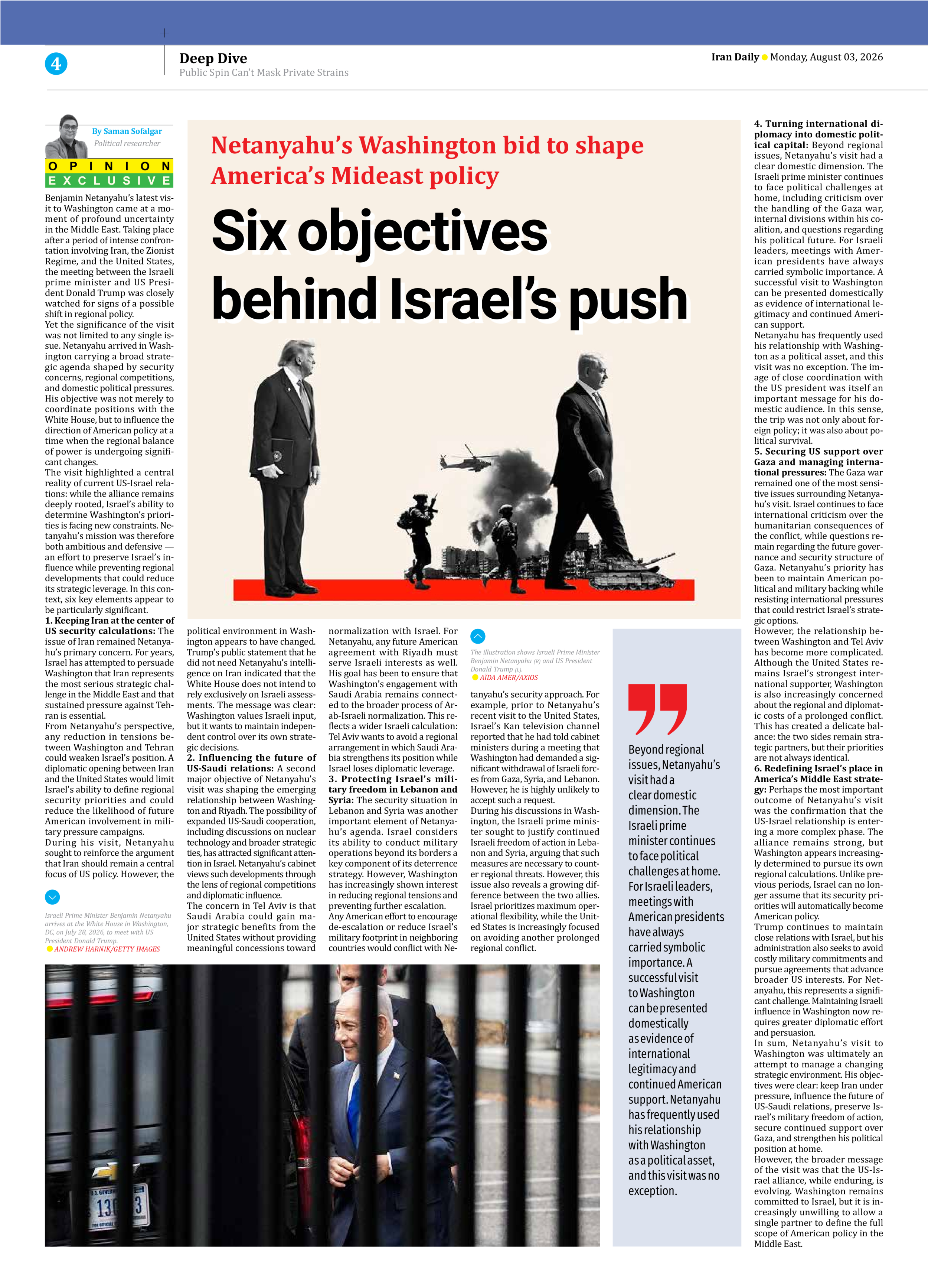
Netanyahu’s Washington bid to shape America’s Mideast policy
Six objectives behind Israel’s push
Political researcher
Benjamin Netanyahu’s latest visit to Washington came at a moment of profound uncertainty in the Middle East. Taking place after a period of intense confrontation involving Iran, the Zionist Regime, and the United States, the meeting between the Israeli prime minister and US President Donald Trump was closely watched for signs of a possible shift in regional policy.
Yet the significance of the visit was not limited to any single issue. Netanyahu arrived in Washington carrying a broad strategic agenda shaped by security concerns, regional competitions, and domestic political pressures. His objective was not merely to coordinate positions with the White House, but to influence the direction of American policy at a time when the regional balance of power is undergoing significant changes.
The visit highlighted a central reality of current US-Israel relations: while the alliance remains deeply rooted, Israel’s ability to determine Washington’s priorities is facing new constraints. Netanyahu’s mission was therefore both ambitious and defensive — an effort to preserve Israel’s influence while preventing regional developments that could reduce its strategic leverage. In this context, six key elements appear to be particularly significant.
1. Keeping Iran at the center of US security calculations: The issue of Iran remained Netanyahu’s primary concern. For years, Israel has attempted to persuade Washington that Iran represents the most serious strategic challenge in the Middle East and that sustained pressure against Tehran is essential.
From Netanyahu’s perspective, any reduction in tensions between Washington and Tehran could weaken Israel’s position. A diplomatic opening between Iran and the United States would limit Israel’s ability to define regional security priorities and could reduce the likelihood of future American involvement in military pressure campaigns.
During his visit, Netanyahu sought to reinforce the argument that Iran should remain a central focus of US policy. However, the political environment in Washington appears to have changed. Trump’s public statement that he did not need Netanyahu’s intelligence on Iran indicated that the White House does not intend to rely exclusively on Israeli assessments. The message was clear: Washington values Israeli input, but it wants to maintain independent control over its own strategic decisions.
2. Influencing the future of US-Saudi relations: A second major objective of Netanyahu’s visit was shaping the emerging relationship between Washington and Riyadh. The possibility of expanded US-Saudi cooperation, including discussions on nuclear technology and broader strategic ties, has attracted significant attention in Israel. Netanyahu’s cabinet views such developments through the lens of regional competitions and diplomatic influence.
The concern in Tel Aviv is that Saudi Arabia could gain major strategic benefits from the United States without providing meaningful concessions toward normalization with Israel. For Netanyahu, any future American agreement with Riyadh must serve Israeli interests as well. His goal has been to ensure that Washington’s engagement with Saudi Arabia remains connected to the broader process of Arab-Israeli normalization. This reflects a wider Israeli calculation: Tel Aviv wants to avoid a regional arrangement in which Saudi Arabia strengthens its position while Israel loses diplomatic leverage.
3. Protecting Israel’s military freedom in Lebanon and Syria: The security situation in Lebanon and Syria was another important element of Netanyahu’s agenda. Israel considers its ability to conduct military operations beyond its borders a key component of its deterrence strategy. However, Washington has increasingly shown interest in reducing regional tensions and preventing further escalation.
Any American effort to encourage de-escalation or reduce Israel’s military footprint in neighboring countries would conflict with Netanyahu’s security approach. For example, prior to Netanyahu’s recent visit to the United States, Israel’s Kan television channel reported that he had told cabinet ministers during a meeting that Washington had demanded a significant withdrawal of Israeli forces from Gaza, Syria, and Lebanon. However, he is highly unlikely to accept such a request.
During his discussions in Washington, the Israeli prime minister sought to justify continued Israeli freedom of action in Lebanon and Syria, arguing that such measures are necessary to counter regional threats. However, this issue also reveals a growing difference between the two allies. Israel prioritizes maximum operational flexibility, while the United States is increasingly focused on avoiding another prolonged regional conflict.
4. Turning international diplomacy into domestic political capital: Beyond regional issues, Netanyahu’s visit had a clear domestic dimension. The Israeli prime minister continues to face political challenges at home, including criticism over the handling of the Gaza war, internal divisions within his coalition, and questions regarding his political future. For Israeli leaders, meetings with American presidents have always carried symbolic importance. A successful visit to Washington can be presented domestically as evidence of international legitimacy and continued American support.
Netanyahu has frequently used his relationship with Washington as a political asset, and this visit was no exception. The image of close coordination with the US president was itself an important message for his domestic audience. In this sense, the trip was not only about foreign policy; it was also about political survival.
5. Securing US support over Gaza and managing international pressures: The Gaza war remained one of the most sensitive issues surrounding Netanyahu’s visit. Israel continues to face international criticism over the humanitarian consequences of the conflict, while questions remain regarding the future governance and security structure of Gaza. Netanyahu’s priority has been to maintain American political and military backing while resisting international pressures that could restrict Israel’s strategic options.
However, the relationship between Washington and Tel Aviv has become more complicated. Although the United States remains Israel’s strongest international supporter, Washington is also increasingly concerned about the regional and diplomatic costs of a prolonged conflict. This has created a delicate balance: the two sides remain strategic partners, but their priorities are not always identical.
6. Redefining Israel’s place in America’s Middle East strategy: Perhaps the most important outcome of Netanyahu’s visit was the confirmation that the US-Israel relationship is entering a more complex phase. The alliance remains strong, but Washington appears increasingly determined to pursue its own regional calculations. Unlike previous periods, Israel can no longer assume that its security priorities will automatically become American policy.
Trump continues to maintain close relations with Israel, but his administration also seeks to avoid costly military commitments and pursue agreements that advance broader US interests. For Netanyahu, this represents a significant challenge. Maintaining Israeli influence in Washington now requires greater diplomatic effort and persuasion.
In sum, Netanyahu’s visit to Washington was ultimately an attempt to manage a changing strategic environment. His objectives were clear: keep Iran under pressure, influence the future of US-Saudi relations, preserve Israel’s military freedom of action, secure continued support over Gaza, and strengthen his political position at home.
However, the broader message of the visit was that the US-Israel alliance, while enduring, is evolving. Washington remains committed to Israel, but it is increasingly unwilling to allow a single partner to define the full scope of American policy in the Middle East.