





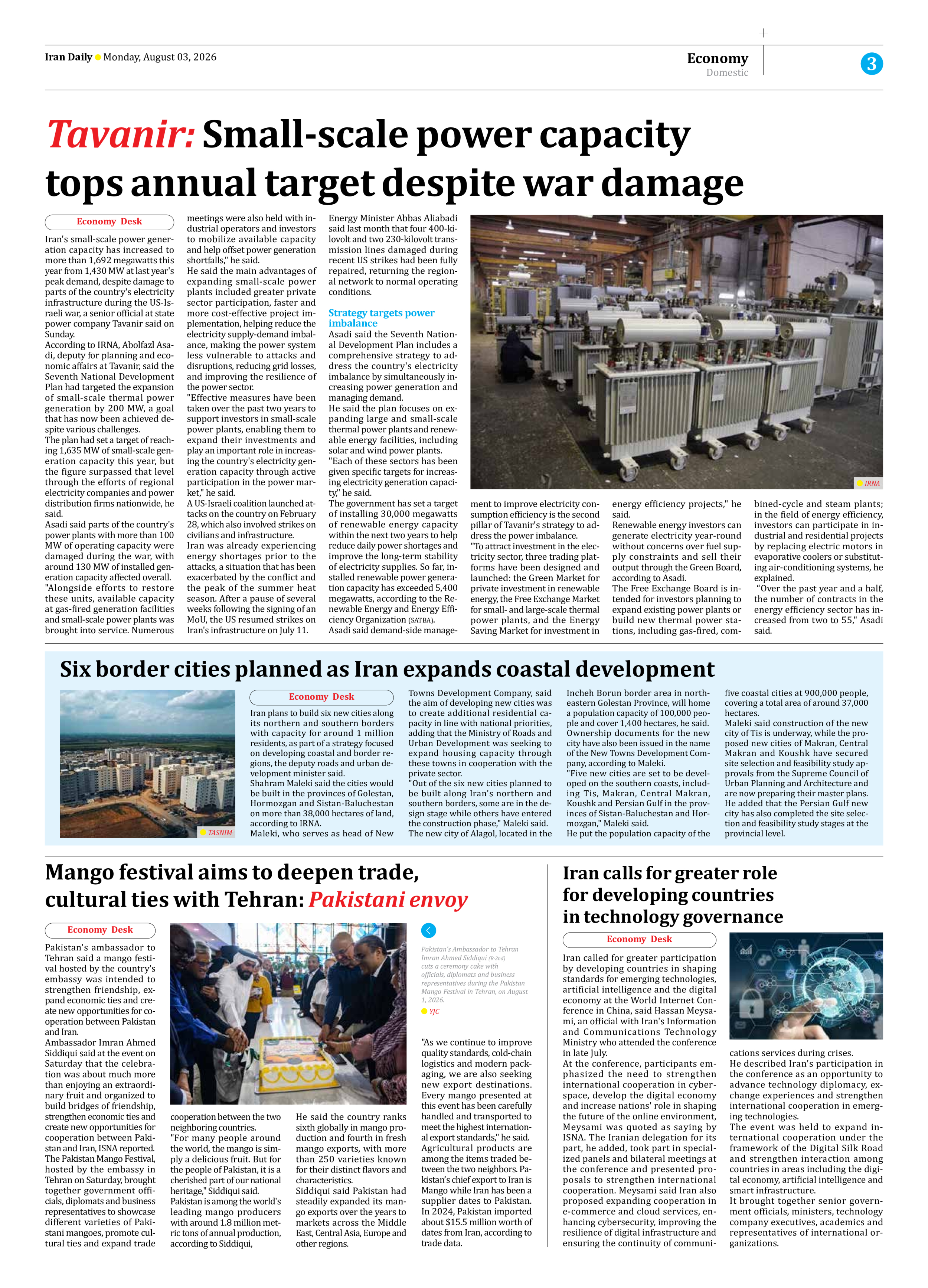


Tavanir: Small-scale power capacity tops annual target despite war damage
Iran's small-scale power generation capacity has increased to more than 1,692 megawatts this year from 1,430 MW at last year's peak demand, despite damage to parts of the country's electricity infrastructure during the US-Israeli war, a senior official at state power company Tavanir said on Sunday.
According to IRNA, Abolfazl Asadi, deputy for planning and economic affairs at Tavanir, said the Seventh National Development Plan had targeted the expansion of small-scale thermal power generation by 200 MW, a goal that has now been achieved despite various challenges.
The plan had set a target of reaching 1,635 MW of small-scale generation capacity this year, but the figure surpassed that level through the efforts of regional electricity companies and power distribution firms nationwide, he said.
Asadi said parts of the country's power plants with more than 100 MW of operating capacity were damaged during the war, with around 130 MW of installed generation capacity affected overall.
"Alongside efforts to restore these units, available capacity at gas-fired generation facilities and small-scale power plants was brought into service. Numerous meetings were also held with industrial operators and investors to mobilize available capacity and help offset power generation shortfalls," he said.
He said the main advantages of expanding small-scale power plants included greater private sector participation, faster and more cost-effective project implementation, helping reduce the electricity supply-demand imbalance, making the power system less vulnerable to attacks and disruptions, reducing grid losses, and improving the resilience of the power sector.
"Effective measures have been taken over the past two years to support investors in small-scale power plants, enabling them to expand their investments and play an important role in increasing the country's electricity generation capacity through active participation in the power market," he said.
A US-Israeli coalition launched attacks on the country on February 28, which also involved strikes on civilians and infrastructure.
Iran was already experiencing energy shortages prior to the attacks, a situation that has been exacerbated by the conflict and the peak of the summer heat season. After a pause of several weeks following the signing of an MoU, the US resumed strikes on Iran's infrastructure on July 11.
Energy Minister Abbas Aliabadi said last month that four 400-kilovolt and two 230-kilovolt transmission lines damaged during recent US strikes had been fully repaired, returning the regional network to normal operating conditions.
Strategy targets power imbalance
Asadi said the Seventh National Development Plan includes a comprehensive strategy to address the country's electricity imbalance by simultaneously increasing power generation and managing demand.
He said the plan focuses on expanding large and small-scale thermal power plants and renewable energy facilities, including solar and wind power plants.
"Each of these sectors has been given specific targets for increasing electricity generation capacity," he said.
The government has set a target of installing 30,000 megawatts of renewable energy capacity within the next two years to help reduce daily power shortages and improve the long-term stability of electricity supplies. So far, installed renewable power generation capacity has exceeded 5,400 megawatts, according to the Renewable Energy and Energy Efficiency Organization (SATBA).
Asadi said demand-side management to improve electricity consumption efficiency is the second pillar of Tavanir's strategy to address the power imbalance.
"To attract investment in the electricity sector, three trading platforms have been designed and launched: the Green Market for private investment in renewable energy, the Free Exchange Market for small- and large-scale thermal power plants, and the Energy Saving Market for investment in energy efficiency projects," he said.
Renewable energy investors can generate electricity year-round without concerns over fuel supply constraints and sell their output through the Green Board, according to Asadi.
The Free Exchange Board is intended for investors planning to expand existing power plants or build new thermal power stations, including gas-fired, combined-cycle and steam plants; in the field of energy efficiency, investors can participate in industrial and residential projects by replacing electric motors in evaporative coolers or substituting air-conditioning systems, he explained.
“Over the past year and a half, the number of contracts in the energy efficiency sector has increased from two to 55," Asadi said.