





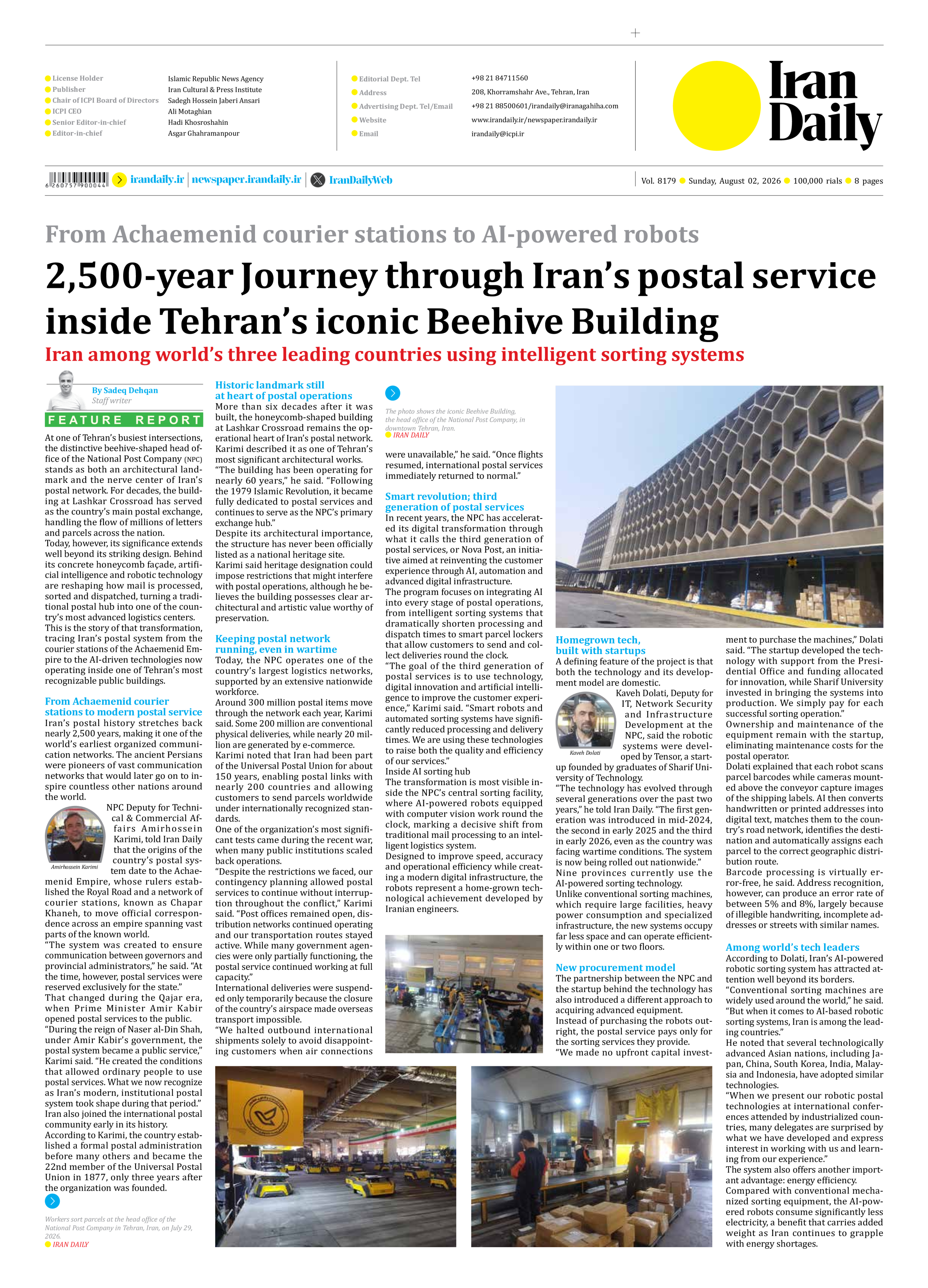


From Achaemenid courier stations to AI-powered robots
2,500-year Journey through Iran’s postal service inside Tehran’s iconic Beehive Building
Iran among world’s three leading countries using intelligent sorting systems
By Sadeq Dehqan
Staff writer
At one of Tehran’s busiest intersections, the distinctive beehive-shaped head office of the National Post Company (NPC) stands as both an architectural landmark and the nerve center of Iran’s postal network. For decades, the building at Lashkar Crossroad has served as the country’s main postal exchange, handling the flow of millions of letters and parcels across the nation.
Today, however, its significance extends well beyond its striking design. Behind its concrete honeycomb façade, artificial intelligence and robotic technology are reshaping how mail is processed, sorted and dispatched, turning a traditional postal hub into one of the country’s most advanced logistics centers.
This is the story of that transformation, tracing Iran’s postal system from the courier stations of the Achaemenid Empire to the AI-driven technologies now operating inside one of Tehran’s most recognizable public buildings.
From Achaemenid courier stations to modern postal service
Iran’s postal history stretches back nearly 2,500 years, making it one of the world’s earliest organized communication networks. The ancient Persians were pioneers of vast communication networks that would later go on to inspire countless other nations around the world.
NPC Deputy for Technical & Commercial Affairs Amirhossein Karimi, told Iran Daily that the origins of the country’s postal system date to the Achaemenid Empire, whose rulers established the Royal Road and a network of courier stations, known as Chapar Khaneh, to move official correspondence across an empire spanning vast parts of the known world.
“The system was created to ensure communication between governors and provincial administrators,” he said. “At the time, however, postal services were reserved exclusively for the state.”
That changed during the Qajar era, when Prime Minister Amir Kabir opened postal services to the public.
“During the reign of Naser al-Din Shah, under Amir Kabir’s government, the postal system became a public service,” Karimi said. “He created the conditions that allowed ordinary people to use postal services. What we now recognize as Iran’s modern, institutional postal system took shape during that period.”
Iran also joined the international postal community early in its history.
According to Karimi, the country established a formal postal administration before many others and became the 22nd member of the Universal Postal Union in 1877, only three years after the organization was founded.
Historic landmark still
at heart of postal operations
More than six decades after it was built, the honeycomb-shaped building at Lashkar Crossroad remains the operational heart of Iran’s postal network.
Karimi described it as one of Tehran’s most significant architectural works.
“The building has been operating for nearly 60 years,” he said. “Following the 1979 Islamic Revolution, it became fully dedicated to postal services and continues to serve as the NPC’s primary exchange hub.”
Despite its architectural importance, the structure has never been officially listed as a national heritage site.
Karimi said heritage designation could impose restrictions that might interfere with postal operations, although he believes the building possesses clear architectural and artistic value worthy of preservation.
Keeping postal network running, even in wartime
Today, the NPC operates one of the country’s largest logistics networks, supported by an extensive nationwide workforce.
Around 300 million postal items move through the network each year, Karimi said. Some 200 million are conventional physical deliveries, while nearly 20 million are generated by e-commerce.
Karimi noted that Iran had been part of the Universal Postal Union for about 150 years, enabling postal links with nearly 200 countries and allowing customers to send parcels worldwide under internationally recognized standards.
One of the organization’s most significant tests came during the recent war, when many public institutions scaled back operations.
“Despite the restrictions we faced, our contingency planning allowed postal services to continue without interruption throughout the conflict,” Karimi said. “Post offices remained open, distribution networks continued operating and our transportation routes stayed active. While many government agencies were only partially functioning, the postal service continued working at full capacity.”
International deliveries were suspended only temporarily because the closure of the country’s airspace made overseas transport impossible.
“We halted outbound international shipments solely to avoid disappointing customers when air connections were unavailable,” he said. “Once flights resumed, international postal services immediately returned to normal.”
Smart revolution; third generation of postal services
In recent years, the NPC has accelerated its digital transformation through what it calls the third generation of postal services, or Nova Post, an initiative aimed at reinventing the customer experience through AI, automation and advanced digital infrastructure.
The program focuses on integrating AI into every stage of postal operations, from intelligent sorting systems that dramatically shorten processing and dispatch times to smart parcel lockers that allow customers to send and collect deliveries round the clock.
“The goal of the third generation of postal services is to use technology, digital innovation and artificial intelligence to improve the customer experience,” Karimi said. “Smart robots and automated sorting systems have significantly reduced processing and delivery times. We are using these technologies to raise both the quality and efficiency of our services.”
Inside AI sorting hub
The transformation is most visible inside the NPC’s central sorting facility, where AI-powered robots equipped with computer vision work round the clock, marking a decisive shift from traditional mail processing to an intelligent logistics system.
Designed to improve speed, accuracy and operational efficiency while creating a modern digital infrastructure, the robots represent a home-grown technological achievement developed by Iranian engineers.
Homegrown tech,
built with startups
A defining feature of the project is that both the technology and its development model are domestic.
Kaveh Dolati, Deputy for IT, Network Security and Infrastructure Development at the NPC, said the robotic systems were developed by Tensor, a startup founded by graduates of Sharif University of Technology.
“The technology has evolved through several generations over the past two years,” he told Iran Daily. “The first generation was introduced in mid-2024, the second in early 2025 and the third in early 2026, even as the country was facing wartime conditions. The system is now being rolled out nationwide.”
Nine provinces currently use the AI-powered sorting technology.
Unlike conventional sorting machines, which require large facilities, heavy power consumption and specialized infrastructure, the new systems occupy far less space and can operate efficiently within one or two floors.
New procurement model
The partnership between the NPC and the startup behind the technology has also introduced a different approach to acquiring advanced equipment.
Instead of purchasing the robots outright, the postal service pays only for the sorting services they provide.
“We made no upfront capital investment to purchase the machines,” Dolati said. “The startup developed the technology with support from the Presidential Office and funding allocated for innovation, while Sharif University invested in bringing the systems into production. We simply pay for each successful sorting operation.”
Ownership and maintenance of the equipment remain with the startup, eliminating maintenance costs for the postal operator.
Dolati explained that each robot scans parcel barcodes while cameras mounted above the conveyor capture images of the shipping labels. AI then converts handwritten or printed addresses into digital text, matches them to the country’s road network, identifies the destination and automatically assigns each parcel to the correct geographic distribution route.
Barcode processing is virtually error-free, he said. Address recognition, however, can produce an error rate of between 5% and 8%, largely because of illegible handwriting, incomplete addresses or streets with similar names.
Among world’s tech leaders
According to Dolati, Iran’s AI-powered robotic sorting system has attracted attention well beyond its borders.
“Conventional sorting machines are widely used around the world,” he said. “But when it comes to AI-based robotic sorting systems, Iran is among the leading countries.”
He noted that several technologically advanced Asian nations, including Japan, China, South Korea, India, Malaysia and Indonesia, have adopted similar technologies.
“When we present our robotic postal technologies at international conferences attended by industrialized countries, many delegates are surprised by what we have developed and express interest in working with us and learning from our experience.”
The system also offers another important advantage: energy efficiency.
Compared with conventional mechanized sorting equipment, the AI-powered robots consume significantly less electricity, a benefit that carries added weight as Iran continues to grapple with energy shortages.