







Aichi-Nagoya 2026 Asian Games:
Reduced quotas, new rules raise stakes for Iran weightlifters
Iran’s weightlifting team faces a far more demanding task at the Aichi-Nagoya 2026 Asian Games as reduced athlete quotas, new competition regulations, and stronger regional rivals threaten the country’s hopes of a prolific campaign.
Weightlifting has traditionally been one of Iran’s richest sources of Asian Games gold medals alongside wrestling, but the sport heads into Nagoya under a significantly different format.
The most notable change is the introduction of the “total-only” medal system, with medals to be awarded solely based on combined lifts rather than separate snatch and clean and jerk results. In addition, each nation will be allowed to enter only one athlete in each weight category, making team selection more challenging for countries with multiple medal contenders.
Iran has secured eight quota places for the Games, comprising five men and three women, two fewer than it had at the previous edition in Hangzhou. The men’s team will compete in the 75kg, 85kg, 95kg, 110kg and +110kg categories, while the women’s representatives will contest the 69kg, 77kg and 86kg divisions.
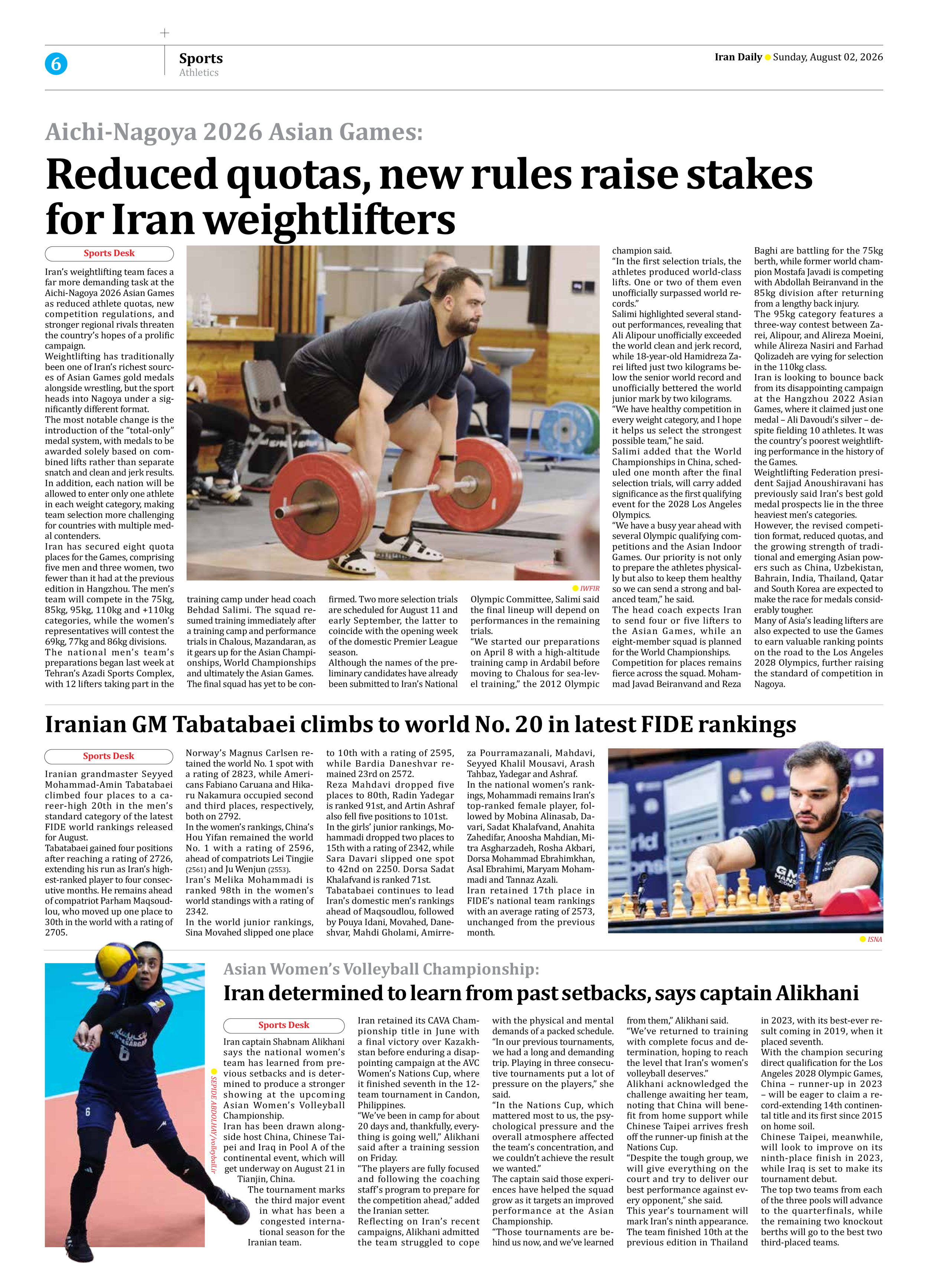
The national men’s team’s preparations began last week at Tehran’s Azadi Sports Complex, with 12 lifters taking part in the training camp under head coach Behdad Salimi. The squad resumed training immediately after a training camp and performance trials in Chalous, Mazandaran, as it gears up for the Asian Championships, World Championships and ultimately the Asian Games.
The final squad has yet to be confirmed. Two more selection trials are scheduled for August 11 and early September, the latter to coincide with the opening week of the domestic Premier League season.
Although the names of the preliminary candidates have already been submitted to Iran’s National Olympic Committee, Salimi said the final lineup will depend on performances in the remaining trials.
“We started our preparations on April 8 with a high-altitude training camp in Ardabil before moving to Chalous for sea-level training,” the 2012 Olympic champion said.
“In the first selection trials, the athletes produced world-class lifts. One or two of them even unofficially surpassed world records.”
Salimi highlighted several standout performances, revealing that Ali Alipour unofficially exceeded the world clean and jerk record, while 18-year-old Hamidreza Zarei lifted just two kilograms below the senior world record and unofficially bettered the world junior mark by two kilograms.
“We have healthy competition in every weight category, and I hope it helps us select the strongest possible team,” he said.
Salimi added that the World Championships in China, scheduled one month after the final selection trials, will carry added significance as the first qualifying event for the 2028 Los Angeles Olympics.
“We have a busy year ahead with several Olympic qualifying competitions and the Asian Indoor Games. Our priority is not only to prepare the athletes physically but also to keep them healthy so we can send a strong and balanced team,” he said.
The head coach expects Iran to send four or five lifters to the Asian Games, while an eight-member squad is planned for the World Championships.
Competition for places remains fierce across the squad. Mohammad Javad Beiranvand and Reza Baghi are battling for the 75kg berth, while former world champion Mostafa Javadi is competing with Abdollah Beiranvand in the 85kg division after returning from a lengthy back injury.
The 95kg category features a three-way contest between Zarei, Alipour, and Alireza Moeini, while Alireza Nasiri and Farhad Qolizadeh are vying for selection in the 110kg class.
Iran is looking to bounce back from its disappointing campaign at the Hangzhou 2022 Asian Games, where it claimed just one medal – Ali Davoudi’s silver – despite fielding 10 athletes. It was the country’s poorest weightlifting performance in the history of the Games.
Weightlifting Federation president Sajjad Anoushiravani has previously said Iran’s best gold medal prospects lie in the three heaviest men’s categories.
However, the revised competition format, reduced quotas, and the growing strength of traditional and emerging Asian powers such as China, Uzbekistan, Bahrain, India, Thailand, Qatar and South Korea are expected to make the race for medals considerably tougher.
Many of Asia’s leading lifters are also expected to use the Games to earn valuable ranking points on the road to the Los Angeles 2028 Olympics, further raising the standard of competition in Nagoya.