







Gov’t approves East-West transit corridor plan linking Afghanistan railway project
Iran approved the general framework of an East-West transport corridor anchored by the Herat–Mazar-e Sharif railway project on Saturday, aiming to increase its share of the international transit market, strengthen its geoeconomic position and expand regional economic cooperation and investment.
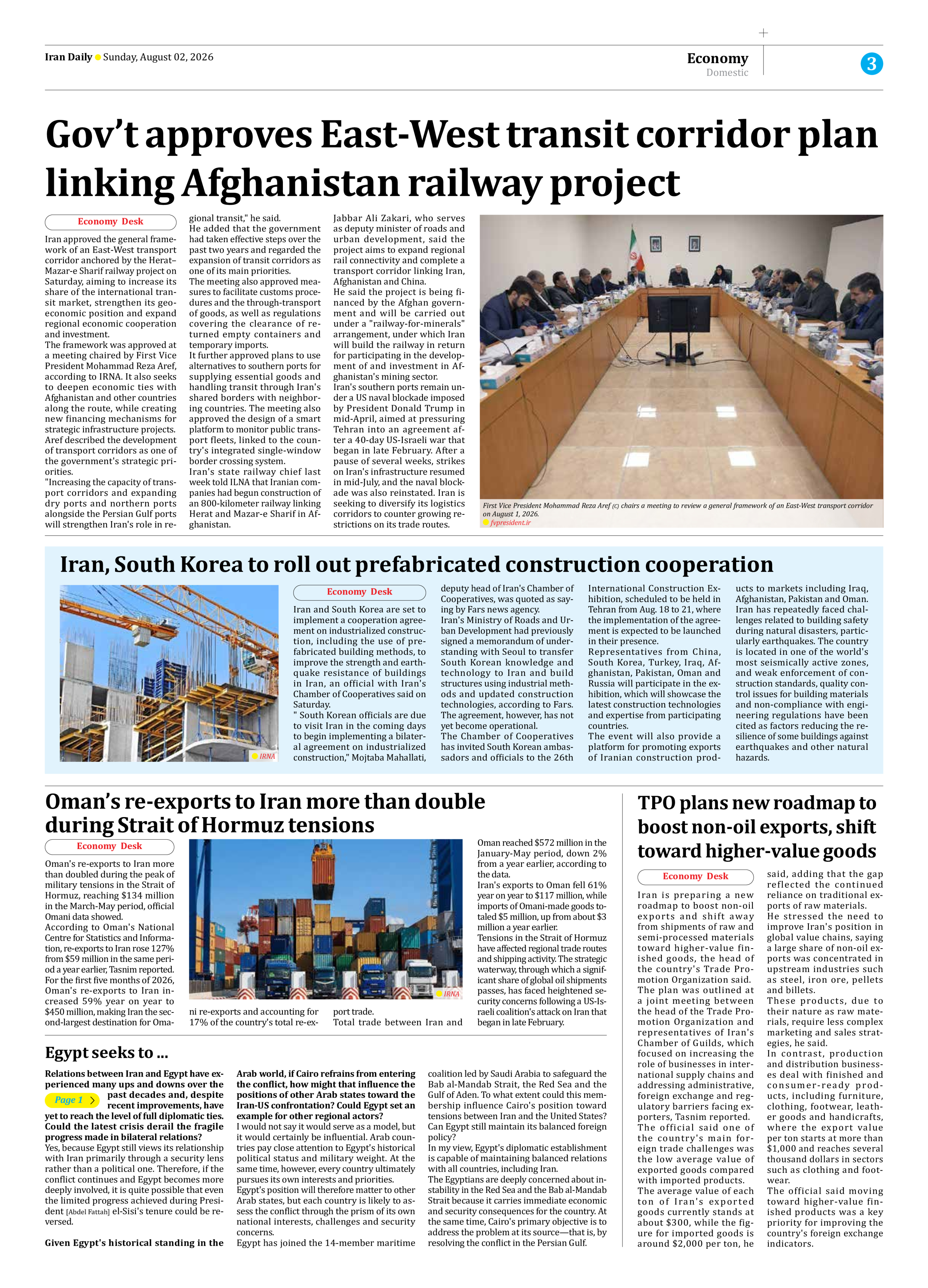
The framework was approved at a meeting chaired by First Vice President Mohammad Reza Aref, according to IRNA. It also seeks to deepen economic ties with Afghanistan and other countries along the route, while creating new financing mechanisms for strategic infrastructure projects.
Aref described the development of transport corridors as one of the government's strategic priorities.
"Increasing the capacity of transport corridors and expanding dry ports and northern ports alongside the Persian Gulf ports will strengthen Iran's role in regional transit," he said.
He added that the government had taken effective steps over the past two years and regarded the expansion of transit corridors as one of its main priorities.
The meeting also approved measures to facilitate customs procedures and the through-transport of goods, as well as regulations covering the clearance of returned empty containers and temporary imports.
It further approved plans to use alternatives to southern ports for supplying essential goods and handling transit through Iran's shared borders with neighboring countries. The meeting also approved the design of a smart platform to monitor public transport fleets, linked to the country's integrated single-window border crossing system.
Iran's state railway chief last week told ILNA that Iranian companies had begun construction of an 800-kilometer railway linking Herat and Mazar-e Sharif in Afghanistan.
Jabbar Ali Zakari, who serves as deputy minister of roads and urban development, said the project aims to expand regional rail connectivity and complete a transport corridor linking Iran, Afghanistan and China.
He said the project is being financed by the Afghan government and will be carried out under a "railway-for-minerals" arrangement, under which Iran will build the railway in return for participating in the development of and investment in Afghanistan's mining sector.
Iran's southern ports remain under a US naval blockade imposed by President Donald Trump in mid-April, aimed at pressuring Tehran into an agreement after a 40-day US-Israeli war that began in late February. After a pause of several weeks, strikes on Iran's infrastructure resumed in mid-July, and the naval blockade was also reinstated. Iran is seeking to diversify its logistics corridors to counter growing restrictions on its trade routes.