







US warmongering will tighten closure of Strait of Hormuz: Iran’s security chief
Iran’s security chief warned that continued warmongering on the part of the United States towards the Islamic Republic will tighten the closure that the country has imposed on the Strait of Hormuz in response to Washington’s violations.
Secretary of Iran's Supreme National Security Council, Mohammad Bagher Zolqadr made the remarks in a message issued on Friday as he cautioned against continuation of the US’s warlike attitude towards the Islamic Republic, including the illegal naval blockade that Washington has imposed on the country.
The two sides signed a memorandum of understanding last month to end the cycle arising from the latest bout of unprovoked American-Israeli aggression against the Islamic Republic, which had begun on February 28.
Under the understanding, Iran agreed to allow fee-free maritime transit through the strait for a period of 60 days.
In compliance with the MoU, the Islamic Republic devised a special maritime route for vessels to cross the chokepoint, warning vessels against using illegal routes.
The US has, however, been trying to escort transit through the strait along an illegal passageway, prompting the Islamic Republic to confront every instance of Washington-instigated transit through the chokepoint and shut the corridor until Washington ended its interference in regional maritime movement.
Adding to his remarks, Zolghadr noted that, not only would Washington’s prolonged adversarial approach further complicate the closure of the waterway, “but also close other straits and chokepoints.”
“The global economy, energy markets, and American voters will pay the price,” he concluded as skyrocketing gasoline prices continue to exact a toll on American taxpayers.
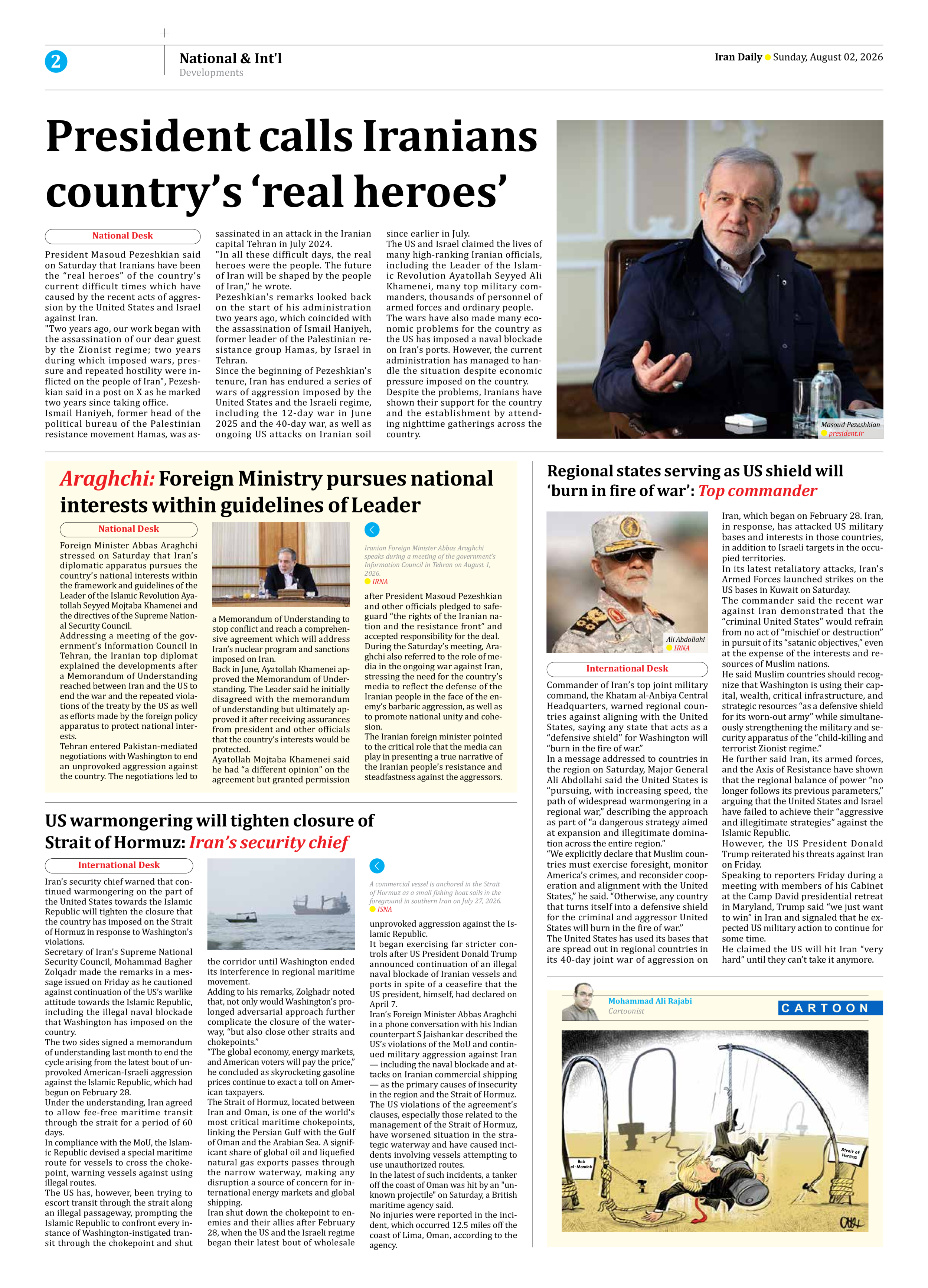
The Strait of Hormuz, located between Iran and Oman, is one of the world's most critical maritime chokepoints, linking the Persian Gulf with the Gulf of Oman and the Arabian Sea. A significant share of global oil and liquefied natural gas exports passes through the narrow waterway, making any disruption a source of concern for international energy markets and global shipping.
Iran shut down the chokepoint to enemies and their allies after February 28, when the US and the Israeli regime began their latest bout of wholesale unprovoked aggression against the Islamic Republic.
It began exercising far stricter controls after US President Donald Trump announced continuation of an illegal naval blockade of Iranian vessels and ports in spite of a ceasefire that the US president, himself, had declared on April 7.
Iran’s Foreign Minister Abbas Araghchi in a phone conversation with his Indian counterpart S Jaishankar described the US’s violations of the MoU and continued military aggression against Iran — including the naval blockade and attacks on Iranian commercial shipping — as the primary causes of insecurity in the region and the Strait of Hormuz.
The US violations of the agreement’s clauses, especially those related to the management of the Strait of Hormuz, have worsened situation in the strategic waterway and have caused incidents involving vessels attempting to use unauthorized routes.
In the latest of such incidents, a tanker off the coast of Oman was hit by an "unknown projectile" on Saturday, a British maritime agency said.
No injuries were reported in the incident, which occurred 12.5 miles off the coast of Lima, Oman, according to the agency.