







Copy in clipboard...
Iran says Oman’s Hormuz proposal does not address its security concerns
Iran rejected an Omani proposal for joint control of the Strait of Hormuz, saying it does not address Tehran's security concerns, while warning the strategic waterway would remain closed unless Muscat accepts Iran's own proposal.
In an interview with state TV on Tuesday, Iran's Deputy Foreign Minister Kazem Gharibabadi said that Omani officials had proposed a plan under which 50% of the shipping route would be under Iran's control and the remaining 50% under Oman's control.
"We said this does not address Iran's concerns," he added.
The Iranian official said Tehran had instead proposed that the inbound shipping route be placed entirely under Iran's control, while part of the outbound route should also fall under Iranian control.
"This scenario is final and Iran will accept no other formula. 'If they accept this, we will move on to the next stage,'" Gharibabadi said.
He said the Strait of Hormuz would remain closed if Oman rejected Iran's proposal and added that Tehran was prepared for a resumption of war.
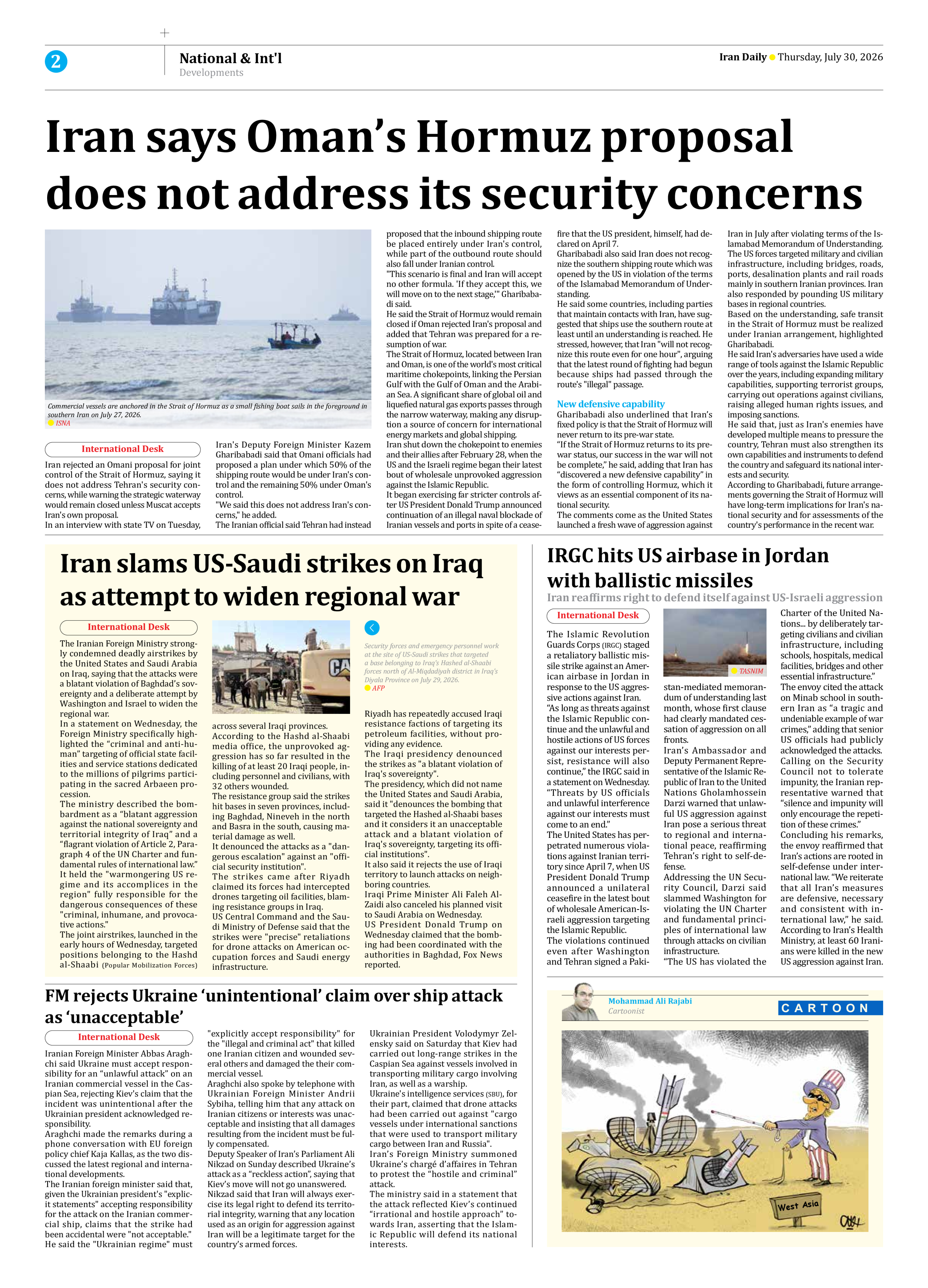
The Strait of Hormuz, located between Iran and Oman, is one of the world's most critical maritime chokepoints, linking the Persian Gulf with the Gulf of Oman and the Arabian Sea. A significant share of global oil and liquefied natural gas exports passes through the narrow waterway, making any disruption a source of concern for international energy markets and global shipping.
Iran shut down the chokepoint to enemies and their allies after February 28, when the US and the Israeli regime began their latest bout of wholesale unprovoked aggression against the Islamic Republic.
It began exercising far stricter controls after US President Donald Trump announced continuation of an illegal naval blockade of Iranian vessels and ports in spite of a ceasefire that the US president, himself, had declared on April 7.
Gharibabadi also said Iran does not recognize the southern shipping route which was opened by the US in violation of the terms of the Islamabad Memorandum of Understanding.
He said some countries, including parties that maintain contacts with Iran, have suggested that ships use the southern route at least until an understanding is reached. He stressed, however, that Iran "will not recognize this route even for one hour", arguing that the latest round of fighting had begun because ships had passed through the route's "illegal" passage.
New defensive capability
Gharibabadi also underlined that Iran’s fixed policy is that the Strait of Hormuz will never return to its pre-war state.
“If the Strait of Hormuz returns to its pre-war status, our success in the war will not be complete,” he said, adding that Iran has “discovered a new defensive capability” in the form of controlling Hormuz, which it views as an essential component of its national security.
The comments come as the United States launched a fresh wave of aggression against Iran in July after violating terms of the Islamabad Memorandum of Understanding. The US forces targeted military and civilian infrastructure, including bridges, roads, ports, desalination plants and rail roads mainly in southern Iranian provinces. Iran also responded by pounding US military bases in regional countries.
Based on the understanding, safe transit in the Strait of Hormuz must be realized under Iranian arrangement, highlighted Gharibabadi.
He said Iran's adversaries have used a wide range of tools against the Islamic Republic over the years, including expanding military capabilities, supporting terrorist groups, carrying out operations against civilians, raising alleged human rights issues, and imposing sanctions.
He said that, just as Iran's enemies have developed multiple means to pressure the country, Tehran must also strengthen its own capabilities and instruments to defend the country and safeguard its national interests and security.
According to Gharibabadi, future arrangements governing the Strait of Hormuz will have long-term implications for Iran's national security and for assessments of the country's performance in the recent war.