





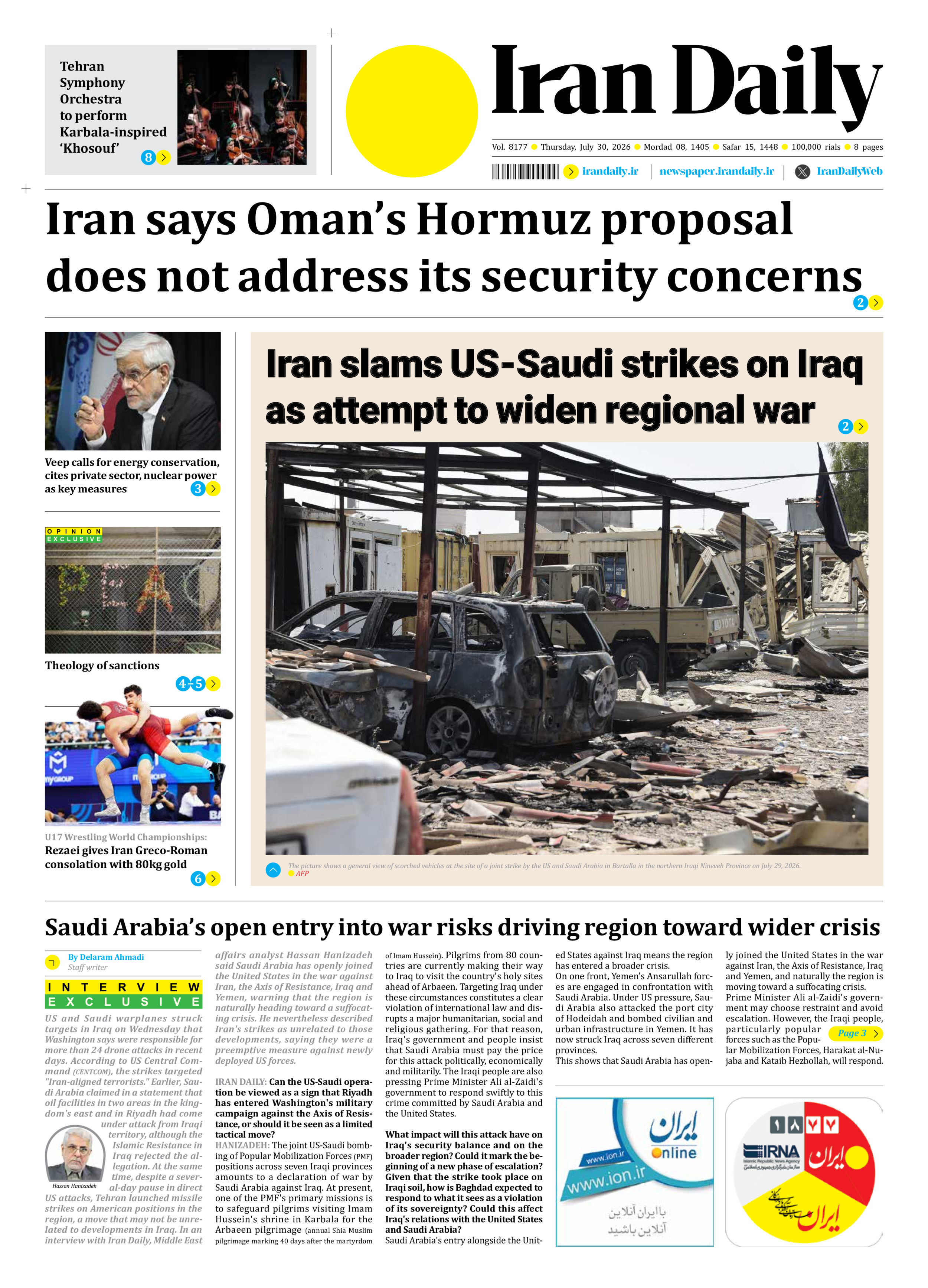


Saudi Arabia’s open entry into war risks driving region toward wider crisis
By Delaram Ahmadi
Staff writer
US and Saudi warplanes struck targets in Iraq on Wednesday that Washington says were responsible for more than 24 drone attacks in recent days. According to US Central Command (CENTCOM), the strikes targeted "Iran-aligned terrorists." Earlier, Saudi Arabia claimed in a statement that oil facilities in two areas in the kingdom's east and in Riyadh had come under attack from Iraqi territory, although the Islamic Resistance in Iraq rejected the allegation. At the same time, despite a several-day pause in direct US attacks, Tehran launched missile strikes on American positions in the region, a move that may not be unrelated to developments in Iraq. In an interview with Iran Daily, Middle East affairs analyst Hassan Hanizadeh said Saudi Arabia has openly joined the United States in the war against Iran, the Axis of Resistance, Iraq and Yemen, warning that the region is naturally heading toward a suffocating crisis. He nevertheless described Iran's strikes as unrelated to those developments, saying they were a preemptive measure against newly deployed US forces.
IRAN DAILY: Can the US-Saudi operation be viewed as a sign that Riyadh has entered Washington's military campaign against the Axis of Resistance, or should it be seen as a limited tactical move?
HANIZADEH: The joint US-Saudi bombing of Popular Mobilization Forces (PMF) positions across seven Iraqi provinces amounts to a declaration of war by Saudi Arabia against Iraq. At present, one of the PMF's primary missions is to safeguard pilgrims visiting Imam Hussein's shrine in Karbala for the Arbaeen pilgrimage (annual Shia Muslim pilgrimage marking 40 days after the martyrdom of Imam Hussein). Pilgrims from 80 countries are currently making their way to Iraq to visit the country's holy sites ahead of Arbaeen. Targeting Iraq under these circumstances constitutes a clear violation of international law and disrupts a major humanitarian, social and religious gathering. For that reason, Iraq's government and people insist that Saudi Arabia must pay the price for this attack politically, economically and militarily. The Iraqi people are also pressing Prime Minister Ali al-Zaidi's government to respond swiftly to this crime committed by Saudi Arabia and the United States.
What impact will this attack have on Iraq's security balance and on the broader region? Could it mark the beginning of a new phase of escalation? Given that the strike took place on Iraqi soil, how is Baghdad expected to respond to what it sees as a violation of its sovereignty? Could this affect Iraq's relations with the United States and Saudi Arabia?
Saudi Arabia's entry alongside the United States against Iraq means the region has entered a broader crisis.
On one front, Yemen’s Ansarullah forces are engaged in confrontation with Saudi Arabia. Under US pressure, Saudi Arabia also attacked the port city of Hodeidah and bombed civilian and urban infrastructure in Yemen. It has now struck Iraq across seven different provinces.
This shows that Saudi Arabia has openly joined the United States in the war against Iran, the Axis of Resistance, Iraq and Yemen, and naturally the region is moving toward a suffocating crisis.
Prime Minister Ali al-Zaidi's government may choose restraint and avoid escalation. However, the Iraqi people, particularly popular forces such as the Popular Mobilization Forces, Harakat al-Nujaba and Kataib Hezbollah, will respond.
Page 3