





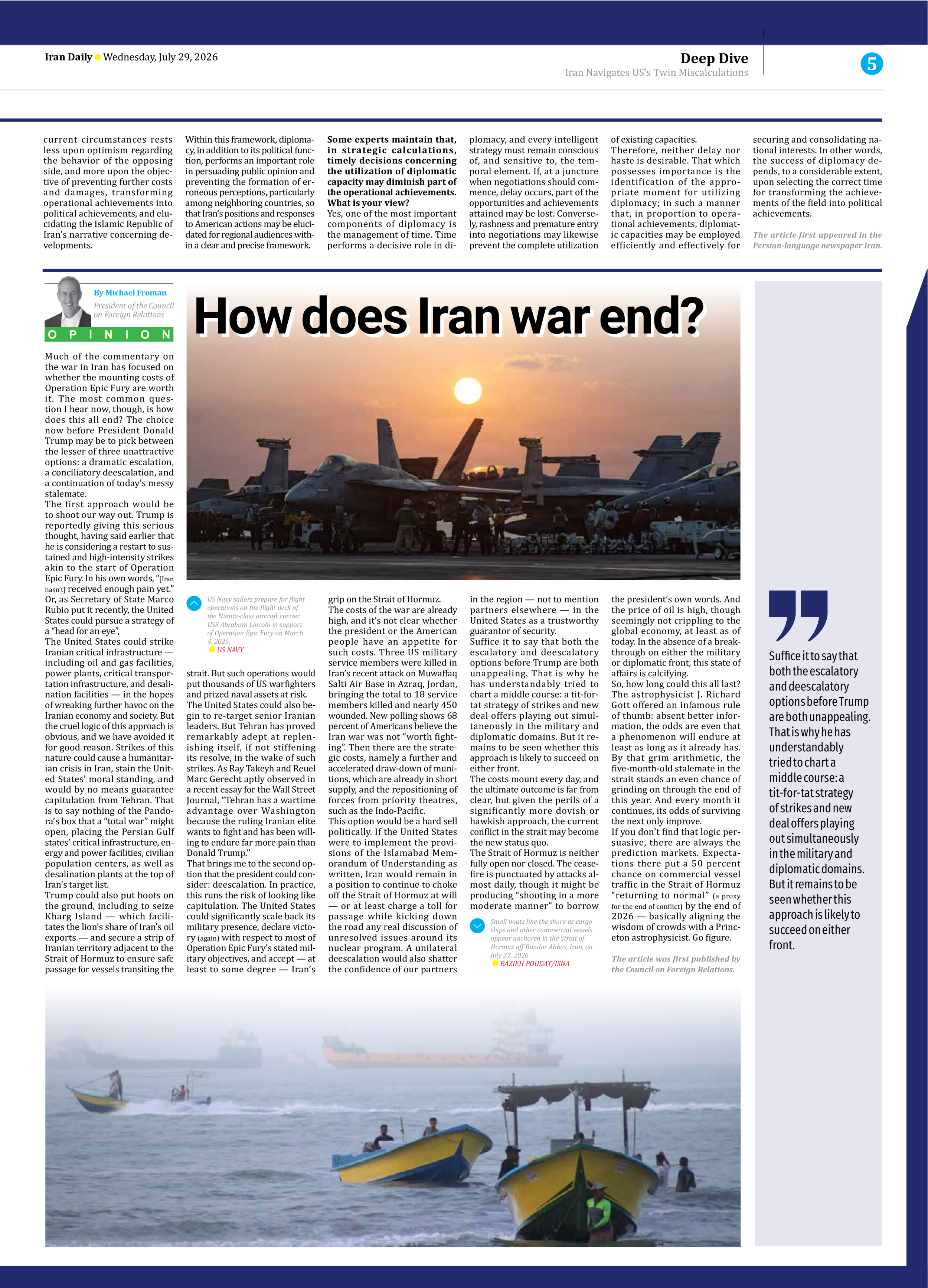


How does Iran war end?
By Michael Froman
President of the Council on Foreign Relations
Much of the commentary on the war in Iran has focused on whether the mounting costs of Operation Epic Fury are worth it. The most common question I hear now, though, is how does this all end? The choice now before President Donald Trump may be to pick between the lesser of three unattractive options: a dramatic escalation, a conciliatory deescalation, and a continuation of today’s messy stalemate.
The first approach would be to shoot our way out. Trump is reportedly giving this serious thought, having said earlier that he is considering a restart to sustained and high-intensity strikes akin to the start of Operation Epic Fury. In his own words, “[Iran hasn’t] received enough pain yet.” Or, as Secretary of State Marco Rubio put it recently, the United States could pursue a strategy of a “head for an eye”,
The United States could strike Iranian critical infrastructure — including oil and gas facilities, power plants, critical transportation infrastructure, and desalination facilities — in the hopes of wreaking further havoc on the Iranian economy and society. But the cruel logic of this approach is obvious, and we have avoided it for good reason. Strikes of this nature could cause a humanitarian crisis in Iran, stain the United States’ moral standing, and would by no means guarantee capitulation from Tehran. That is to say nothing of the Pandora’s box that a “total war” might open, placing the Persian Gulf states’ critical infrastructure, energy and power facilities, civilian population centers, as well as desalination plants at the top of Iran’s target list.
Trump could also put boots on the ground, including to seize Kharg Island — which facilitates the lion’s share of Iran’s oil exports — and secure a strip of Iranian territory adjacent to the Strait of Hormuz to ensure safe passage for vessels transiting the strait. But such operations would put thousands of US warfighters and prized naval assets at risk.
The United States could also begin to re-target senior Iranian leaders. But Tehran has proved remarkably adept at replenishing itself, if not stiffening its resolve, in the wake of such strikes. As Ray Takeyh and Reuel Marc Gerecht aptly observed in a recent essay for the Wall Street Journal, “Tehran has a wartime advantage over Washington because the ruling Iranian elite wants to fight and has been willing to endure far more pain than Donald Trump.”
That brings me to the second option that the president could consider: deescalation. In practice, this runs the risk of looking like capitulation. The United States could significantly scale back its military presence, declare victory (again) with respect to most of Operation Epic Fury’s stated military objectives, and accept — at least to some degree — Iran’s grip on the Strait of Hormuz.
The costs of the war are already high, and it’s not clear whether the president or the American people have an appetite for such costs. Three US military service members were killed in Iran’s recent attack on Muwaffaq Salti Air Base in Azraq, Jordan, bringing the total to 18 service members killed and nearly 450 wounded. New polling shows 68 percent of Americans believe the Iran war was not “worth fighting”. Then there are the strategic costs, namely a further and accelerated draw-down of munitions, which are already in short supply, and the repositioning of forces from priority theatres, such as the Indo-Pacific.
This option would be a hard sell politically. If the United States were to implement the provisions of the Islamabad Memorandum of Understanding as written, Iran would remain in a position to continue to choke off the Strait of Hormuz at will — or at least charge a toll for passage while kicking down the road any real discussion of unresolved issues around its nuclear program. A unilateral deescalation would also shatter the confidence of our partners in the region — not to mention partners elsewhere — in the United States as a trustworthy guarantor of security.
Suffice it to say that both the escalatory and deescalatory options before Trump are both unappealing. That is why he has understandably tried to chart a middle course: a tit-for-tat strategy of strikes and new deal offers playing out simultaneously in the military and diplomatic domains. But it remains to be seen whether this approach is likely to succeed on either front.
The costs mount every day, and the ultimate outcome is far from clear, but given the perils of a significantly more dovish or hawkish approach, the current conflict in the strait may become the new status quo.
The Strait of Hormuz is neither fully open nor closed. The cease-fire is punctuated by attacks almost daily, though it might be producing “shooting in a more moderate manner” to borrow the president’s own words. And the price of oil is high, though seemingly not crippling to the global economy, at least as of today. In the absence of a breakthrough on either the military or diplomatic front, this state of affairs is calcifying.
So, how long could this all last? The astrophysicist J. Richard Gott offered an infamous rule of thumb: absent better information, the odds are even that a phenomenon will endure at least as long as it already has. By that grim arithmetic, the five-month-old stalemate in the strait stands an even chance of grinding on through the end of this year. And every month it continues, its odds of surviving the next only improve.
If you don’t find that logic persuasive, there are always the prediction markets. Expectations there put a 50 percent chance on commercial vessel traffic in the Strait of Hormuz “returning to normal” (a proxy for the end of conflict) by the end of 2026 — basically aligning the wisdom of crowds with a Princeton astrophysicist. Go figure.
The article was first published by the Council on Foreign Relations.