





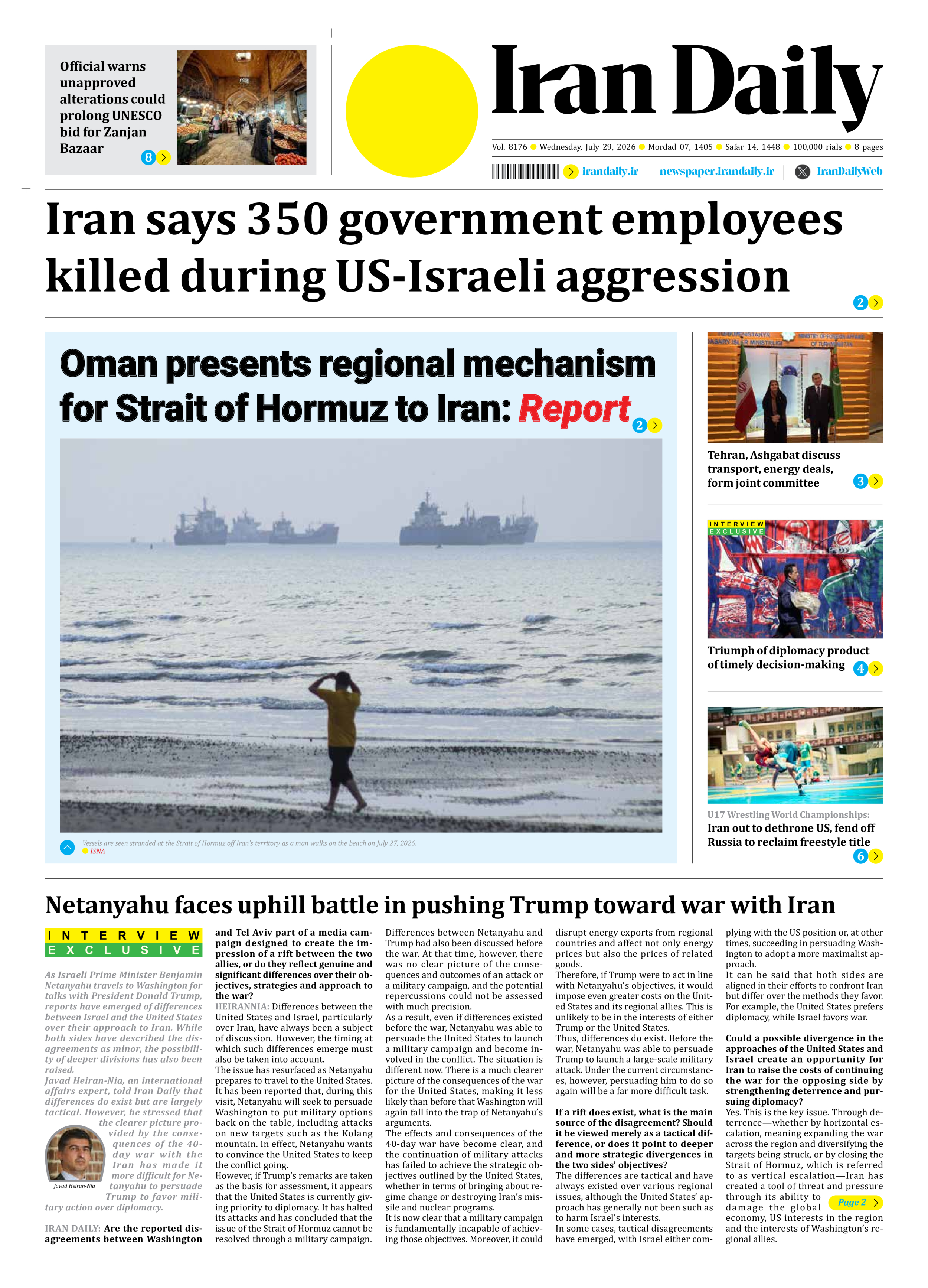


Netanyahu faces uphill battle in pushing Trump toward war with Iran
As Israeli Prime Minister Benjamin Netanyahu travels to Washington for talks with President Donald Trump, reports have emerged of differences between Israel and the United States over their approach to Iran. While both sides have described the disagreements as minor, the possibility of deeper divisions has also been raised.
Javad Heiran-Nia, an international affairs expert, told Iran Daily that differences do exist but are largely tactical. However, he stressed that the clearer picture provided by the consequences of the 40-day war with the Iran has made it more difficult for Netanyahu to persuade Trump to favor military action over diplomacy.
IRAN DAILY: Are the reported disagreements between Washington and Tel Aviv part of a media campaign designed to create the impression of a rift between the two allies, or do they reflect genuine and significant differences over their objectives, strategies and approach to the war?
HEIRANNIA: Differences between the United States and Israel, particularly over Iran, have always been a subject of discussion. However, the timing at which such differences emerge must also be taken into account.
The issue has resurfaced as Netanyahu prepares to travel to the United States. It has been reported that, during this visit, Netanyahu will seek to persuade Washington to put military options back on the table, including attacks on new targets such as the Kolang mountain. In effect, Netanyahu wants to convince the United States to keep the conflict going.
However, if Trump’s remarks are taken as the basis for assessment, it appears that the United States is currently giving priority to diplomacy. It has halted its attacks and has concluded that the issue of the Strait of Hormuz cannot be resolved through a military campaign.
Differences between Netanyahu and Trump had also been discussed before the war. At that time, however, there was no clear picture of the consequences and outcomes of an attack or a military campaign, and the potential repercussions could not be assessed with much precision.
As a result, even if differences existed before the war, Netanyahu was able to persuade the United States to launch a military campaign and become involved in the conflict. The situation is different now. There is a much clearer picture of the consequences of the war for the United States, making it less likely than before that Washington will again fall into the trap of Netanyahu’s arguments.
The effects and consequences of the 40-day war have become clear, and the continuation of military attacks has failed to achieve the strategic objectives outlined by the United States, whether in terms of bringing about regime change or destroying Iran’s missile and nuclear programs.
It is now clear that a military campaign is fundamentally incapable of achieving those objectives. Moreover, it could disrupt energy exports from regional countries and affect not only energy prices but also the prices of related goods.
Therefore, if Trump were to act in line with Netanyahu’s objectives, it would impose even greater costs on the United States and its regional allies. This is unlikely to be in the interests of either Trump or the United States.
Thus, differences do exist. Before the war, Netanyahu was able to persuade Trump to launch a large-scale military attack. Under the current circumstances, however, persuading him to do so again will be a far more difficult task.
If a rift does exist, what is the main source of the disagreement? Should it be viewed merely as a tactical difference, or does it point to deeper and more strategic divergences in the two sides’ objectives?
The differences are tactical and have always existed over various regional issues, although the United States’ approach has generally not been such as to harm Israel’s interests.
In some cases, tactical disagreements have emerged, with Israel either complying with the US position or, at other times, succeeding in persuading Washington to adopt a more maximalist approach.
It can be said that both sides are aligned in their efforts to confront Iran but differ over the methods they favor. For example, the United States prefers diplomacy, while Israel favors war.
Could a possible divergence in the approaches of the United States and Israel create an opportunity for Iran to raise the costs of continuing the war for the opposing side by strengthening deterrence and pursuing diplomacy?
Yes. This is the key issue. Through deterrence—whether by horizontal escalation, meaning expanding the war across the region and diversifying the targets being struck, or by closing the Strait of Hormuz, which is referred to as vertical escalation—Iran has created a tool of threat and pressure through its ability to damage the global economy, US interests in the region and the interests of Washington’s regional allies.
Page 2