





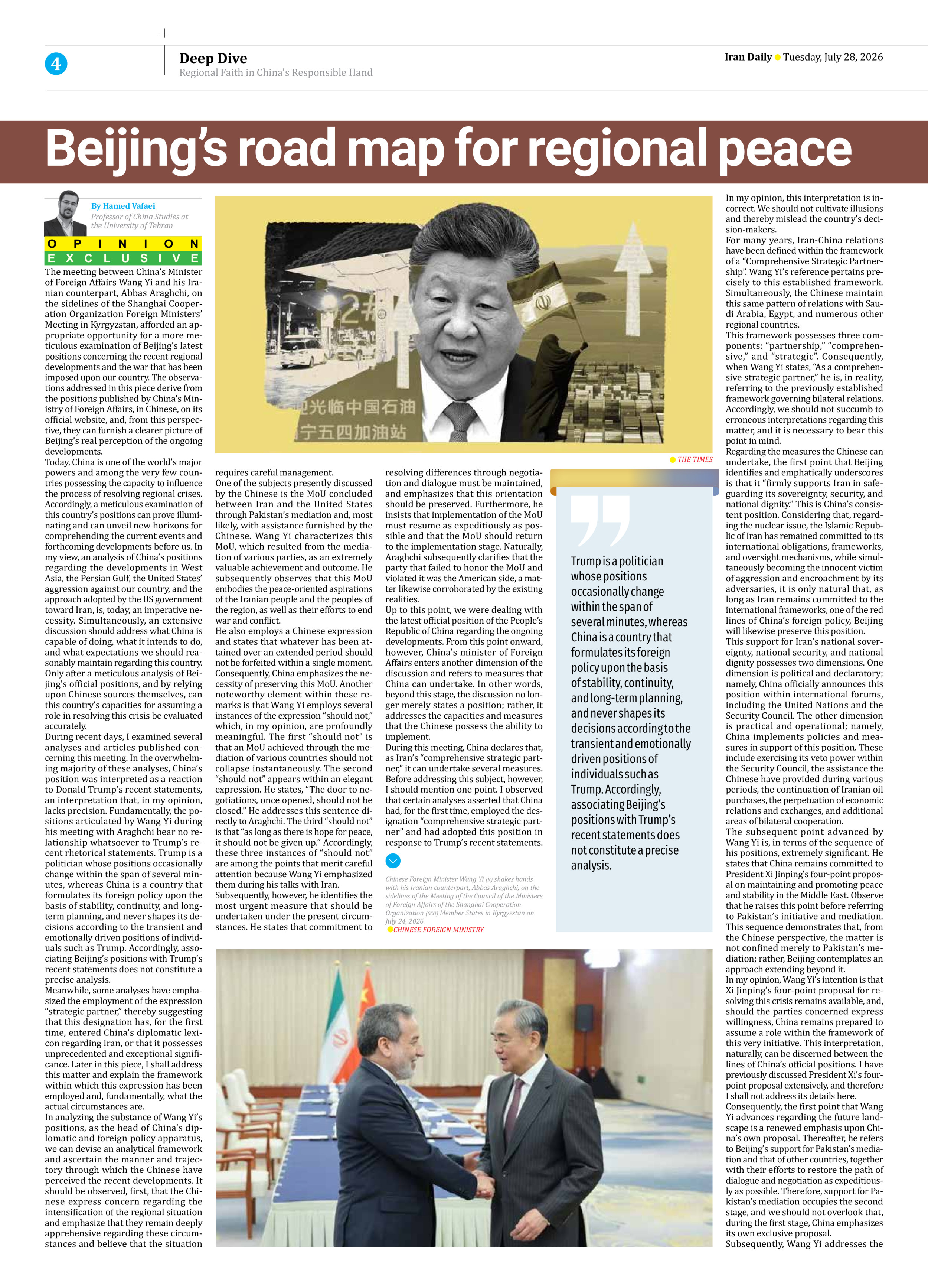


Beijing’s road map for regional peace
By Hamed Vafaei
Professor of China Studies at the University of Tehran
The meeting between China’s Minister of Foreign Affairs Wang Yi and his Iranian counterpart, Abbas Araghchi, on the sidelines of the Shanghai Cooperation Organization Foreign Ministers’ Meeting in Kyrgyzstan, afforded an appropriate opportunity for a more meticulous examination of Beijing’s latest positions concerning the recent regional developments and the war that has been imposed upon our country. The observations addressed in this piece derive from the positions published by China’s Ministry of Foreign Affairs, in Chinese, on its official website, and, from this perspective, they can furnish a clearer picture of Beijing’s real perception of the ongoing developments.
Today, China is one of the world’s major powers and among the very few countries possessing the capacity to influence the process of resolving regional crises. Accordingly, a meticulous examination of this country’s positions can prove illuminating and can unveil new horizons for comprehending the current events and forthcoming developments before us. In my view, an analysis of China’s positions regarding the developments in West Asia, the Persian Gulf, the United States’ aggression against our country, and the approach adopted by the US government toward Iran, is, today, an imperative necessity. Simultaneously, an extensive discussion should address what China is capable of doing, what it intends to do, and what expectations we should reasonably maintain regarding this country. Only after a meticulous analysis of Beijing’s official positions, and by relying upon Chinese sources themselves, can this country’s capacities for assuming a role in resolving this crisis be evaluated accurately.
During recent days, I examined several analyses and articles published concerning this meeting. In the overwhelming majority of these analyses, China’s position was interpreted as a reaction to Donald Trump’s recent statements, an interpretation that, in my opinion, lacks precision. Fundamentally, the positions articulated by Wang Yi during his meeting with Araghchi bear no relationship whatsoever to Trump’s recent rhetorical statements. Trump is a politician whose positions occasionally change within the span of several minutes, whereas China is a country that formulates its foreign policy upon the basis of stability, continuity, and long-term planning, and never shapes its decisions according to the transient and emotionally driven positions of individuals such as Trump. Accordingly, associating Beijing’s positions with Trump’s recent statements does not constitute a precise analysis.
Meanwhile, some analyses have emphasized the employment of the expression “strategic partner,” thereby suggesting that this designation has, for the first time, entered China’s diplomatic lexicon regarding Iran, or that it possesses unprecedented and exceptional significance. Later in this piece, I shall address this matter and explain the framework within which this expression has been employed and, fundamentally, what the actual circumstances are.
In analyzing the substance of Wang Yi’s positions, as the head of China’s diplomatic and foreign policy apparatus, we can devise an analytical framework and ascertain the manner and trajectory through which the Chinese have perceived the recent developments. It should be observed, first, that the Chinese express concern regarding the intensification of the regional situation and emphasize that they remain deeply apprehensive regarding these circumstances and believe that the situation requires careful management.
One of the subjects presently discussed by the Chinese is the MoU concluded between Iran and the United States through Pakistan’s mediation and, most likely, with assistance furnished by the Chinese. Wang Yi characterizes this MoU, which resulted from the mediation of various parties, as an extremely valuable achievement and outcome. He subsequently observes that this MoU embodies the peace-oriented aspirations of the Iranian people and the peoples of the region, as well as their efforts to end war and conflict.
He also employs a Chinese expression and states that whatever has been attained over an extended period should not be forfeited within a single moment. Consequently, China emphasizes the necessity of preserving this MoU. Another noteworthy element within these remarks is that Wang Yi employs several instances of the expression “should not,” which, in my opinion, are profoundly meaningful. The first “should not” is that an MoU achieved through the mediation of various countries should not collapse instantaneously. The second “should not” appears within an elegant expression. He states, “The door to negotiations, once opened, should not be closed.” He addresses this sentence directly to Araghchi. The third “should not” is that “as long as there is hope for peace, it should not be given up.” Accordingly, these three instances of “should not” are among the points that merit careful attention because Wang Yi emphasized them during his talks with Iran.
Subsequently, however, he identifies the most urgent measure that should be undertaken under the present circumstances. He states that commitment to resolving differences through negotiation and dialogue must be maintained, and emphasizes that this orientation should be preserved. Furthermore, he insists that implementation of the MoU must resume as expeditiously as possible and that the MoU should return to the implementation stage. Naturally, Araghchi subsequently clarifies that the party that failed to honor the MoU and violated it was the American side, a matter likewise corroborated by the existing realities.
Up to this point, we were dealing with the latest official position of the People’s Republic of China regarding the ongoing developments. From this point onward, however, China’s minister of Foreign Affairs enters another dimension of the discussion and refers to measures that China can undertake. In other words, beyond this stage, the discussion no longer merely states a position; rather, it addresses the capacities and measures that the Chinese possess the ability to implement.
During this meeting, China declares that, as Iran’s “comprehensive strategic partner,” it can undertake several measures. Before addressing this subject, however, I should mention one point. I observed that certain analyses asserted that China had, for the first time, employed the designation “comprehensive strategic partner” and had adopted this position in response to Trump’s recent statements. In my opinion, this interpretation is incorrect. We should not cultivate illusions and thereby mislead the country’s decision-makers.
For many years, Iran-China relations have been defined within the framework of a “Comprehensive Strategic Partnership”. Wang Yi’s reference pertains precisely to this established framework. Simultaneously, the Chinese maintain this same pattern of relations with Saudi Arabia, Egypt, and numerous other regional countries.
This framework possesses three components: “partnership,” “comprehensive,” and “strategic”. Consequently, when Wang Yi states, “As a comprehensive strategic partner,” he is, in reality, referring to the previously established framework governing bilateral relations. Accordingly, we should not succumb to erroneous interpretations regarding this matter, and it is necessary to bear this point in mind.
Regarding the measures the Chinese can undertake, the first point that Beijing identifies and emphatically underscores is that it “firmly supports Iran in safeguarding its sovereignty, security, and national dignity.” This is China’s consistent position. Considering that, regarding the nuclear issue, the Islamic Republic of Iran has remained committed to its international obligations, frameworks, and oversight mechanisms, while simultaneously becoming the innocent victim of aggression and encroachment by its adversaries, it is only natural that, as long as Iran remains committed to the international frameworks, one of the red lines of China’s foreign policy, Beijing will likewise preserve this position.
This support for Iran’s national sovereignty, national security, and national dignity possesses two dimensions. One dimension is political and declaratory; namely, China officially announces this position within international forums, including the United Nations and the Security Council. The other dimension is practical and operational; namely, China implements policies and measures in support of this position. These include exercising its veto power within the Security Council, the assistance the Chinese have provided during various periods, the continuation of Iranian oil purchases, the perpetuation of economic relations and exchanges, and additional areas of bilateral cooperation.
The subsequent point advanced by Wang Yi is, in terms of the sequence of his positions, extremely significant. He states that China remains committed to President Xi Jinping’s four-point proposal on maintaining and promoting peace and stability in the Middle East. Observe that he raises this point before referring to Pakistan’s initiative and mediation. This sequence demonstrates that, from the Chinese perspective, the matter is not confined merely to Pakistan’s mediation; rather, Beijing contemplates an approach extending beyond it.
In my opinion, Wang Yi’s intention is that Xi Jinping’s four-point proposal for resolving this crisis remains available, and, should the parties concerned express willingness, China remains prepared to assume a role within the framework of this very initiative. This interpretation, naturally, can be discerned between the lines of China’s official positions. I have previously discussed President Xi’s four-point proposal extensively, and therefore I shall not address its details here.
Consequently, the first point that Wang Yi advances regarding the future landscape is a renewed emphasis upon China’s own proposal. Thereafter, he refers to Beijing’s support for Pakistan’s mediation and that of other countries, together with their efforts to restore the path of dialogue and negotiation as expeditiously as possible. Therefore, support for Pakistan’s mediation occupies the second stage, and we should not overlook that, during the first stage, China emphasizes its own exclusive proposal.
Subsequently, Wang Yi addresses the matter of the Strait of Hormuz. In Chinese, he employs an expression signifying proper management and handling of an issue. This expression demonstrates that, from the Chinese perspective, the situation in the Strait of Hormuz should be managed in a more precise and purpose-oriented manner. I have occasionally observed assertions within Iran that China maintains no position regarding Hormuz or remains satisfied with the existing circumstances. However, what emerges from China’s official positions is an emphasis upon the “proper” management of this matter.
In my opinion, the Islamic Republic of Iran should engage in more meticulous consultations with China regarding this issue. Most likely, negotiations concerning this matter have already occurred, or are presently occurring, among Iran, China, and several other countries. Accordingly, China’s perspectives and capacities can be utilized for managing the Strait of Hormuz and shaping the region’s new order, while simultaneously incorporating this country into that process.
Another significant domain identified by Wang Yi concerns the improvement of interactions and relations among neighboring countries within the Persian Gulf. It appears that the Chinese are likewise prepared to assume a role in this regard. The expression employed in the Chinese text signifies “addressing and advancing”. In other words, China is prepared to pursue and advance the process of improving neighborly relations among the countries of the region.
Consequently, another new domain emerges within China’s positions, namely, Beijing’s readiness to assume a role in improving Iran’s relations with neighboring countries, particularly those countries that, regrettably, presently host American military bases and from whose territories actions are undertaken against the Islamic Republic of Iran.
Another domain referenced by Wang Yi concerns the issue of joint design and planning. In my opinion, this point possesses considerable significance. He discusses joint design and planning for realizing the collective security of the Persian Gulf countries. While examining China’s positions, we should carefully scrutinize the terminology and expressions employed by the Chinese. The introduction of the concept of “collective security” within the Persian Gulf constitutes a significant development. Considering that the summit of Arab leaders and China will soon convene, it appears that this matter will constitute one of its principal agenda items.
In my opinion, the Islamic Republic should commence action as quickly as possible and place its own concept of collective security within this region upon the negotiating table, so that it does not become incorporated into other parties’ strategic calculations. After all, the Persian Gulf countries, on the one hand, maintain extensive relations with the Americans and our adversaries, and, on the other hand, have established highly significant cooperation with China. The Islamic Republic should likewise define its own share and position within the collective security mechanism that is to emerge in this region, thereby reaching shared equations with China regarding this matter and consolidating its own role within this evolving order.
Ultimately, it should be stated that the Chinese continue to declare their readiness to assume a role regarding the recent developments and the events witnessed throughout the region. Although some individuals within Iran continue to harbor doubts concerning this matter, it should be recognized that China is entirely prepared to assume such a role. When, during the meeting with Araghchi, they declare, “Such efforts are aimed at helping restore peace and stability in the Middle East at an early date,” this signifies that the Chinese are prepared to assume responsibilities extending beyond those they have undertaken previously.
I would also like to mention one additional point. It appears that the establishment of the cease-fire and the attainment of an MoU between Iran and the United States through the mediation of Pakistan and several other countries, became possible through reliance upon the role of regional middle powers such as Pakistan and Oman. These countries successfully advanced the first stage, and the hostilities, albeit temporarily, ceased. Naturally, the United States has violated this MoU repeatedly.
From this stage onward, however, consolidating the cease-fire and transforming it into enduring peace requires a balancing power, a power capable of guaranteeing the continuity of this process. In my opinion, assuming such a role exceeds the capacities of countries such as Pakistan and Oman. They completed the first step, but the subsequent stage requires the presence of a global power such as China.
Another important point is that China has been accepted by both parties, namely, both Iran and the Arab countries of the region, as a credible actor for assuming this role. Consequently, if the Islamic Republic of Iran utilizes China’s capacities with greater precision and advances toward benefiting from Beijing’s role in this dossier, the possibility still exists that, under the present volatile circumstances, new foundations for agreement and movement toward peace may emerge.
The article first appeared in the
Persian-language newspaper Iran.