







UNESCO lists Alamut Castle as Iran’s 30th World Heritage Site
Global recognition indicative of country’s diverse history: President
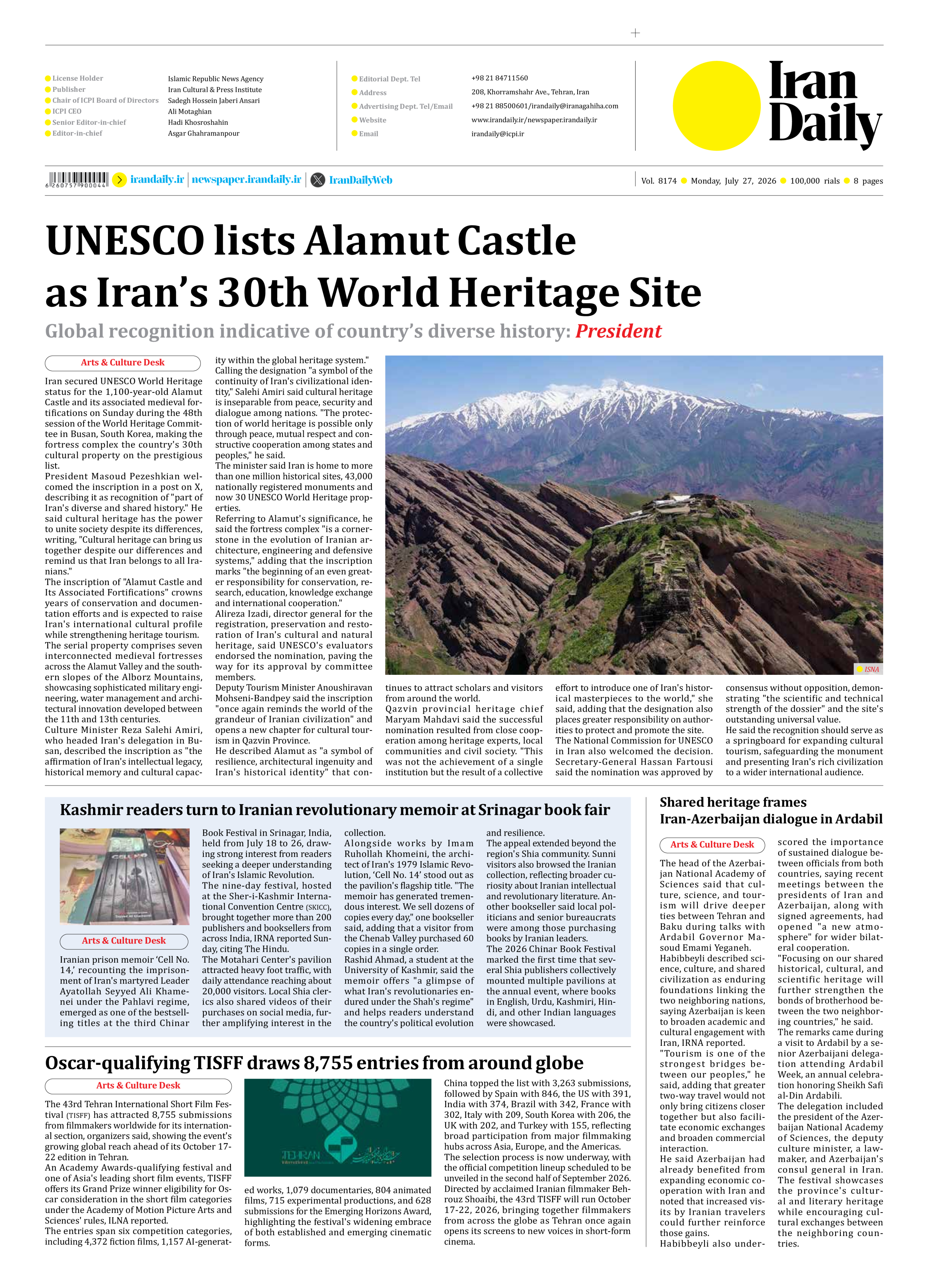
Iran secured UNESCO World Heritage status for the 1,100-year-old Alamut Castle and its associated medieval fortifications on Sunday during the 48th session of the World Heritage Committee in Busan, South Korea, making the fortress complex the country's 30th cultural property on the prestigious list.
President Masoud Pezeshkian welcomed the inscription in a post on X, describing it as recognition of "part of Iran's diverse and shared history." He said cultural heritage has the power to unite society despite its differences, writing, "Cultural heritage can bring us together despite our differences and remind us that Iran belongs to all Iranians."
The inscription of "Alamut Castle and Its Associated Fortifications" crowns years of conservation and documentation efforts and is expected to raise Iran's international cultural profile while strengthening heritage tourism.
The serial property comprises seven interconnected medieval fortresses across the Alamut Valley and the southern slopes of the Alborz Mountains, showcasing sophisticated military engineering, water management and architectural innovation developed between the 11th and 13th centuries.
Culture Minister Reza Salehi Amiri, who headed Iran's delegation in Busan, described the inscription as "the affirmation of Iran's intellectual legacy, historical memory and cultural capacity within the global heritage system."
Calling the designation "a symbol of the continuity of Iran's civilizational identity," Salehi Amiri said cultural heritage is inseparable from peace, security and dialogue among nations. "The protection of world heritage is possible only through peace, mutual respect and constructive cooperation among states and peoples," he said.
The minister said Iran is home to more than one million historical sites, 43,000 nationally registered monuments and now 30 UNESCO World Heritage properties.
Referring to Alamut's significance, he said the fortress complex "is a cornerstone in the evolution of Iranian architecture, engineering and defensive systems," adding that the inscription marks "the beginning of an even greater responsibility for conservation, research, education, knowledge exchange and international cooperation."
Alireza Izadi, director general for the registration, preservation and restoration of Iran's cultural and natural heritage, said UNESCO's evaluators endorsed the nomination, paving the way for its approval by committee members.
Deputy Tourism Minister Anoushiravan Mohseni-Bandpey said the inscription "once again reminds the world of the grandeur of Iranian civilization" and opens a new chapter for cultural tourism in Qazvin Province.
He described Alamut as "a symbol of resilience, architectural ingenuity and Iran's historical identity" that continues to attract scholars and visitors from around the world.
Qazvin provincial heritage chief Maryam Mahdavi said the successful nomination resulted from close cooperation among heritage experts, local communities and civil society. "This was not the achievement of a single institution but the result of a collective effort to introduce one of Iran's historical masterpieces to the world," she said, adding that the designation also places greater responsibility on authorities to protect and promote the site.
The National Commission for UNESCO in Iran also welcomed the decision. Secretary-General Hassan Fartousi said the nomination was approved by consensus without opposition, demonstrating "the scientific and technical strength of the dossier" and the site's outstanding universal value.
He said the recognition should serve as a springboard for expanding cultural tourism, safeguarding the monument and presenting Iran's rich civilization to a wider international audience.