





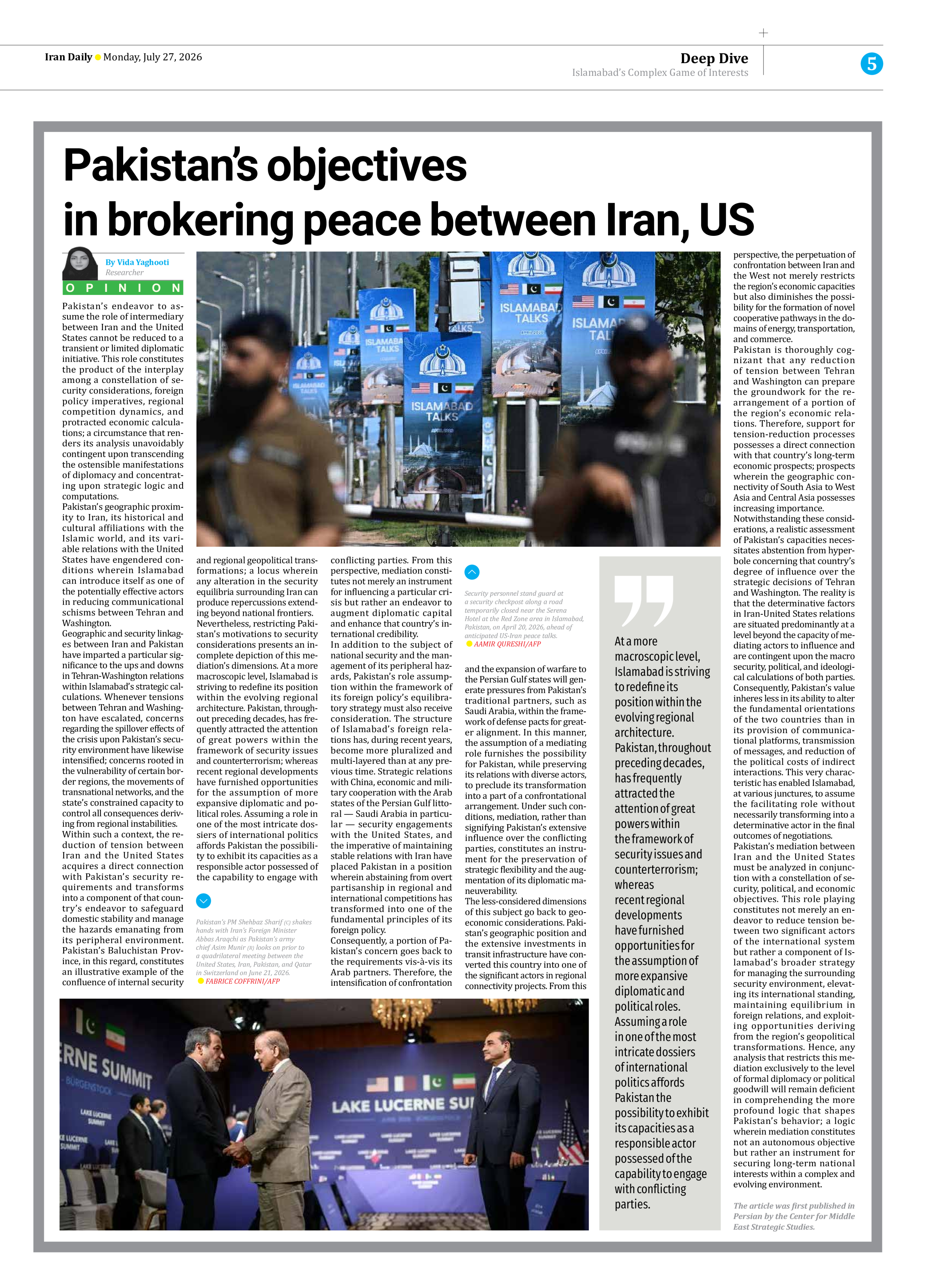


Pakistan’s objectives in brokering peace between Iran, US
By Vida Yaghooti
Researcher
Pakistan’s endeavor to assume the role of intermediary between Iran and the United States cannot be reduced to a transient or limited diplomatic initiative. This role constitutes the product of the interplay among a constellation of security considerations, foreign policy imperatives, regional competition dynamics, and protracted economic calculations; a circumstance that renders its analysis unavoidably contingent upon transcending the ostensible manifestations of diplomacy and concentrating upon strategic logic and computations.
Pakistan’s geographic proximity to Iran, its historical and cultural affiliations with the Islamic world, and its variable relations with the United States have engendered conditions wherein Islamabad can introduce itself as one of the potentially effective actors in reducing communicational schisms between Tehran and Washington.
Geographic and security linkages between Iran and Pakistan have imparted a particular significance to the ups and downs in Tehran-Washington relations within Islamabad’s strategic calculations. Whenever tensions between Tehran and Washington have escalated, concerns regarding the spillover effects of the crisis upon Pakistan’s security environment have likewise intensified; concerns rooted in the vulnerability of certain border regions, the movements of transnational networks, and the state’s constrained capacity to control all consequences deriving from regional instabilities.
Within such a context, the reduction of tension between Iran and the United States acquires a direct connection with Pakistan’s security requirements and transforms into a component of that country’s endeavor to safeguard domestic stability and manage the hazards emanating from its peripheral environment. Pakistan’s Baluchistan Province, in this regard, constitutes an illustrative example of the confluence of internal security and regional geopolitical transformations; a locus wherein any alteration in the security equilibria surrounding Iran can produce repercussions extending beyond national frontiers.
Nevertheless, restricting Pakistan’s motivations to security considerations presents an incomplete depiction of this mediation’s dimensions. At a more macroscopic level, Islamabad is striving to redefine its position within the evolving regional architecture. Pakistan, throughout preceding decades, has frequently attracted the attention of great powers within the framework of security issues and counterterrorism; whereas recent regional developments have furnished opportunities for the assumption of more expansive diplomatic and political roles. Assuming a role in one of the most intricate dossiers of international politics affords Pakistan the possibility to exhibit its capacities as a responsible actor possessed of the capability to engage with conflicting parties. From this perspective, mediation constitutes not merely an instrument for influencing a particular crisis but rather an endeavor to augment diplomatic capital and enhance that country’s international credibility.
In addition to the subject of national security and the management of its peripheral hazards, Pakistan’s role assumption within the framework of its foreign policy’s equilibratory strategy must also receive consideration. The structure of Islamabad’s foreign relations has, during recent years, become more pluralized and multi-layered than at any previous time. Strategic relations with China, economic and military cooperation with the Arab states of the Persian Gulf littoral — Saudi Arabia in particular — security engagements with the United States, and the imperative of maintaining stable relations with Iran have placed Pakistan in a position wherein abstaining from overt partisanship in regional and international competitions has transformed into one of the fundamental principles of its foreign policy.
Consequently, a portion of Pakistan’s concern goes back to the requirements vis-à-vis its Arab partners. Therefore, the intensification of confrontation and the expansion of warfare to the Persian Gulf states will generate pressures from Pakistan’s traditional partners, such as Saudi Arabia, within the framework of defense pacts for greater alignment. In this manner, the assumption of a mediating role furnishes the possibility for Pakistan, while preserving its relations with diverse actors, to preclude its transformation into a part of a confrontational arrangement. Under such conditions, mediation, rather than signifying Pakistan’s extensive influence over the conflicting parties, constitutes an instrument for the preservation of strategic flexibility and the augmentation of its diplomatic maneuverability.
The less-considered dimensions of this subject go back to geoeconomic considerations. Pakistan’s geographic position and the extensive investments in transit infrastructure have converted this country into one of the significant actors in regional connectivity projects. From this perspective, the perpetuation of confrontation between Iran and the West not merely restricts the region’s economic capacities but also diminishes the possibility for the formation of novel cooperative pathways in the domains of energy, transportation, and commerce.
Pakistan is thoroughly cognizant that any reduction of tension between Tehran and Washington can prepare the groundwork for the rearrangement of a portion of the region’s economic relations. Therefore, support for tension-reduction processes possesses a direct connection with that country’s long-term economic prospects; prospects wherein the geographic connectivity of South Asia to West Asia and Central Asia possesses increasing importance.
Notwithstanding these considerations, a realistic assessment of Pakistan’s capacities necessitates abstention from hyperbole concerning that country’s degree of influence over the strategic decisions of Tehran and Washington. The reality is that the determinative factors in Iran-United States relations are situated predominantly at a level beyond the capacity of mediating actors to influence and are contingent upon the macro security, political, and ideological calculations of both parties. Consequently, Pakistan’s value inheres less in its ability to alter the fundamental orientations of the two countries than in its provision of communicational platforms, transmission of messages, and reduction of the political costs of indirect interactions. This very characteristic has enabled Islamabad, at various junctures, to assume the facilitating role without necessarily transforming into a determinative actor in the final outcomes of negotiations.
Pakistan’s mediation between Iran and the United States must be analyzed in conjunction with a constellation of security, political, and economic objectives. This role playing constitutes not merely an endeavor to reduce tension between two significant actors of the international system but rather a component of Islamabad’s broader strategy for managing the surrounding security environment, elevating its international standing, maintaining equilibrium in foreign relations, and exploiting opportunities deriving from the region’s geopolitical transformations. Hence, any analysis that restricts this mediation exclusively to the level of formal diplomacy or political goodwill will remain deficient in comprehending the more profound logic that shapes Pakistan’s behavior; a logic wherein mediation constitutes not an autonomous objective but rather an instrument for securing long-term national interests within a complex and evolving environment.
The article was first published in Persian by the Center for Middle East Strategic Studies.