





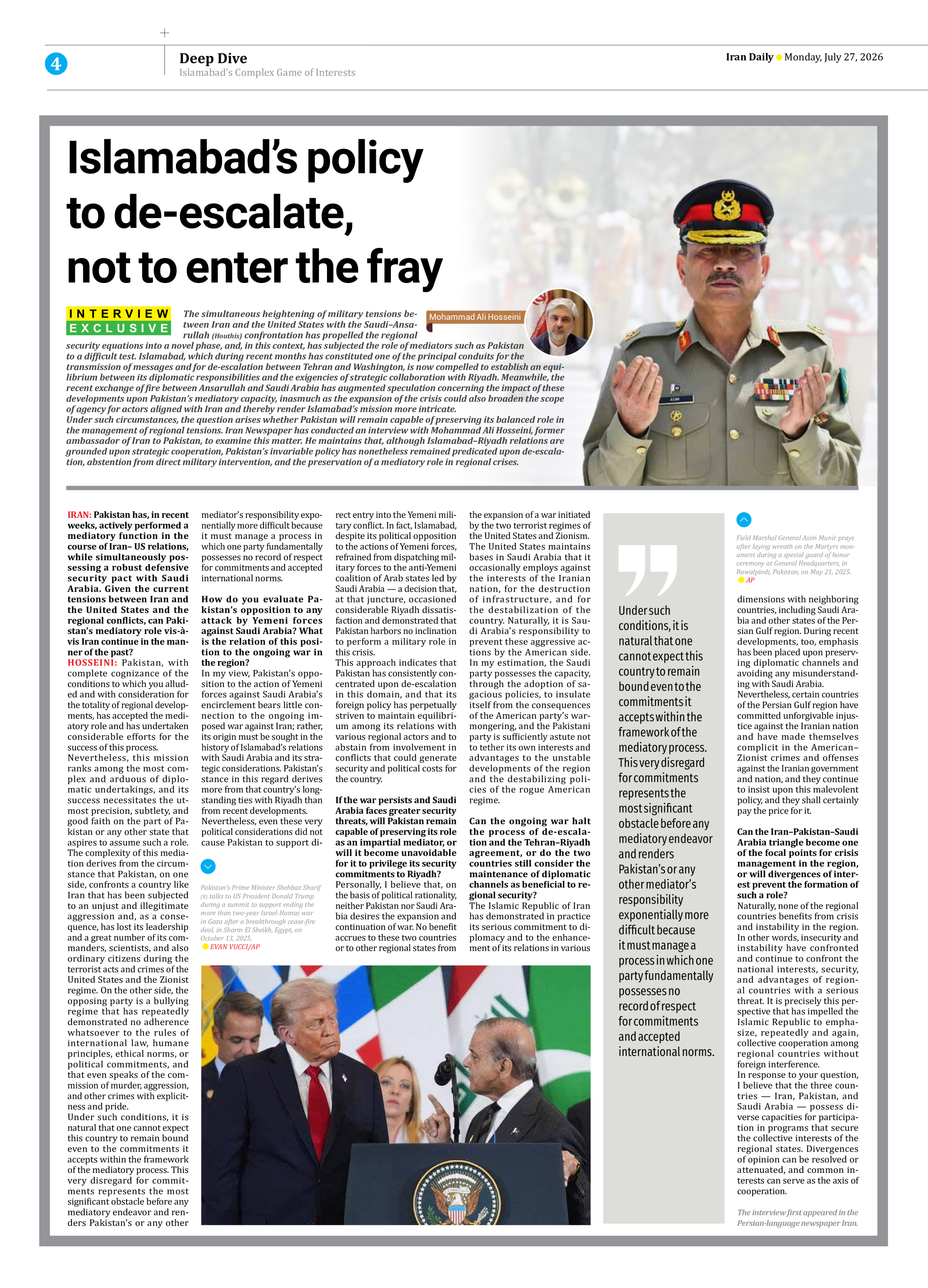


Islamabad’s policy to de-escalate, not to enter the fray
The simultaneous heightening of military tensions between Iran and the United States with the Saudi–Ansarullah (Houthis) confrontation has propelled the regional security equations into a novel phase, and, in this context, has subjected the role of mediators such as Pakistan to a difficult test. Islamabad, which during recent months has constituted one of the principal conduits for the transmission of messages and for de-escalation between Tehran and Washington, is now compelled to establish an equilibrium between its diplomatic responsibilities and the exigencies of strategic collaboration with Riyadh. Meanwhile, the recent exchange of fire between Ansarullah and Saudi Arabia has augmented speculation concerning the impact of these developments upon Pakistan’s mediatory capacity, inasmuch as the expansion of the crisis could also broaden the scope of agency for actors aligned with Iran and thereby render Islamabad’s mission more intricate. Under such circumstances, the question arises whether Pakistan will remain capable of preserving its balanced role in the management of regional tensions. Iran Newspaper has conducted an interview with Mohammad Ali Hosseini, former ambassador of Iran to Pakistan, to examine this matter. He maintains that, although Islamabad–Riyadh relations are grounded upon strategic cooperation, Pakistan’s invariable policy has nonetheless remained predicated upon de-escalation, abstention from direct military intervention, and the preservation of a mediatory role in regional crises.
Mohammad Ali Hosseini
IRAN: Pakistan has, in recent weeks, actively performed a mediatory function in the course of Iran– US relations, while simultaneously possessing a robust defensive security pact with Saudi Arabia. Given the current tensions between Iran and the United States and the regional conflicts, can Pakistan’s mediatory role vis-à-vis Iran continue in the manner of the past?
HOSSEINI: Pakistan, with complete cognizance of the conditions to which you alluded and with consideration for the totality of regional developments, has accepted the mediatory role and has undertaken considerable efforts for the success of this process.
Nevertheless, this mission ranks among the most complex and arduous of diplomatic undertakings, and its success necessitates the utmost precision, subtlety, and good faith on the part of Pakistan or any other state that aspires to assume such a role. The complexity of this mediation derives from the circumstance that Pakistan, on one side, confronts a country like Iran that has been subjected to an unjust and illegitimate aggression and, as a consequence, has lost its leadership and a great number of its commanders, scientists, and also ordinary citizens during the terrorist acts and crimes of the United States and the Zionist regime. On the other side, the opposing party is a bullying regime that has repeatedly demonstrated no adherence whatsoever to the rules of international law, humane principles, ethical norms, or political commitments, and that even speaks of the commission of murder, aggression, and other crimes with explicitness and pride.
Under such conditions, it is natural that one cannot expect this country to remain bound even to the commitments it accepts within the framework of the mediatory process. This very disregard for commitments represents the most significant obstacle before any mediatory endeavor and renders Pakistan’s or any other mediator’s responsibility exponentially more difficult because it must manage a process in which one party fundamentally possesses no record of respect for commitments and accepted international norms.
How do you evaluate Pakistan’s opposition to any attack by Yemeni forces against Saudi Arabia? What is the relation of this position to the ongoing war in the region?
In my view, Pakistan’s opposition to the action of Yemeni forces against Saudi Arabia’s encirclement bears little connection to the ongoing imposed war against Iran; rather, its origin must be sought in the history of Islamabad’s relations with Saudi Arabia and its strategic considerations. Pakistan’s stance in this regard derives more from that country’s longstanding ties with Riyadh than from recent developments.
Nevertheless, even these very political considerations did not cause Pakistan to support direct entry into the Yemeni military conflict. In fact, Islamabad, despite its political opposition to the actions of Yemeni forces, refrained from dispatching military forces to the anti-Yemeni coalition of Arab states led by Saudi Arabia — a decision that, at that juncture, occasioned considerable Riyadh dissatisfaction and demonstrated that Pakistan harbors no inclination to perform a military role in this crisis.
This approach indicates that Pakistan has consistently concentrated upon de-escalation in this domain, and that its foreign policy has perpetually striven to maintain equilibrium among its relations with various regional actors and to abstain from involvement in conflicts that could generate security and political costs for the country.
If the war persists and Saudi Arabia faces greater security threats, will Pakistan remain capable of preserving its role as an impartial mediator, or will it become unavoidable for it to privilege its security commitments to Riyadh?
Personally, I believe that, on the basis of political rationality, neither Pakistan nor Saudi Arabia desires the expansion and continuation of war. No benefit accrues to these two countries or to other regional states from the expansion of a war initiated by the two terrorist regimes of the United States and Zionism.
The United States maintains bases in Saudi Arabia that it occasionally employs against the interests of the Iranian nation, for the destruction of infrastructure, and for the destabilization of the country. Naturally, it is Saudi Arabia’s responsibility to prevent these aggressive actions by the American side. In my estimation, the Saudi party possesses the capacity, through the adoption of sagacious policies, to insulate itself from the consequences of the American party’s warmongering, and the Pakistani party is sufficiently astute not to tether its own interests and advantages to the unstable developments of the region and the destabilizing policies of the rogue American regime.
Can the ongoing war halt the process of de-escalation and the Tehran–Riyadh agreement, or do the two countries still consider the maintenance of diplomatic channels as beneficial to regional security?
The Islamic Republic of Iran has demonstrated in practice its serious commitment to diplomacy and to the enhancement of its relations in various dimensions with neighboring countries, including Saudi Arabia and other states of the Persian Gulf region. During recent developments, too, emphasis has been placed upon preserving diplomatic channels and avoiding any misunderstanding with Saudi Arabia.
Nevertheless, certain countries of the Persian Gulf region have committed unforgivable injustice against the Iranian nation and have made themselves complicit in the American–Zionist crimes and offenses against the Iranian government and nation, and they continue to insist upon this malevolent policy, and they shall certainly pay the price for it.
Can the Iran–Pakistan–Saudi Arabia triangle become one of the focal points for crisis management in the region, or will divergences of interest prevent the formation of such a role?
Naturally, none of the regional countries benefits from crisis and instability in the region. In other words, insecurity and instability have confronted and continue to confront the national interests, security, and advantages of regional countries with a serious threat. It is precisely this perspective that has impelled the Islamic Republic to emphasize, repeatedly and again, collective cooperation among regional countries without foreign interference.
In response to your question, I believe that the three countries — Iran, Pakistan, and Saudi Arabia — possess diverse capacities for participation in programs that secure the collective interests of the regional states. Divergences of opinion can be resolved or attenuated, and common interests can serve as the axis of cooperation.
The interview first appeared in the Persian-language newspaper Iran.