





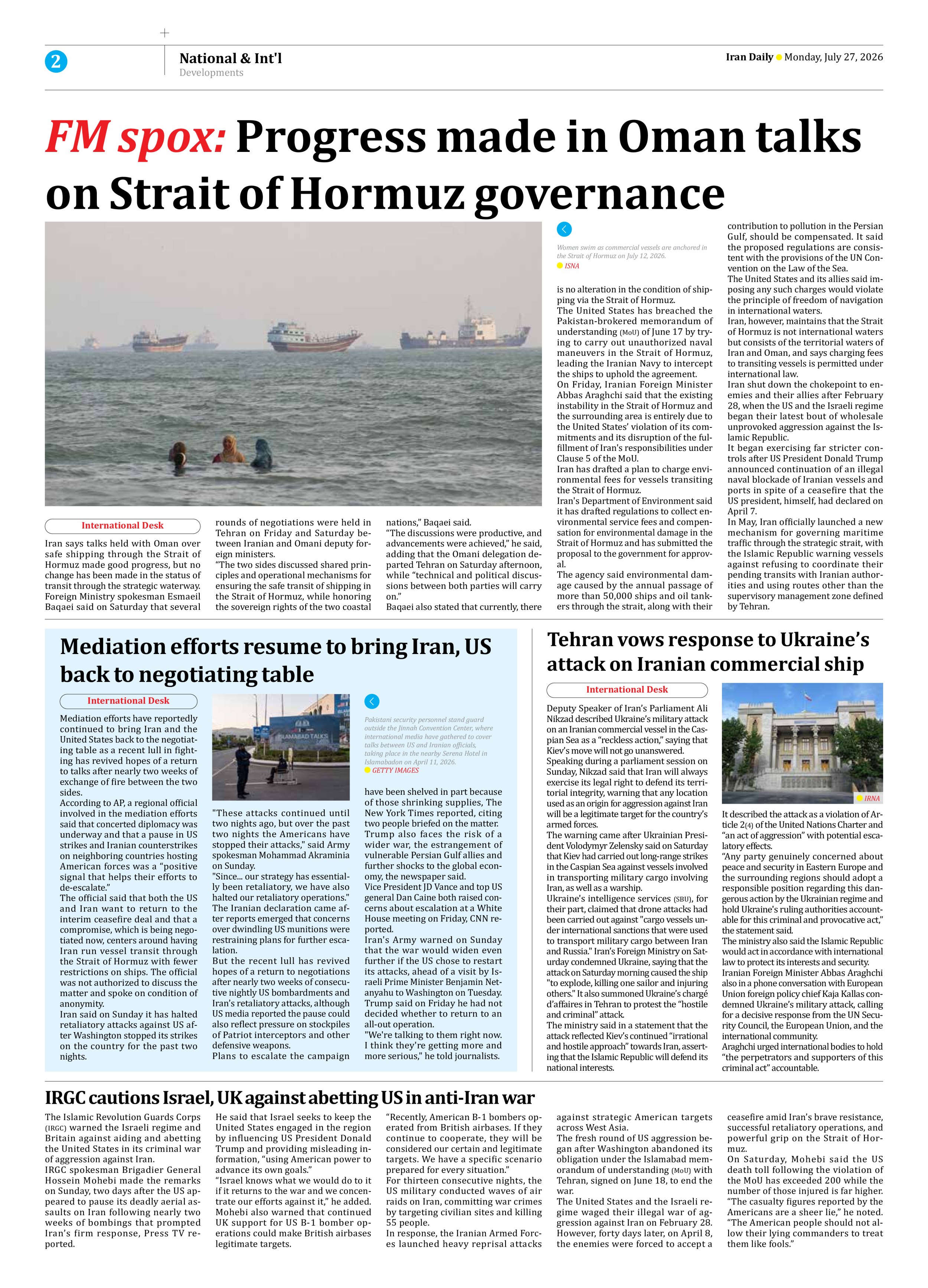


FM spox: Progress made in Oman talks on Strait of Hormuz governance
Iran says talks held with Oman over safe shipping through the Strait of Hormuz made good progress, but no change has been made in the status of transit through the strategic waterway.
Foreign Ministry spokesman Esmaeil Baqaei said on Saturday that several rounds of negotiations were held in Tehran on Friday and Saturday between Iranian and Omani deputy foreign ministers.
“The two sides discussed shared principles and operational mechanisms for ensuring the safe transit of shipping in the Strait of Hormuz, while honoring the sovereign rights of the two coastal nations,” Baqaei said.
“The discussions were productive, and advancements were achieved,” he said, adding that the Omani delegation departed Tehran on Saturday afternoon, while “technical and political discussions between both parties will carry on.”
Baqaei also stated that currently, there is no alteration in the condition of shipping via the Strait of Hormuz.
The United States has breached the Pakistan-brokered memorandum of understanding (MoU) of June 17 by trying to carry out unauthorized naval maneuvers in the Strait of Hormuz, leading the Iranian Navy to intercept the ships to uphold the agreement.
On Friday, Iranian Foreign Minister Abbas Araghchi said that the existing instability in the Strait of Hormuz and the surrounding area is entirely due to the United States’ violation of its commitments and its disruption of the fulfillment of Iran's responsibilities under Clause 5 of the MoU.
Iran has drafted a plan to charge environmental fees for vessels transiting the Strait of Hormuz.
Iran's Department of Environment said it has drafted regulations to collect environmental service fees and compensation for environmental damage in the Strait of Hormuz and has submitted the proposal to the government for approval.
The agency said environmental damage caused by the annual passage of more than 50,000 ships and oil tankers through the strait, along with their contribution to pollution in the Persian Gulf, should be compensated. It said the proposed regulations are consistent with the provisions of the UN Convention on the Law of the Sea.
The United States and its allies said imposing any such charges would violate the principle of freedom of navigation in international waters.
Iran, however, maintains that the Strait of Hormuz is not international waters but consists of the territorial waters of Iran and Oman, and says charging fees to transiting vessels is permitted under international law.
Iran shut down the chokepoint to enemies and their allies after February 28, when the US and the Israeli regime began their latest bout of wholesale unprovoked aggression against the Islamic Republic.
It began exercising far stricter controls after US President Donald Trump announced continuation of an illegal naval blockade of Iranian vessels and ports in spite of a ceasefire that the US president, himself, had declared on April 7.
In May, Iran officially launched a new mechanism for governing maritime traffic through the strategic strait, with the Islamic Republic warning vessels against refusing to coordinate their pending transits with Iranian authorities and using routes other than the supervisory management zone defined by Tehran.