







Strait of Hormuz security ‘prerequisite’ for regional trade prosperity: Businessman
The Strait of Hormuz is not merely a maritime passage; it represents the vital artery of the economy and commerce of the Persian Gulf littoral states. The main portion of energy exports and essential commodity imports of regional countries traverses this strategic waterway, and, for this very reason, any perturbation or insecurity therein directly influences transportation expenditures, insurance premiums, commodity prices, and the flow of investment. Hence, the security of this route, beyond being purely a political matter, constitutes an economic prerequisite for all nations of the region. Under such circumstances, constructive and amicable relations among neighbors, particularly Iran and Kuwait, acquire augmented significance. According to experts, the more mutual confidence and regional stability are fortified, the more commercial costs diminish, investment flourishes, and international enterprises will participate in regional markets with greater assurance. Conversely, the escalation of security risks, even absent the closure of shipping lanes, can encumber commerce with heightened costs and decelerated exchange velocity. Arash Nikpay Salakdeh, vice chairman of the Board of Directors of the Iran and Kuwait Chamber of Commerce, in an exclusive interview with Iran Daily, while elucidating the capacities for bilateral economic cooperation, addressed the strategic function of the Strait of Hormuz in Kuwaiti commerce, opportunities for Iranian companies within that nation’s market, and the imperative for expanding regional collaboration to fortify economic security and develop commercial exchanges. The complete text of this interview follows.
By Sadeq Dehqan
Staff writer
IRAN DAILY: What is your assessment of the current status of commercial relations between Iran and Kuwait? And kindly elucidate the capacities and necessities for economic and commercial cooperation between the two countries.
NIKPAY: Iran and Kuwait, as two neighboring states in the northern Persian Gulf, possess considerable capacities for the development of economic cooperation. Geographic proximity, low maritime transportation costs, the complementarity of certain sectors of the two economies, and a history of balanced political relations furnish a suitable groundwork for the expansion of commerce.
Nevertheless, the current volume of bilateral trade remains inferior to real capacity. A portion of this circumstance is attributable to banking restrictions, international sanctions, difficulties in monetary transfer, and the caution of Kuwaiti enterprises in collaborating with Iranian counterparts.
On the other hand, subsequent to the recent conflict and the rise of security tensions in the region, numerous shipping companies, insurers, and financial institutions operate with heightened sensitivity concerning commerce in the Persian Gulf region. Elevated marine insurance costs, banking constraints, and risk assessments have impacted the speed and cost of trade.
Notwithstanding these restrictions, if regional political and security relations proceed along a trajectory of stability, Iran-Kuwait commerce could experience considerable growth in the medium term since both countries will derive mutual benefit from economic cooperation.
With regard to the requirements of the Kuwaiti market, what opportunities exist for the presence of Iranian companies in the technical and engineering domains, construction, food industries, and services?
The Kuwaiti economy exhibits substantial dependence on imports and procures a significant portion of its consumer goods, construction materials, and specialized services from abroad. This has created suitable opportunities for Iranian enterprises.
In the field of technical and engineering services, Iranian companies can participate in construction projects, utilities, water and wastewater treatment, energy, oil and gas industries, industrial repairs, and infrastructural undertakings.
In the construction sector as well, the export of Iranian steel, cement, tiles and ceramics, dimensional stone, glass, doors and windows, mechanical and electrical equipment, and petrochemical products possesses a competitive advantage.
In the food industries, Iranian agricultural products, dried fruits, dairy goods, dates, processed foods, aquatic products, and organic items — if health standards and quality requirements are observed — possess suitable capacity for presence in the Kuwaiti market.
Of course, in post-conflict conditions, Kuwaiti companies, more than before, pay attention to supply chain stability, transportation continuity, and the capacity for uninterrupted provision of goods. Therefore, Iranian exporters must, in addition to quality and price, concentrate on reliable delivery capability, after-sales services, and the establishment of local offices or partnerships.
Kindly elaborate on the function of the Strait of Hormuz in the context of Kuwait’s commercial connectivity and transportation. How much of Kuwaiti commerce is conducted through this strait, and what impact do amicable bilateral relations exert upon economic interests?
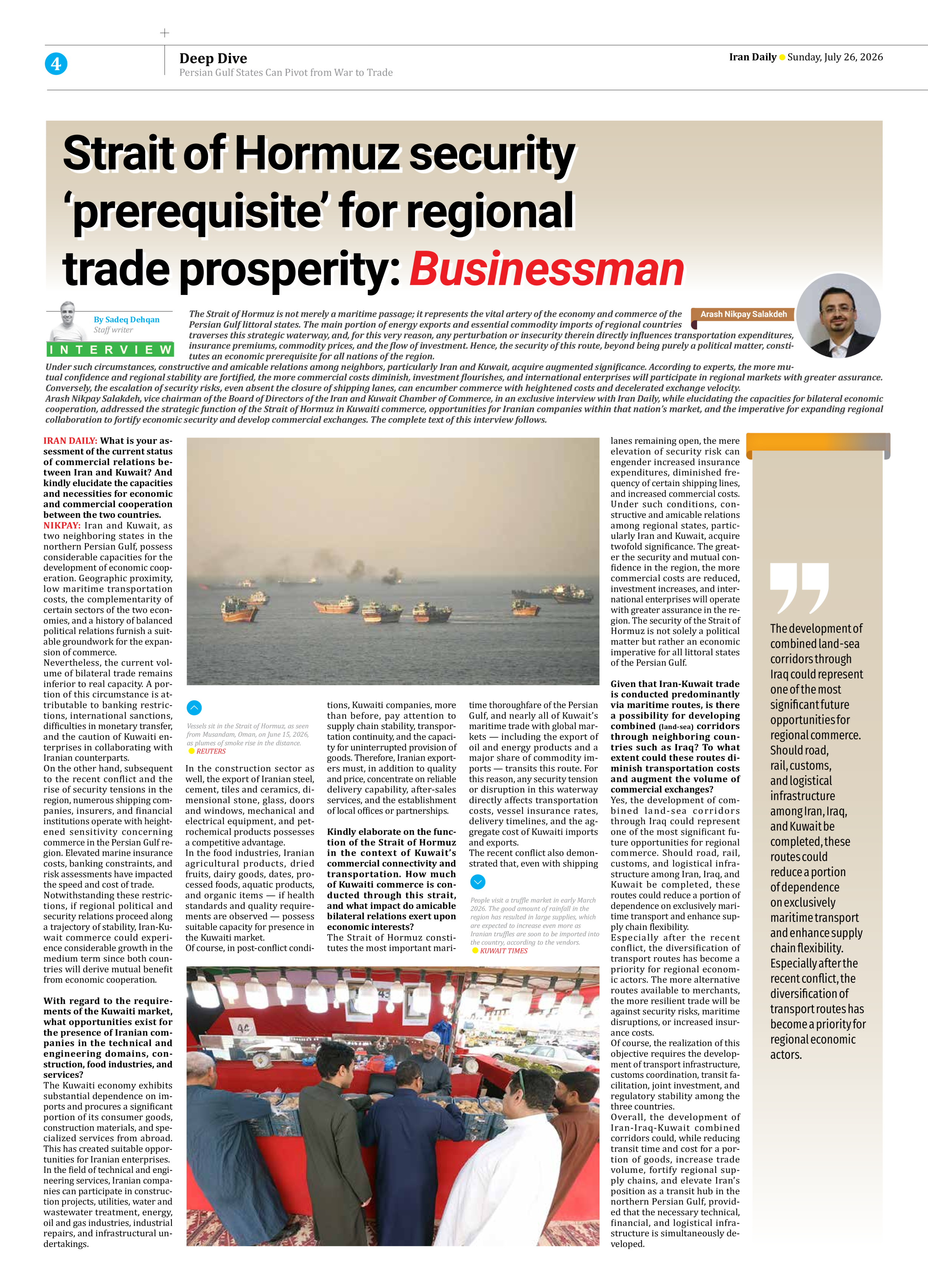
The Strait of Hormuz constitutes the most important maritime thoroughfare of the Persian Gulf, and nearly all of Kuwait’s maritime trade with global markets — including the export of oil and energy products and a major share of commodity imports — transits this route. For this reason, any security tension or disruption in this waterway directly affects transportation costs, vessel insurance rates, delivery timelines, and the aggregate cost of Kuwaiti imports and exports.
The recent conflict also demonstrated that, even with shipping lanes remaining open, the mere elevation of security risk can engender increased insurance expenditures, diminished frequency of certain shipping lines, and increased commercial costs.
Under such conditions, constructive and amicable relations among regional states, particularly Iran and Kuwait, acquire twofold significance. The greater the security and mutual confidence in the region, the more commercial costs are reduced, investment increases, and international enterprises will operate with greater assurance in the region. The security of the Strait of Hormuz is not solely a political matter but rather an economic imperative for all littoral states of the Persian Gulf.
Given that Iran-Kuwait trade is conducted predominantly via maritime routes, is there a possibility for developing combined (land-sea) corridors through neighboring countries such as Iraq? To what extent could these routes diminish transportation costs and augment the volume of commercial exchanges?
Yes, the development of combined land-sea corridors through Iraq could represent one of the most significant future opportunities for regional commerce. Should road, rail, customs, and logistical infrastructure among Iran, Iraq, and Kuwait be completed, these routes could reduce a portion of dependence on exclusively maritime transport and enhance supply chain flexibility.
Especially after the recent conflict, the diversification of transport routes has become a priority for regional economic actors. The more alternative routes available to merchants, the more resilient trade will be against security risks, maritime disruptions, or increased insurance costs.
Of course, the realization of this objective requires the development of transport infrastructure, customs coordination, transit facilitation, joint investment, and regulatory stability among the three countries.
Overall, the development of Iran-Iraq-Kuwait combined corridors could, while reducing transit time and cost for a portion of goods, increase trade volume, fortify regional supply chains, and elevate Iran’s position as a transit hub in the northern Persian Gulf, provided that the necessary technical, financial, and logistical infrastructure is simultaneously developed.